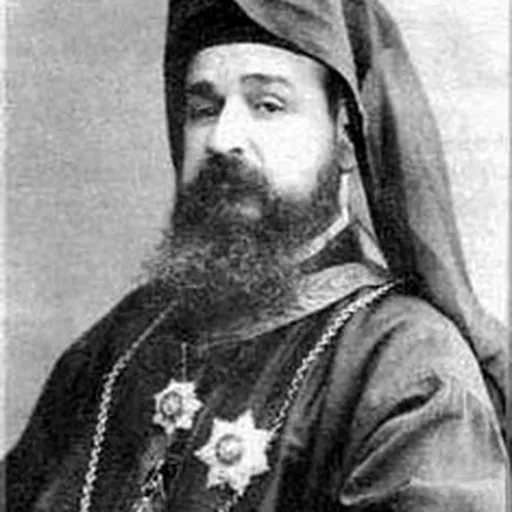
Ignatius Maloyan
Armenian Catholic archbishop, martyr and saint
About Ignatius Maloyan
Lived 1869 – 1915 (aged 46). Ignatius Maloyan was a Turkish catholic priest, eastern Catholic monk, catholic bishop and archbishop.
Ignatius Maloyan (, April 8, 1869 – June 11, 1915), born as Shukrallah Maloyan, was an Armenian Catholic prelate who served as Archbishop of Mardin from 1911 to 1915. After repeatedly refusing conversion to Islam, he was tortured and murdered by the Ottoman Gendarmerie during the Armenian genocide, specifically in Diyarbekir Vilayet under Mehmed Reshid. Maloyan was beatified by Pope John Paul II as a martyr in 2001. In 2025, Pope Francis approved a plan for his canonization. He was canonized on October 19, 2025.
Early life Shoukrallah Maloyan was born in 1869 in an Armenian family. When he was fourteen years old, he was sent by his parish priest to the Armenian Catholic Cathedral at Bzoummar, Lebanon. According to historian Charles A. Frazee, the Patriarch chose to continue the policies of his predecessor and did not protest against Turkish and Kurdish massacres of his faithful, but instead focused upon giving humanitarian relief to the survivors.
After the Young Turk Revolution in 1908, however, the Patriarch came under attack by some Catholic Armenians, who considered him, "an unworthy prelate". Having little desire for conflict, Patriarch Paul Petros submitted his resignation to Pope Pius X in August 1910.
The National Council of the Armenian Catholic Church accordingly met and, on April 23, 1911, unanimously selected the Bishop of Adana as Paul Petros XIII Terzian. During a visit to the Vatican in order to receive the Pallium, the Patriarch was told that the Pope would choose the bishops for the vacant Sees out of a list of names chosen by the Patriarch and approved by the Congregation for the Propagation of the Faith. Pope Pius X also summoned the Armenian Catholic bishops to Rome, "to confer on the difficulties facing their Church." Fr. Maloyan was consecrated in Rome as Archbishop of Mardin on October 22, 1911.
In a 20th-century renewal of the Investiture Controversy, both the National Council and Sultan Mehmet V declared, in retaliation for having convened a Synod outside of the Ottoman Empire and for consecrating Bishops without asking first for the Government's approval, that Patriarch Paul Petros XIII was deposed. A Patriarchal locum tenens, Bishop Hatchadourian of Malatia, was appointed instead and moved into the Patriarch's official residence in Istanbul. Although Pope Pius X immediately declared the new "Patriarch" suspended, the Vatican was unable to restore Patriarch Paul Petros XIII as long as the Ottoman Government supported his rival.
For this reason, Archbishop Maloyan arrived in his Archdiocese, immediately after the 1913 Ottoman coup d'état transformed the Empire into a de facto single party state governed by the Three Pashas as the thinking heads of the Committee of Union and Progress political party, to find the Armenian Catholics of Mardin in turmoil. He tried to restore order, while also encouraging devotion to the Sacred Heart.
According to Charles E. Frazee, "Thus the Armenian Catholic Church, with about 140,000 members, entered the period of the First World War with a deep division in its ranks. Each Patriarch had his own partisans among the clergy and laity, and compromise seemed far away. Despite the fact that, of all Armenians, Catholics were the most loyal to the Ottoman Government, they were not to be spared the genocide that lay ahead."
The conscription and mobilization of adult males, including Christians, began in Mardin in August 1914. House searches and public executions of both real and imagined deserters became a daily occurrence. The Ottoman Army also "requisitioned" both goods from Christian owned shops and draft animals for military use. The detailed Arabic language diary of Syriac Catholic priest Fr. Ishaq Armalé also records multiple cases of random violence and murders of Mardin's Christians.
On December 13, 1914, however, Hilmi Bey was appointed as mutasarrif of Mardin. Upon arrival, Hilmi Bey was polite and proper towards Archbishops Maloyan and Gabriel Tappouni and promised to, "help them with their problems." Soon after, when accusations spread that more Christian deserters were hiding in the area, both Archbishops met with the Mutasarrif, the police chief, and the head of the military garrison and requested a list of names so that might help with the search. This was interpreted by Hilmi Bey as a, "sign of upright love of the state."
On February 11, 1915, Archbishop Maloyan attended a dinner at Archbishop Tappouni's residence, which the Mutasarrif also attended.
On March 28, which was Palm Sunday, Turkish soldiers entered all of the churches for mass arrests of alleged deserters, including deacons, who previously been exempt from the draft. The military continued to harass both Armenian and Assyrian churchgoers all through Holy Week and Easter Sunday was spent with, "scared hearts and fearful restless minds."
Hoping to save lives, Archbishop Maloyan made every opportunity to express his Archdiocese's loyalty to the Ottoman Empire. For these statements, Maloyan was informed on April 6 that he was to receive a medal from Sultan Mehmed V.
On April 20, 1915, the medal arrived and was publicly presented to Archbishop Maloyan along with a proclamation from the Sultan. In his acceptance speech, the Archbishop expressed hope for the continued health of Sultan Mehmet and the success of his Ministers and Generals in leading the Ottoman Empire to victory over the Allies. Feyzi accused Hamid Bey, the previous Vali, of, "being soft on the Armenians and of being a close friend of the Armenian Bishop."
Feyzi also mocked those who objected to murdering Christians, "You surprise me. What is holding you back? Is it the fear of one day having to pay for this? But what happened to those who killed Armenians in Abdul Hamid’s time? Today Germany is with us and our enemies are its enemies. This will surely give us victory in this war, and we won’t have to answer to anyone. Let us get rid of the Christians so we can be masters in our own house. This is what the government wants."
On June 1, 1915, Archbishop Maloyan met with Mar Gabriel Tappouni the Syriac Catholic Archbishop of Mardin. Maloyan read aloud the letter he had written to prepare his clergy and faithful for martyrdom, then folded it, and gave it to Tappouni, with the words, "Keep this testament on you." Although Tappouni then tried to console him, Maloyan replied, "I know for sure that I and my congregation will be condemned to torture and death. I expect them to come and arrest us any day. It is unavoidable... Pray for me. I suspect that this will be the last time I will see you."
Arrest and trial On June 3, Hilmi Bey was lured away from Mardin and a delegation of officials arrived from Diyarbekir with long lists of Christian leaders to arrest under orders from the Vali.
Between 3 and 4 June 1915, Archbishop Maloyan and 420 of the other leading Christians of Mardin were arrested and imprisoned in Mardin Castle.
When he was brought to trial, Maloyan stood accused of forming and leading a terrorist organization of Armenian nationalists and of hiding two boxes of guns and ammunition inside his cathedral.
To the outrage of those present, the Archbishop replied, "Muslim? There is no way I would reject my religion and my Saviour. I have been brought up in the Holy Catholic Church, assimilated the base of its truthful teachings from a young age and became proficient in its undisputable facts until I unworthily become one of its pastors. I consider the shed of my blood for my faith to be the sweetest thing to my heart because I know for sure that if I get tortured for the love of the One who died for me I would become one of the happiest blessed people and I will see my Lord and my God in heaven. You can only beat me and cut me into pieces but I will never deny my religion."
On June 7, 1915, Hilmi Bey returned to Mardin and, "began energetic efforts to free the Christians, but he was quickly deposed and temporarily replaced by one of the conspirators, Khalil Adib, a judge of the criminal court and leader of the town's Committee of Union and Progress."
Martyrdom Under the direction of Mardin's chief of the Ottoman Gendarmerie, Mahmdouh Bey, Archbishop Maloyan, along with around 400 other Christians, was force-marched into the desert on the night of June 10, 1915. "a religious cult-place about six hours from Mardin."
At the Sheikhan Caves, Mahmdouh Bey read out what he said was an Imperial Firman charging all Christians with treason and sentencing them to death. Those prisoners who converted to Islam, however, would be set free and allowed to return to Mardin. Otherwise, they would be executed within the hour.
Archbishop Maloyan replied that he preferred to die as a Christian than live as a Muslim. The vast majority of the deportees agreed with the Archbishop and, the few who did not, were taken away by local Kurdish villagers and brought before their Shayk to undergo conversion to Islam.
One of the Turkish soldiers present at the scene later recalled, "We have never seen people so strong in their faith. If the Christians had captured us and offered us the same chance to convert, we all would have become Christians."
Archbishop Maloyan ordered his priests to circulate among the other prisoners to give them Absolution and Holy Communion. Then, he watched as his priests and faithful were massacred in front of him. The Archbishop's last words after being shot were reportedly, "My God, have mercy on me! Into Your hands I commend my spirit!"
Perpetrators
Reşit Bey
Walter Holstein, the Imperial German Consul at Mosul, learned of the deportation and murder of Archbishop Maloyan and every other member of the caravan via a letter which no longer survives, but which was written either by Hilmi Bey or Shefik Bey. Holstein immediately informed the German Ambassador in Constantinople, Hans von Wangenheim, who in turn informed Berlin. The German Foreign Office then issued a formal protest through Ambassador von Wangenheim to the Ottoman Minister of the Interior, Talat Pasha. Through Ambassador von Wangenheim, the Imperial German Government demanded that Reşit Bey be removed as Vali of Diyarbekir, "lest his murderous policies lead to the total extermination of the Christians in his area." Instead, Talat Pasha chose to send an ambiguously worded reprimand ordering an end to the killing of non-Armenian Christians to Reşit Bey, who ignored it,
Even though he is now known as the "Butcher of Diyarbakir", Reşit Bey claimed, during a conversation with Ottoman Army officer Rafael de Nogales, to bear no legal or moral responsibility for the systematic massacre of Christians in his province, as he only followed orders from Talat Pasha. According to De Nogales, "Talat had ordered the slaughter by a circular telegram, if my memory is correct, containing a scant three words: Yak – Vur – Oldur, meaning, 'Burn, demolish, kill'. The authenticity of that terrible phrase was confirmed by the press of Constantinople after the Armistice with the publication of a certain telegram, which the Ottoman commission engaged in investigating the massacres and deportations had discovered among the papers of the Committee of Union and Progress."
Süleyman Nazif, the former Vali of Mosul, had a very different opinion and testified after the Armistice, "The catastrophic deportations and murders in Diyarbekir were Reshid's work. He alone is responsible. He recruited people from the outside in order to perpetrate the killings. He murdered the Kaimakams in order to scare all other opposed Muslim men and women; he displayed the corpses of the Kaimakams in public."
On July 16, 1915, the German Consul at Mosul, Walter Holstein, reported to the German Embassy that, despite official denials, Reşit Bey had ordered his bodyguards to commit the recent assassination of Nuri Bey, the Kaimakam of Midyat, for having, "refused to let the Christians in his district be massacred."
According to Taner Akçam, Reşit Bey ordered the assassination of many other Muslims, including fellow Ottoman officials, policemen, and many civilians, for opposing the genocides, including Hüseyin Nesimi, the Kaimakam of Lice, Ferit, the Assistant-Vali of Basra, Bedri Nuri, the Mutasarrif of Müntefak, Sabit, the Kaimakam of Beşiri, and the journalist Ísmail Mestan.
All jewellery and other possessions that Reşit Bey "requisitioned" from massacred Christians were, in theory, to be forwarded to the central government's treasury. Talat Pasha's concern for missing valuables resulted in an investigation into Reşit for "embezzlement of State property", which easily proved that Reşit had amassed a personal fortune from the genocides. For this reason, in March 1916, Talat Pasha had Reşit removed from his post. Süleyman Nazif later commented, "Talat Pasha dismissed Reşit as a thief, while he adored him as murderer".
On 5 November 1918, a little less than a week after the Ottoman Empire surrendered to the Allies in the Armistice of Mudros, Reşit was arrested. His role in both the Armenian and Assyrian genocides was exposed in the Constantinople press, though he continued to deny having ever committed a crime.
When asked by CUP secretary general Mithat Şukru Bleda how he, as a doctor, could have had the heart to violate the Hippocratic Oath and send so many unarmed civilians to their deaths, Reshid Bey replied:
When further asked by Bleda how history might remember him, Reshid simply responded, "Let other nations write about me whatever history they want, I couldn't care less."
Reshid Bey escaped from imprisonment in January 1919, but when government authorities cornered him he committed suicide by shooting himself in the head.
According to Hans-Lukas Kieser, despite being one of the worst genocide perpetrators Reşit "is perceived as a patriot and martyr in official Turkish-nationalist diction". In Ankara, a boulevard is named in his honour.
Aziz Feyzi Pirinççizâde After the defeat of the Ottoman Empire in 1918, Aziz Feyzi Pirinççizâde transferred his support from Sultan Mehmed VI to the Turkish Republican Government based in Ankara Vilayet. On 15 January 1919, Feyzi was arrested and charged with involvement in the Armenian genocide. The British Government deported him to the Crown Colony of Malta in May 1919, where Feyzi was held for two years awaiting prosecution for war crimes as part of Group A, which was reserved for Turks and Kurds who were directly involved in the genocides. In 1921, Feyzi escaped with 15 fellow prisoners, returned to Turkey, and joined the Kemalists. Later in life, Feyzi was a facilitator of massacres and forced resettlements of the Kurdish people.
Talat Pasha
Talat Pasha, who is widely considered the mastermind of the Armenian, Assyrian, and Greek genocides, continued to skillfully mislead and calmly dismiss foreign diplomats, including those from the Ottoman Empire's Allies, who continued to demand an immediate end to all three. In his postwar memoirs, subsequent German Ambassador Count Johann Heinrich von Bernstorff recalled of Talat, "When I kept on pestering him about the Armenian question, he once said with a smile: 'What on earth do you want? The question is settled, there are no more Armenians.'"
Talat Pasha fled to the Weimar Republic in November 1918. An Ottoman Special Military Tribunal tried, convicted, and sentenced Talat to death in absentia for subverting the Constitution, war profiteering, and organizing genocide against Ottoman Greeks and Armenians. On March 15, 1921, Talat was assassinated in Berlin by Soghomon Tehlirian as part of Operation Nemesis, a worldwide plan by the Armenian Revolutionary Federation to hunt down and liquidate all surviving perpetrators of the Armenian genocide. After a two-day trial, a German court found Tehlirian not guilty of murder by reason of temporary insanity, and released him, much to the joyful applause of the German people who had attended his trial. As efforts to prosecute the genocide's perpetrators had ceased by this time, Tehlirian is considered a national hero by Armenians. In contrast, Talat Pasha's remains were later re-exhumed, repatriated, and buried at the Monument of Liberty in Istanbul and many streets throughout Turkey are named in his honour. This, and the Armenian genocide denial that is still at the heart of the official history promoted by the Turkish government, remains highly controversial worldwide.
Legacy
According to Donald Attwater, "During the massacres by Turks and Kurds in the war of 1914–1918, the Catholic Armenians lost seven bishops, over one hundred priests, forty-five nuns, and thirty-thousand lay folk; over eight hundred ecclesiastical buildings and schools were pillaged and destroyed, and a dozen dioceses laid waste. Moreover, the formation of a Soviet Socialist Republic in Russian Armenia cut off an indeterminate number of Catholics from their fellows. A conference of Armenian bishops at Rome in 1928 reorganized their Church in view of these events and of the conditions now obtaining."
According to Fr Ishaq Armalé, who survived the local Assyrian genocide by fleeing into Lebanon and published his diary in Beirut after the Armistice of Mudros, "Some leading Muslims employed Christian servants, who by hiding listened to what was said and told of the secrets. We did not believe them and said, 'Our friendship with the Muslims is purer than the eye of a rooster and stronger than iron. It would be impossible to turn such a friendship into hostility and mildness into harshness, because we have no conflicts with each other.' We added that in our area, there were no hundred percent Armenians or opponents to the government. No, we are, praise God, Catholics and loyal to the state and follow its decisions to the letter of the law. Therefore, it has no reason to harass us and claim that we are hostile and plot treason. … But we were disappointed. The truest friend and the dearest comrade became the worst and most distrustful enemy. The sheep became wolves and the doves became snakes."
Archbishop Ignatius Maloyan was beatified in Saint Peter's Basilica by Pope John Paul II on October 7, 2001. Although the resurfacing of Jacques Rhetoré's formerly lost memoirs during the 1991 Gulf War in Mosul certainly added to the evidence for Maloyan's martyrdom,
The Vatican City State commemorated the centennial of Blessed Ignatius Maloyan's martyrdom with a postage stamp issued on the 2 September 2015.
The Servant of God Fr. Leonard Melki, a Lebanese Capuchin priest who was deported in the same convoy and martyred at the Sheikhan Caves alongside Archbishop Maloyan, was Beatified by Pope Francis in Beirut on 4 June 2022. He was canonized by Pope Leo XIV on October 19, 2025.
Don’t just read it —
keep it.
Full-length biographies made to live with: read them, listen on the way to work, watch them tonight.
- E-book
- Audio
- Video
Instant download · yours to keep · every purchase keeps this site free
Important facts
People in Ignatius Maloyan's life
Named in this biography and alive at the same time




Related people
Same field, nearest in time

Contemporaries
People whose lives overlapped Ignatius Maloyan's



Frequently asked questions
Who was Ignatius Maloyan?
Armenian Catholic archbishop, martyr and saint
When was Ignatius Maloyan born?
Ignatius Maloyan was born on 19 April 1869 in Mardin.
When did Ignatius Maloyan die?
Ignatius Maloyan died on 11 June 1915 in Diyarbakır.
What was Ignatius Maloyan's occupation?
Ignatius Maloyan was a catholic priest, eastern Catholic monk, catholic bishop and archbishop.
What nationality was Ignatius Maloyan?
Ignatius Maloyan was Turkish.
Sources & further reading
Cite this page
APA: Biography.guide. (2026). Ignatius Maloyan. https://biography.guide/ignatius-maloyan/
MLA: "Ignatius Maloyan." Biography.guide, https://biography.guide/ignatius-maloyan/.
Chicago: "Ignatius Maloyan." Biography.guide. https://biography.guide/ignatius-maloyan/.
Data last updated: 2026-09-21 · Spot an error? Report a correction.
Portrait: Wikimedia Commons · author & licence
Page generated 2026-09-27 05:01 UTC