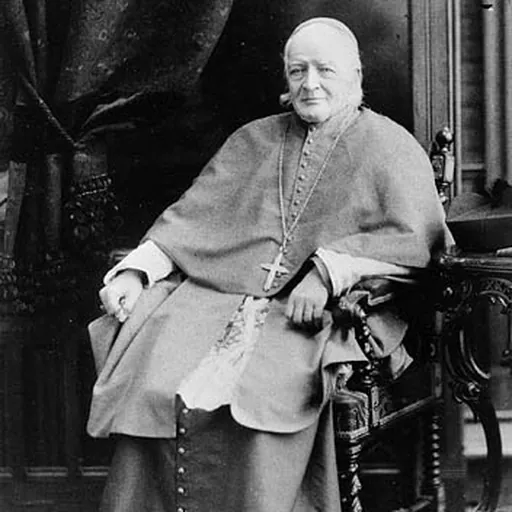
About Ignace Bourget
Lived 1799 – 1885 (aged 85). Ignace Bourget was a Canadian catholic priest, essayist, catholic bishop, catholic deacon, bishop and catholic theologian.
Ignace Bourget (; October 30, 1799 – June 8, 1885) was a Canadian Catholic prelate who served as Bishop of Montreal from 1840 to 1876.
Born in Lévis, Quebec, in 1799, Bourget entered the clergy at an early age, undertook several courses of religious study, and in 1837 was named coadjutor bishop of the newly created Diocese of Montreal. Following the death of Jean-Jacques Lartigue in 1840, Bourget became Bishop of Montreal.
During the 1840s, Bourget led the expansion of the Catholic Church in Quebec. He encouraged the immigration of European missionary societies, including the Oblates of Mary Immaculate, the Jesuits, the Society of the Sacred Heart and the Good Shepherd Sisters. He also established entirely new religious communities including the Sisters of the Holy Names of Jesus and Mary, Sisters of Saint Anne, Sisters of Providence, and the Institute of Misericordia Sisters. He commissioned the construction of St James Cathedral, known today as Mary, Queen of the World Cathedral, and played a key role in the establishment of the Université Laval and the Hospice of the Holy Child Jesus.
Bourget was a fierce ultramontanist, supporting the supreme authority of the pope in matters both secular and spiritual. He frequently clashed with the Canadian secular authorities, most notably through his attacks on the anti-clericist Institut Canadien de Montréal, his defence of parochial schooling in New Brunswick, and his refusal to grant a Catholic burial to Joseph Guibord. In 1876, facing an inquiry by the Vatican into his increasing involvement in secular politics, Bourget resigned as Bishop of Montreal and retired to Sault-au-Récollet, where he continued to take an active role in church life until his death in 1885.
Early life Bourget was born in the parish of St Joseph in Lévis, Quebec, on October 30, 1799. He was the eleventh child of thirteen born to Piere Bourget, a farmer, and Therese Paradis. He received elementary schooling at home and at the Point Lévis school, and then went on to study at the Petit Séminaire de Québec, and at the Grand Séminaire de Québec.
In 1812, Bourget was admitted to the Congrégation de la Sainte-Vierge. On August 11, 1818, he was tonsured in the cathedral at Quebec City and from September 1818 commenced three years of study at the Séminaire de Nicolet, where he studied theology, and also taught first year classes in Latin elements and second year classes in syntax. On January 28, 1821, he was conferred minor orders by Joseph-Octave Plessis, Archbishop of Quebec, and on May 20 of that year at the parish church of Nicolet he was elevated to the position of subdeacon. On May 21, 1821, Bourget left Nicolet to assume the post of secretary to Jean-Jacques Lartigue, vicar general of Montreal. On December 22, 1821, he was made a deacon at the bishop's residence in the Hôtel-Dieu. and the Sisters of the Holy Names of Jesus and Mary under Eulalie Durocher.
On August 30, 1850, Bourget founded the Hospice du Saint-Enfant-Jesus (Hospice of the Holy Child Jesus), an institute for the care of deaf-mutes, At around this time, Bourget was reported as taking no more than five hours' sleep a day, and produced a substantial body of written works including pastoral correspondence and manuscript works. He was also reported to be an enthusiastic conversationalist. His hair had prematurely whitened. In 1871 the Institut closed its debating room, and in 1880 it closed its library.
The fall of the Papal States
Bourget was concerned not only with politics in Montreal, but also with politics in Italy, which directly affected the affairs of the Roman Catholic Church as a whole. Between 1849 and 1870, the Italian peninsula underwent dramatic political changes, culminating in the unification of Italy into one nation. This had severe consequences for the Vatican and for the Roman Catholic Church. In 1848 Pope Pius IX was evacuated from Rome, and on September 20, 1870, the Papal States were annexed to the Kingdom of Italy, effectively ending their sovereignty. These upheavals were a source of great concern to many Catholics, and they were of particular importance to Bourget, who as an ultramontane believed firmly in the supreme authority of the Pope in all matters both temporal and spiritual.
On October 23, 1854, Bourget travelled to Europe, where he remained until July 29, 1856. He visited Rome to represent the ecclesiastical province at the proclamation of the dogma of the Immaculate Conception on December 8, 1854,
John Sweeny, bishop of Saint John fought an unsuccessful campaign against the act for several years, both through the auspices of Catholic MPs in the New Brunswick parliament, and via challenge in the courts. However, he was unsuccessful. He also urged Catholics to stop paying the school tax in protest, to which the government responded by imprisoning key priests and seizing property, including Sweeny's carriage.
Finally on May 18, 1873, Sweeny attended the provincial council of the Quebec church, where he invited the bishops of Quebec to intervene in New Brunswick affairs with the goal of supporting the cause of religious schooling. Bourget, who had had a key role in developing Lower Canada's system of religious schooling, accepted the invitation. The act prevented the teaching of Catholicism, regarded by the Roman Catholic Church as one of its key duties. On May 19, Bourget and Bishop Louis-François Laflèche co-authored and released a statement opposing the Common Schools Act, with the effect that several Conservative MPs of New Brunswick hailing from Quebec threatened to break ranks and support a motion of no-confidence against the government. The New Brunswick government responded by offering to pay the church's costs in the ongoing legal action over the act if the no-confidence motion was not passed - a deal which the church accepted. Their argument was that under the civil law of Canada the Church had a legal obligation to afford Guibord a Catholic burial.
In 1874 the Privy Council ruled that Guibord should be buried in a Catholic cemetery, and ordered that Bourget and the Roman Catholic Church pay the costs of the legal proceedings. Following the ruling, Bourget went to the Notre Dame des Neiges Cemetery and deconsecrated the burial plot where the Privy Council had ordered that Guibord could be buried.
Involvement in church politics
Université Laval
In 1852, Bourget was involved with the founding of the Université Laval by the Séminaire de Québec. At the time, Bourget believed that responsibility for the university was to be shared by all bishops within the episcopal province of Quebec. However, the organisation and management of the university were subsequently taken over by the archbishop and seminary of Quebec, with the result that by 1858 none of the local (Montreal) classical colleges were affiliated with the university.
This led Bourget, from 1862, to plan the founding of a new Catholic university in Montreal. This was in part prompted by increasing numbers of Catholic students enrolling at the (secular) McGill College and elsewhere to study law and medicine out of lack of a Catholic alternative. In 1865 Bourget petitioned the Vatican for the establishment of a new Catholic university in Montreal but his application was rejected. In 1870 the Université Laval proposed opening a branch in Montreal but Bourget rejected this proposition as it did not accept his authority over it as bishop. In 1876 the Vatican ordered the establishment of a branch of the Université Laval at Montreal, answering only to Quebec (not Bourget), but Bourget resigned as Bishop shortly thereafter and therefore was never required to enact the order.
Division of Notre-Dame parish By 1863, the Montreal parish of Notre-Dame had grown in size to a population of around 100,000, with its parish priest by tradition being the Sulpician superior of the Grand Séminaire de Montréal. Following an application by the Superior General of Saint-Sulpice in Paris, Bourget was asked by the Holy See to comment on the situation of Notre-Dame parish. Bourget commented that he was happy with the current situation, providing that the parish priest was wholly subordinated to Bourget as bishop, meaning that Bourget would have the power to dismiss them from the position.
The Sulpicians disputed Bourget's proposed hierarchy and both Bourget and the Superior General of Saint-Sulpice were summoned to Rome. The Sulpicians refused to allow Bourget to have authority to dismiss the parish priest and threatened to withdraw their entire religious community of 57 priests from Montreal, which would have created a crippling shortage of clergy in the diocese. Negotiations were held with the result that in 1865 Bourget was given authority to divide the parish of Notre-Dame on the condition that the new parishes would be offered first to the Sulpicians, that the Sulpicians would name their own priests to the parishes but would require them to be invested by the Bishop, and that the new parish priests could be dismissed by either the Bishop or the Superior of the Sulpicians.
Between September 1866 and December 1867, Bourget divided Notre-Dame into ten new canonical parishes. However, in order to invest the parishes with legal existence they were required to be incorporated. The Sulpicians advised the government not to recognise the new parishes, claiming that they were merely succursal chapels of the parish of Notre-Dame. This resulted in a series of protracted legal and political battles between Bourget and the Sulpicians which ended with Bourget's victory in 1873, when all the parishes obtained their civil registration.
Resignation, late life and death
From October 27 to 30, 1872, Bourget celebrated the golden anniversary of his ordination, and on May 1, 1873, he ordained Édouard-Charles Fabre as coadjutor bishop in a ceremony at the church of the Collège Sainte-Marie. Around this time, Bourget was frequently beset by illness, but despite this he continued a series of energetic attacks on liberalism, including liberalism within the Catholic Church. These attacks caused the Archbishop of Quebec and members of his inner circle to question Bourget's judgement and ability to perform as Bishop. The Archbishop of Quebec was also concerned that the church was becoming increasingly involved in secular politics, to its detriment. Ignazio Persico, parish priest of Sillery, proposed that Rome undertake an inquiry into the matter, including Bourget's conduct.
To forestall the inquiry, on April 28, 1876, Bourget resigned as Bishop of Montreal and on May 15 that resignation was accepted by the Pope, to take effect in September. Following his resignation, Bourget was appointed archbishop of the titular see of Marcianopolis, and in early 1877 he retired to Sault-au-Récollet, taking with him his secretary, Joseph-Octave Paré.
Between August 12 and October 30, 1881, Bourget travelled to Rome, pleading unsuccessfully for the establishment of a second Catholic university in Montreal. In 1882, Bourget took part in a fundraising drive to help raise money to pay off the Diocese of Montreal's significant debts, which totalled some $840,000. On October 11, 1882, he announced that a sum of $84,782 had been raised through these efforts. On November 9, 1882, Bourget made his final public appearance at Boucherville, celebrating the diamond anniversary of his ordination as the conclusion of his fundraising tour.
Bourget died on June 8, 1885, at Sault-au-Récollet. A funeral service was conducted by Father Collin, the Superior of the Sulpicians, at the Church of Notre Dame, and Bourget's body was buried alongside that of his predecessor Jean-Jacques Lartigue in a vault under the southwest pillar of the dome of the then-unfinished St James Cathedral, later renamed as Mary, Queen of the World Cathedral. On March 20, 1993, his remains were transferred to the cathedral's mortuary chapel for bishops and archbishops, of which his mausoleum forms the centre. On June 24, 1903, a statue of Bourget created by artist Louis-Philippe Hébert was unveiled in the parvis of the St James Cathedral. The statue was funded by approximately $25,000 in donations from Catholic clergy and faithful. In 2005 a cleaning and restoration of the statue was performed.
Don’t just read it —
keep it.
Full-length biographies made to live with: read them, listen on the way to work, watch them tonight.
- E-book
- Audio
- Video
Instant download · yours to keep · every purchase keeps this site free
Important facts
People in Ignace Bourget's life
Named in this biography and alive at the same time



Related people
Same field, nearest in time


Contemporaries
People whose lives overlapped Ignace Bourget's





Frequently asked questions
Who was Ignace Bourget?
Catholic archbishop
When was Ignace Bourget born?
Ignace Bourget was born on 30 October 1799 in Lévis.
When did Ignace Bourget die?
Ignace Bourget died on 8 June 1885 in Montreal.
What was Ignace Bourget's occupation?
Ignace Bourget was a catholic priest, essayist, catholic bishop, catholic deacon, bishop and catholic theologian.
What nationality was Ignace Bourget?
Ignace Bourget was Canadian.
Sources & further reading
Cite this page
APA: Biography.guide. (2026). Ignace Bourget. https://biography.guide/ignace-bourget/
MLA: "Ignace Bourget." Biography.guide, https://biography.guide/ignace-bourget/.
Chicago: "Ignace Bourget." Biography.guide. https://biography.guide/ignace-bourget/.
Data last updated: 2026-09-21 · Spot an error? Report a correction.
Portrait: Wikimedia Commons · author & licence
Page generated 2026-09-27 05:01 UTC