
About Idriz Seferi
Lived 1847 – 1927 (aged 80). Idriz Seferi was an Albanian and Turkish politician.
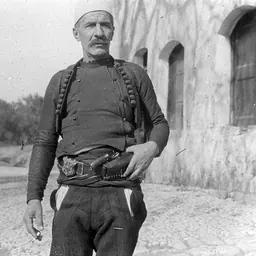
Idriz Seferi (14 March 1847 – 25 March 1927) was an Albanian nationalist, revolutionary leader, and guerrilla fighter who played a prominent role in the Albanian uprisings against the Ottoman Empire, the Kingdom of Serbia, and the Kingdom of Bulgaria during the late 19th and early 20th centuries. During his 56-year military career, he fought in 35 battles.
A member of both the League of Prizren and the League of Peja, he was a close collaborator of Isa Boletini, with whom he organized an Albanian uprising against the Ottoman Empire in 1910 in the Kosovo Vilayet. After the suppression of the uprising, Seferi continued fighting against the Ottoman authorities and played a prominent role in the Albanian uprising of 1912. During the First Balkan War, Boletini and Seferi rose up against Serbia and continued attacking Serbian posts during the subsequent occupation and the initial phase of World War I (1913–1915). In the second phase of the war (1916–1918), he led his troops against Bulgarian forces.
Early life Idriz Seferi was born to an Albanian family in the village of Sefer (in present-day Preševo, Serbia) in the Karadaku region, which was then part of the Kosovo Vilayet of the Ottoman Empire. He joined the Albanian national movement at an early age, becoming a member of the League of Prizren (established in 1878) and the League of Peja (established in 1899). While Operating in South Serbia, Idriz Seferi was captured by Ottomans and imprisoned in Niš. An Ottoman court, assessing him as a dangerous person, sentenced him to 101 years in prison. The situation created by the Russo-Ottoman war of 1877-1878 influenced his release from Niš prison in November 1877. As a result of this war, the Principality of Serbia, which joined the Russian army against the Ottoman Empire, had made progress towards the south, taking the Sanjak of Niš, Pirot, Vranje, Leskovac and had reached Gjilan. Seferi was fighting against the Serbian forces up to Vranje and Leskovac.
1910 Uprising
In the spring of 1910, another Albanian revolt broke out against the Ottomans; twelve Albanian tribes of the Kosovo Vilayet rose in revolt under Isa Boletini and Idriz Seferi, who gathered 9,000 fighters. 3,000 rebels under Seferi defeated Ottoman forces and captured Gjilan. In response to the revolt, the Ottomans sent a large army commanded by Shevket Turgut Pasha, which clashed with the Albanians who had blocked the railway. Seferi's men were only driven out after a desperate battle lasting thirteen hours, for they were greatly outnumbered by a Turkish army numbering 40,000 men. After the Battle at Kaçanik Pass, Seferi and his men retreated to defensive positions near Komogllava, where Seferi himself killed 12 Turkish soldiers, but was ultimately forced to retreat to the Karadak Mountains, where he continued his resistance against the Turks, with the Albanians killing over 2,000 Ottoman soldiers. The largest battle during the insurgency took place at Carraleva Pass, where the Albanians initially repelled the Ottomans before local Serbs informed them of a shortcut over the mountains that would enable them to encircle the Albanians. This forced the rebels to withdraw, and although Seferi and Boletini managed to evade capture, thousands of Albanians were killed, imprisoned and interned.
1911 Uprising Battle of Drenogllava On March 5, 1911, Idriz Seferi together with Isa Boletini faced an Ottoman army sent by Osman Pasha to crush the Albanian rebels. The first column of the Ottoman army, led by Saduddin Bey, headed to Drenogllava in its foothills, just to be ambushed by Halim Begunca with 30-40 warriors, after which the entire Ottoman army consisting of 2000 men marched to the ambush site, falling into a trap by Idriz Seferi, who surrounded the entire Ottoman army, Osman Pasha then ordered two battalions of Shahid Bey to go to the aid of Saduddin Bey. Osman Pasha's maneuver was immediately understood by the Albanian rebels. Isa Boletini then cut the way for Osman Pasha's formations, thus the Ottoman army was divided into three parts and each of them was surrounded by Albanian rebels. After almost a month of heavy fighting, on May 5, Osman Pasha ordered his army to withdraw, ending the Battle with an Albanian victory.
1912 Uprising On 23 April 1912, Hasan Prishtina's rebels revolted in the Gjakova Highlands, and the revolt then spread within the Kosovo Vilayet. On 20 May 1912, Albanian chiefs Bajram Curri, Isa Boletini, Riza Gjakova, Idriz Seferi, Hasan Prishtina, Nexhib Draga, and others, decided on a general armed insurrection throughout the Kosovo Vilayet. On August 18, the moderate faction led by Prishtina managed to convince Seferi and the other leaders Isa Boletini, Bajram Curri and Riza Bey Gjakova of the conservative group to accept the agreement with the Ottomans for Albanian sociopolitical and cultural rights.
Balkan Wars
In a bid to conquer Albanian-inhabited territories that stretched from Kosovo and Ulqin to Durrës as well as Lake Ohrid to the Adriatic Sea, Serbo-Montenegrin forces attacked the Ottoman state in October 1912. The Ottomans provided a weak resistance, whereas Albanian units under Idriz Seferi, Isa Boletini and Bajram Curri provided stiff resistance to the Serbian advances. During the invasion, the Serbians massacred 20,000-25,000 Albanians in an attempt to ethnically-cleanse these regions. The Serbians had hoped that the statistical manipulation of the regional demographics would strengthen their claims before the Great Powers convened in London in December 1912 to finalise the new borders in the Balkans.
When Serbian forces continued to occupy Kosovo during 1913-1915, Seferi continued his struggle to liberate Kosovo and unite it with Albania.
Seferi and his men engaged in a fierce battle at the Končulj pass in an attempt to halt the advance of the third Serbian Army, which consisted of approximately 76,000 soldiers, on their way to the city of Gjilan. Following seven days of intense combat, Seferi and his troops were compelled to withdraw, resulting in the capture of Gjilan by the Serbian army. The entire Albanian civilian population of the villages Kabash, Lubishtë and Gjylekar were massacred by the Serbian army.
World War I During the First World War, Idriz Seferi led an armed uprising in Karadak, which was occupied by Bulgaria. He would later be captured by the Bulgarians in 1916.
Death and legacy Idriz Seferi died in 1927. He was posthumously awarded the Hero of Kosovo-award by the Republic of Kosovo. There is a bust of him in Kaçanik.
Don’t just read it —
keep it.
Full-length biographies made to live with: read them, listen on the way to work, watch them tonight.
- E-book
- Audio
- Video
Instant download · yours to keep · every purchase keeps this site free
Important facts
People in Idriz Seferi's life
Named in this biography and alive at the same time


Related people
Same field, nearest in time





Contemporaries
People whose lives overlapped Idriz Seferi's




Frequently asked questions
Who was Idriz Seferi?
Albanian nationalist and guerilla fighter (1847-1927)
When was Idriz Seferi born?
Idriz Seferi was born on 14 March 1847 in Sefer.
When did Idriz Seferi die?
Idriz Seferi died on 25 March 1927.
What was Idriz Seferi's occupation?
Idriz Seferi was a politician.
What nationality was Idriz Seferi?
Idriz Seferi was Albanian and Turkish.
Sources & further reading
Cite this page
APA: Biography.guide. (2026). Idriz Seferi. https://biography.guide/idriz-seferi/
MLA: "Idriz Seferi." Biography.guide, https://biography.guide/idriz-seferi/.
Chicago: "Idriz Seferi." Biography.guide. https://biography.guide/idriz-seferi/.
Data last updated: 2026-09-20 · Spot an error? Report a correction.
Page generated 2026-09-27 05:31 UTC