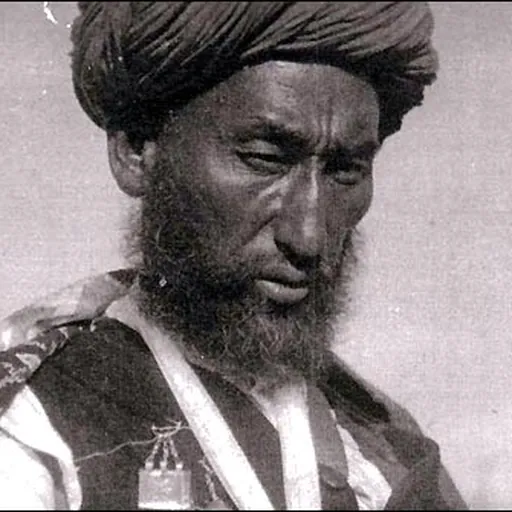
About Ibrahim Bek
Lived 1889 – 1931 (aged 41–42). Ibrahim Bek was a politician.
Ibrahim Bek Lakai (; 1889 – 31 August 1931), also known as Mullah Muhammad Ibrahimbek Chaqabay Toqsaba Oghli and Ibrahimbek Chaqabayev was an Uzbek leader in the Basmachi movement, a liberation movement in Central Asia, which fought against the Red Army. He was a member of the Lakai tribe in Eastern Bukhara and led an organized resistance against the Soviet military in the early 1920s.
Biography Ibrahim Bek was born around 1889 in the Emirate of Bukhara. He hailed from the Lakai tribe, a group of Uzbeks distinguished by their tribal and regional identity. His tribal background influenced his leadership style and his close association with traditional Islamic values. A conservative Muslim, Ibrahim Bek eventually emerged as a prominent leader in the Basmachi movement, a guerrilla resistance against the Russian conquest of Central Asia after the Russian Revolution. Unlike secular, nationalist, or pan-Turkist factions within the Basmachi movement, Ibrahim Bek presented an Islamic conservative ideology advocating for the restoration of Islamic authority and tribal autonomy under the Emirate of Bukhara. Ibrahim Bek strongly opposed the Pan-Turkism of Enver Pasha, emphasizing the Islamic basis of resistance over secularism, nationalism, and other political ideologies perceived as foreign. Ibrahim Bek eventually expelled the jadids from within the Basmachi ranks and actively fought against Enver Pasha. Despite being a capable guerrilla leader, Ibrahim Bek was essentially a relic of an older time and was to find his increasingly sophisticated military tactics out of step with the political nature of the Russian Civil War.
Ibrahim Bek and his Basmachi were engaged and defeated by Red Army units of the Turkestan Military District under the command of Mikhail Frunze in the spring of 1925. The Soviets asserted that Bek had been provided assistance by British intelligence services.
Ibrahim Bek was eventually forced to flee south into Afghanistan, from where he along with Faizal Maksum led several cross-border raids back into the newly organized Soviet Socialist Republic of Tajikistan. Ibrahim Bek was based in Kunduz and Aliabad. Between 1926 and 1931, Ibrahim Bek led raids into Uzbekistan and Tajikistan. Eventually, Ibrahim Bek was captured by Tajik villagers and turned in to Soviet authorities, where he was executed on August 31, 1931. By mid-1931, the Basmachi had been largely defeated by the Red Army.
Don’t just read it —
keep it.
Full-length biographies made to live with: read them, listen on the way to work, watch them tonight.
- E-book
- Audio
- Video
Instant download · yours to keep · every purchase keeps this site free
Important facts
People in Ibrahim Bek's life
Named in this biography and alive at the same time


Related people
Same field, nearest in time






Contemporaries
People whose lives overlapped Ibrahim Bek's



Frequently asked questions
Who was Ibrahim Bek?
Uzbek warlord from first half of 20th century
When was Ibrahim Bek born?
Ibrahim Bek was born in 1889 in Somoniyon.
When did Ibrahim Bek die?
Ibrahim Bek died on 31 August 1931 in Tashkent.
What was Ibrahim Bek's occupation?
Ibrahim Bek was a politician.
What nationality was Ibrahim Bek?
Ibrahim Bek's recorded nationality: Uzbek people.
Sources & further reading
Cite this page
APA: Biography.guide. (2026). Ibrahim Bek. https://biography.guide/ibrahim-bek/
MLA: "Ibrahim Bek." Biography.guide, https://biography.guide/ibrahim-bek/.
Chicago: "Ibrahim Bek." Biography.guide. https://biography.guide/ibrahim-bek/.
Data last updated: 2026-09-20 · Spot an error? Report a correction.
Portrait: Wikimedia Commons · author & licence
Page generated 2026-09-27 04:58 UTC