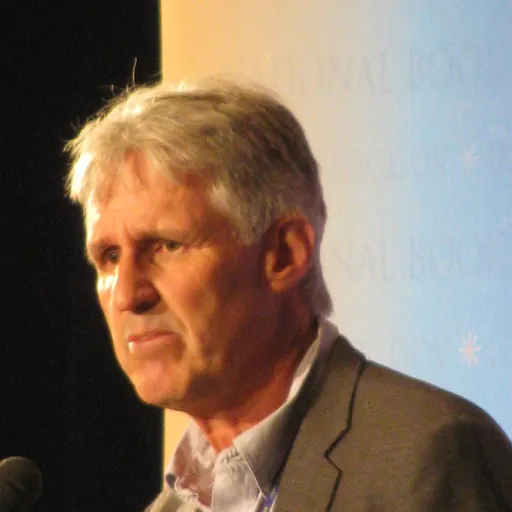
About Ian Morris
Born 1960. Ian Morris is an American anthropologist, art historian, archaeologist, historian, university teacher and academic, known for Why the West Rules—For Now.
Ian Matthew Morris (born 27 January 1960) is a British historian and archaeologist who is the Willard Professor of Classics at Stanford University. He attended Alleyne's High School, a comprehensive school in Stone, Staffordshire. He undertook a Doctor of Philosophy (PhD) degree at St John's College, Cambridge, graduating in 1985. His doctoral thesis was titled "Burial and society at Athens, 1100-500 BC".
Career From 1987 to 1995, Morris taught at the University of Chicago. Since 1995, he has been at Stanford, where he has served as Associate Dean of Humanities and Sciences, Chair of the Classics Department, and Director of the Social Science History Institute. He was one of the founders of the Stanford Archaeology Center and served two terms as its director. He has published extensively on the history and the archaeology of the ancient Mediterranean and on world history. He has also won a Dean's Award for Excellence in Teaching in 2009.
Between 2000 and 2007, he directed Stanford's excavation at Monte Polizzo, Sicily, Italy. National Endowment for the Humanities, and Institute for Research in the Humanities, University of Wisconsin-Madison. He delivered the Tanner Lectures on Human Values at Princeton University in 2012.
Morris plans to develop his views on the first-millennium BC transformations (the shift from religion-based power to bureaucratic and military one, and the rise of Axial thought) in his new book.
Why the West Rules—For Now
His 2010 book, Why the West Rules—For Now, compares East and West across the last 15,000 years, arguing that physical geography, rather than culture, religion, politics, genetics, or great men, explains Western domination of the globe. The Economist has called it "an important book—one that challenges, stimulates and entertains. Anyone who does not believe there are lessons to be learned from history should start here." The book won several literary awards, including the 2011 PEN Center USA Literary Award for Creative Nonfiction, and was named as one of the books of the year by Newsweek, Foreign Affairs, Foreign Policy, The New York Times, and a number of other newspapers. It has been translated into 13 languages.
The Measure of Civilization
The Measure of Civilization is a companion volume to Why the West Rules—For Now. It provides details of the evidence and the statistical methods used by Morris to construct the social development index that he used in Why the West Rules to compare long-term Eastern and Western history. The International Studies Association and Social Science History Association devoted panels to discussing the book at their 2013 annual meetings. The book is being translated into Chinese.
War! What is it Good For? War! What is it Good For?: Conflict and the Progress of Civilization from Primates to Robots was published by Farrar, Straus & Giroux in the US and Profile Books in Britain in April 2014. Morris argues that there is enough evidence to trace the history of violence across many thousands of years and that a startling fact emerges. For all of its horrors, over the last 10,000 years, war has made the world safer and richer, as it is virtually the only way that people have found to create large, internally pacified societies that then drive down the rate of violent death. The lesson of the last 10,000 years of military history, he argues, is that the way to end war is by learning to manage it, not by trying to wish it out of existence. Morris also devotes a chapter to the 1974–1978 Gombe Chimpanzee War in Tanzania. The German translation of the book, Krieg: Wozu er gut ist, was published by Campus Verlag in October 2013. A Dutch translation was published in 2014 by Spectrum (Houten/Antwerp): Verwoesting en vooruitgang. Its Spanish translation was released in 2017, edited by Ático de Libros, under the title Guerra, ¿para qué sirve?.
Awards and honors 2014 California Book Awards Nonfiction Finalist for War! What is it Good For?
Works Burial and Ancient Society, Cambridge, 1987 Death-Ritual and Social Structure in Classical Antiquity, Cambridge 1992 Editor, Classical Greece: Ancient Histories and Modern Archaeologies, Cambridge, 1994 Co-editor, with Barry B. Powell, A New Companion to Homer, E. J. Brill, 1997 Co-editor, with Kurt Raaflaub, Democracy 2500? Questions and Challenges, Kendall-Hunt, 1997 Archaeology as Cultural History, Blackwell, 2000 The Greeks: History, Culture, and Society, with Barry B. Powell; Prentice-Hall, 1st ed. 2005, 2nd ed. 2009 Co-editor, with Joe Manning, The Ancient Economy: Evidence and Models, Stanford, 2005 Co-editor, with Walter Scheidel and Richard Saller, The Cambridge Economic History of the Greco-Roman World, Cambridge, 2007 Co-editor, with Walter Scheidel, of The Dynamics of Ancient Empires, Oxford, 2009 Why the West Rules—For Now: The Patterns of History, and What They Reveal About the Future, Farrar, Straus and Giroux, 2010; Profile Books, 2010 The Measure of Civilisation: How Social Development Decides the Fate of Nations, Princeton University Press, 2013; Profile Books, 2013 War! What is it Good For? Conflict and the Progress of Civilization from Primates to Robots, Farrar, Straus and Giroux, 2014; Profile Books, 2014 Foragers, Farmers, and Fossil Fuels: How Human Values Evolve (The Tanner Lectures, edited and with an introduction by Stephen Macedo and commentaries by Richard Seaford, Jonathan D. Spence, Christine M. Korsgaard, and Margaret Atwood), Princeton University Press, 2015; Geography Is Destiny: Britain and the World: A 10,000-Year History, Farrar, Straus and Giroux, 2022; Profile Books, 2022
Don’t just read it —
keep it.
Full-length biographies made to live with: read them, listen on the way to work, watch them tonight.
- E-book
- Audio
- Video
Instant download · yours to keep · every purchase keeps this site free
Important facts
People in Ian Morris's life
Named in this biography and alive at the same time





Related people
Same field, nearest in time


Contemporaries
People whose lives overlapped Ian Morris's


Frequently asked questions
Who is Ian Morris?
American historian
When was Ian Morris born?
Ian Morris was born on 27 January 1960 in Stoke-on-Trent.
What is Ian Morris's occupation?
Ian Morris is an anthropologist, art historian, archaeologist, historian, university teacher and academic.
What is Ian Morris known for?
Ian Morris is known for Why the West Rules—For Now.
What nationality is Ian Morris?
Ian Morris is American.
Sources & further reading
· DBpedia: Ian Morris (historian)
Cite this page
APA: Biography.guide. (2026). Ian Morris. https://biography.guide/ian-morris-anthropologist/
MLA: "Ian Morris." Biography.guide, https://biography.guide/ian-morris-anthropologist/.
Chicago: "Ian Morris." Biography.guide. https://biography.guide/ian-morris-anthropologist/.
Data last updated: 2026-09-24 · Spot an error? Report a correction.
Portrait: Wikimedia Commons · author & licence
Page generated 2026-09-27 05:08 UTC