
About Hulü Jin
Lived 488 – 567 (aged 78–79). Hulü Jin was a politician.
Hulü Jin (488–567), courtesy name Aliudun, né Hulü Dun, was a Tiele military general and official of the Northern Wei, Eastern Wei and Northern Qi during the Northern and Southern dynasties period. A prominent chieftain among the Tiele, Hulü joined Gao Huan during his war against the Erzhu clan and participated in several battles against the Western Wei, becoming one of his most trusted companions. After Gao Huan's death, he continued to receive favour and rose to great prominence under the Northern Qi as his family members intermarried with the imperial Gao clan.
Hulü Jin is the earliest recorded person to sing the popular "Song of the Chile" (敕勒歌), and his son, Hulü Guang is also a famous general of the Northern Qi.
Early life and career Hulü Jin was a prominent chieftain among the Tiele people in Shuo Province. His great-grandfather was Hulü Beihouli (斛律倍侯利), who was a renowned figure in the frontier region for his strength and bravery. During the reign of Emperor Daowu (386–409), Beihouli led his family south to join the Northern Wei, where he was enfeoffed the Duke of Mengdu. Hulü Guang's grandfather, Hulü Fandijin (斛律幡地斤), served as a Central Master of Writing, while his father, Hulü Danagui (斛律大那瓌) served as a Household Counsellor.
Hulü Jin was described as a man of integrity who was skilled in horse riding and archery. He employed Xiongnu tactics in his military operations, knowing how to estimate the number of enemies by "observing the dust clouds" and calculating their proximity by "smelling the ground". In 521, he followed the commander of Huaishuo, Yang Jun in escorting the Rouran khan, Yujiulü Anagui back to the northern steppe, during which Hulü impressed Yujiulü with his archery skills during a hunting trip. When Anagui's forces raided Gaolu (高陸; southwest of present-day Gaoling, Shaanxi) in 523, Hulü Jin repelled him.
In 524, when Poliuhan Baling led an uprising along the Six Garrisons, Hulü Jin brought his people to join him and was enfeoffed as a king. However, realizing that the rebellion was bound for failure, Hulü led over 10,000 households to Yun province and surrendered back to the Wei. He was subsequently appointed as a Second-Rank Chieftain. In 525, Hulü Jin brought his followers further south, but as he left Huangguadui (黃瓜堆; northeast of present-day Shanyin County, Shanxi), he was attacked and defeated by the rebel leader, Du Luozhou. Many of Hulü's followers scattered, while he and his brother, Hulü Ping fled to join the commander, Erzhu Rong.
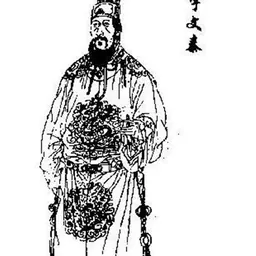
Battle of Heqiao At the subsequent Battle of Heqiao in 538, Gao Huan led his troops to resist Yuwen Tai's invasion and ordered Hulü Jin to rush towards Qin province (秦州; around present-day Yuncheng, Shanxi) to form a pincer attack. When Hulü arrived at Jin province, he received news that the Western Wei army had retreated, so he changed course to join Xue Xiuyi in besieging the enemy at Qiaoshan (喬山; north of present-day Xiangfen County, Shanxi). Gao Huan quickly arrived at Qiaoshan to reinforce them, annihilating the Western Wei army. Hulü then followed Gao in capturing several cities including Nanjiang (南絳; in present-day Jiang County, Shanxi) and Shao Commandery (邵郡; soth of present-day Yuanqu County, Shanxi).
Campaign against the Shanhu In 545, Hulü Jin played a commanding role in Gao's campaign against the Shanhu people. A two-prong attack, Hulü was instructed to secretly lead his forces through the southern route from Huangluo Ridge (黃櫨嶺; in present-day Lüliang, Shanxi) while Gao's forces went through the northern route. Once they both reached Wutu Fort (烏突戍; in present-day Lin County, Shanxi), they carried out a successful surprise attack on the Shanhu. Upon their return, Hulü was appointed Inspector of Ji province.
Service under Gao Cheng
Hou Jing's Rebellion In 547, Gao Huan succumbed to his illness and was succeeded by his eldest son, Gao Cheng. Before his death, Gao Huan advised Gao Cheng to trust Hulü Jin and Shedi Gan, stating, "The Old Xianbei, Shedi Gan and the Old Tiele, Hulü Jin are both upright and honest. They will never let you down." Shortly after, the general, Hou Jing rebelled in the Henan and surrendered to the Western Wei. Gao Cheng ordered Hulü Jin to lead Pan Le, Xuegu Yan and others to defend Heyang from Hou Jing's attacks. Meanwhile, the Western Wei dispatched Li Bi with tens of thousands of troops from Xincheng (新城; in present-day Xianyang, Shaanxi) to Yingchuan to reinforce Hou. In response, Hulü brought his troops to Guangwu, poising to intercept Li's forces. Noticing their arrival, Li Bi was forced to retreat. After returning from Heyang, Hulü Jin was appointed as Inspector of Si province. He continued to order his men to build Yangzhi (楊志), Baijia (百家) and Huyan (呼延) garrisons at Yiyang, where he later stationed his troops. Once the garrisons were completed, he then proceeded to take up his post in Si province (肆州, roughly modern Xinzhou, Shanxi).
Gao Yang, posthumously known as Emperor Wenxuan, conferred Hulü Jin the title of Prince of Xianyang and allowed him to retain his position as Inspector. During a visit to Jinyang palace winter that year, Hulü fell ill, so the emperor personally visited him in his home, gifted him medicine and frequently sending envoys to offer condolences. After he recovered, Hulü returned to Si province. In 552, he was promoted to Grand Preceptor, and he later followed Emperor Wenxuan in his campaign against the Kumo Xi. After they returned, the emperor visited Si and held a banquet for him before bidding farewell.
In his later reign, Emperor Wenxuan was said to have gone mad and acted violently to the people around him. On one occasion, it was recorded that the emperor was on his horse and attempted to stab Hulü three times. Hulü did not react and remained emotionless, eventually prompting Wenxuan to give up. Emperor Wenxuan died in 559 and was succeeded by his son, Emperor Fei.
Later life and death In 560, Hulü Jin sided with Empress Dowager Lou Zhaojun in her coup against the minister, Yang Yin and his associates. Not long after, Emperor Fei was forced to abdicate to his uncle, Gao Yan, posthumously known as Emperor Xiaozhao. The new emperor married Hulü Jin's granddaughter through Hulü Guang to his Crown Prince, Gao Bainian. In 561, Xiaozhao died and was succeeded by Emperor Wucheng, who treated Hulü with even greater respect and married another granddaughter of his to the new Crown Prince, Gao Wei.
At this point, Hulü Jin's family was one of the most powerful families in the empire, with his sons, Hulü Guang and Hulü Xian as well as grandson, Hulü Wudu all occupying important positions while his granddaughters were married into the imperial clan. Still, he warned Hulü Guang, "Though I am not well-read, I have heard that throughout history, relatives of the emperor such as Liang Ji all suffered disaster in the end. If a woman is favoured, then the nobles will be envious; if a woman is not favoured, then the emperor will despise her. Our family achieved wealth and honour through our deeds and loyalty. How can we only rely on our women?"
In 567, Hulü Jin died at the age of 80. Emperor Wucheng, who retired as emperor in favour of Gao Wei in 565, mourned him in the West Hall (西堂), while Gao Wei mourned him in Jinyang Court (晉陽宮). Hulü was posthumously granted tally and the Gilded Axe. He was also posthumously appointed Chief Controller of the Twelve Provinces of Shuo, Ding, Ji, Bing, Ying, Qing, Qi, Cang, You, Si, Jin, and Fen, Prime Minister, Grand Commandant, Manager of the Masters of Writing, Inspector of Shuo province, Chieftain and Prince of Xianyang among other titles. He was also given a million in cash and the posthumous name of "Wu". His son, Hulü Guang succeeded him, but just five years later, he and his family were falsely accused, and most of them were sentenced to death.
Anecdotes
Changing his name Described as a simple and honest person, Hulü Jin was also illiterate. He was initially known as Hulü Dun (斛律敦), but he found his given name, "Dun" (敦) difficult to write. He later changed his given name to "Jin" (金), which was simpler, and even then he struggled to write it. His peer, Sima Ziru taught him how to write his new name, and after building a new house, he had the character hung on his wall. Eventually, Hulü Jin was able to write his name.
Favour from the Gao clan Hulü Jin was well-respected among Gao Huan and his family. Gao Huan warned Gao Cheng to take good care of Hulü, warning him, "Many of your envoys are Han Chinese. Do not trust anybody who brings harm to this man."
When his granddaughter married Gao Wei, Hulü Jin was summoned by Emperor Wucheng and given the special privilege of riding his carriage up the palace steps. On one occasion, Hulü visited Emperor Wucheng to present him with food as tribute, but the Interior Secretary, Li Ruo (李若) mistakenly reported that Hulü had come on his own. Emperor Wucheng left his palace to meet Hulü on his sheep cart with his Palace Attendant Gao Wenyao (高文遙) leading the way. Li Ruo soon realized his mistake and refused to leave the corridor. When Gao Wenyao returned with his report, Emperor Wucheng scolded Li Ruo, saying "You empty-headed idiot! You should be killed!" Despite his threat, the emperor did not punish Li.
Don’t just read it —
keep it.
Full-length biographies made to live with: read them, listen on the way to work, watch them tonight.
- E-book
- Audio
- Video
Instant download · yours to keep · every purchase keeps this site free
Important facts
People in Hulü Jin's life
Named in this biography and alive at the same time




Related people
Same field, nearest in time


Contemporaries
People whose lives overlapped Hulü Jin's




Frequently asked questions
Who was Hulü Jin?
Northern Qi general
When was Hulü Jin born?
Hulü Jin was born in 488 in Shuozhou.
When did Hulü Jin die?
Hulü Jin died in 567.
What was Hulü Jin's occupation?
Hulü Jin was a politician.
What nationality was Hulü Jin?
Hulü Jin's recorded nationality: Eastern Wei, Northern Qi.
Sources & further reading
Cite this page
APA: Biography.guide. (2026). Hulü Jin. https://biography.guide/hulu-jin/
MLA: "Hulü Jin." Biography.guide, https://biography.guide/hulu-jin/.
Chicago: "Hulü Jin." Biography.guide. https://biography.guide/hulu-jin/.
Data last updated: 2026-09-20 · Spot an error? Report a correction.
Page generated 2026-09-27 05:01 UTC