
About Amalasuntha
Lived 498 – 535 (aged 36–37). Amalasuntha was a politician and writer.
Amalasuintha (495 – 30 April 535) was a ruler of the Ostrogothic Kingdom from 526 to 535. Initially serving as regent for her son Athalaric, she became queen regnant after his premature death. Highly educated, Amalasuintha was praised by both Cassiodorus and Procopius for her wisdom and her ability to speak three languages (Greek, Gothic, and Latin). Her status as an independent female monarch and obvious affinity for Roman culture caused discontent among the Gothic nobles in her court, and she was deposed and killed after six months of sole rule. Eastern Roman Emperor Justinian I used her death as a casus belli to invade Italy, setting off the Gothic War.
Family Amalasuintha was likely born in Ravenna in 495, the only child of Theodoric and his wife Audofleda, the sister of Clovis, King of the Franks. The union of Amalasuintha's parents were of a political purpose, as many royal marriages were at the time. Theodoric married Audofleda about the year 493, after he had defeated the various Gothic kingdoms and sought an alliance with the Franks. Like her father, Amalasuintha was married out of political reasons to Eutharic, an Amali prince, to ensure a legitimate heir to the throne. They had two children together, Athalaric and Matasuntha. Eutharic died in 522, causing Theodoric some alarm, as his kingdom lacked an adult male heir to inherit the throne. and, although accounts by Cassiodorus and Procopius refer to Athalaric as King, she effectively ruled on his behalf.
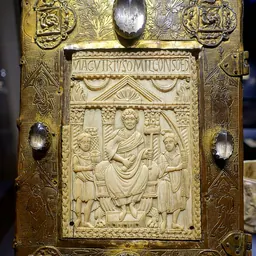
Rule Consular diptych of Rufius Gennadius Probus Orestes, Victoria and Albert museum. Portraits of Amalasuintha and her son Athalaric are above the inscription, flanking the cross.
Regent According to Procopius, the Goth aristocracy wanted Athalaric to be raised in the Gothic manner, but Amalasuintha wanted him to resemble the Roman princes. In order to secure the power in the Amali name, Amalasuintha created the consortium regni that allowed her to continue to rule as queen while still presenting a public face that honored conservative Gothic tradition. She then appointed her older cousin Theodahad to rule as co-regent, in which Amalasuintha would play the male character and Theodahad would play the woman, as male and female monarchs sharing powers. Masculinity is the main characteristic attributed to Amalasuintha by Procopius and Cassiodorus, because she had a strong determination and temperament. Deeply imbued with the old Roman culture, she gave to her son's education a more refined and literary turn than suited her Goth subjects. Conscious of her unpopularity, she banished – and afterwards put to death – three Gothic nobles whom she suspected of conspiring against her rule. It was suggested by Amory, Heather and Heydemann that one of them was Tuluin (a powerful Gothic noble and general). At the same time, she opened negotiations with Justinian, with the view of removing herself and the Gothic treasure to Constantinople.
Queen regnant After Athalaric's death, Amalasuintha became queen and ruled alone for a short while before making her cousin Theodahad co-ruler with the intent of strengthening her position. Theodahad was a prominent leader of the Gothic military aristocracy that opposed her pro-Roman stances, and Amalasuintha believed this duumvirate might make supporters from her harshest critics. Though historian Massimiliano Vitiello has instead suggested a date in May. According to the Eastern Roman historian Procopius, Amalasuintha was thinking about handing over Italy to Justinian around the time of her death. There is some evidence to suggest that the Byzantine Empress Theodora arranged to have Amalasuintha murdered, by conspiring with Theodahad through Justinian's ambassador Peter the Illyrian. Procopius believed that Theodora viewed Amalasuintha as a potential love rival and threat to her position as Empress. However, modern scholarship has contended that Theodora was acting on Justinian's behalf in arranging Amalasuintha's murder as it gave him clear justification to attack Theodahad.
In 536, Theodahad was deposed by Witigis, who had forcibly married Amalasuintha's daughter Matasuintha. With the people's support, Witigis had Theodahad put to death.
Don’t just read it —
keep it.
Full-length biographies made to live with: read them, listen on the way to work, watch them tonight.
- E-book
- Audio
- Video
Instant download · yours to keep · every purchase keeps this site free
Important facts
Family & relationships
People in Amalasuntha's life
Named in this biography and alive at the same time


Related people
Same field, nearest in time



Contemporaries
People whose lives overlapped Amalasuntha's




Frequently asked questions
Who was Amalasuntha?
queen of the Ostrogoths (495-535)
When was Amalasuntha born?
Amalasuntha was born in 498 in Ravenna.
When did Amalasuntha die?
Amalasuntha died on 30 April 535 in Isola Martana.
What was Amalasuntha's occupation?
Amalasuntha was a politician and writer.
What nationality was Amalasuntha?
Amalasuntha's recorded nationality: Ostrogothic Kingdom.
Sources & further reading
Cite this page
APA: Biography.guide. (2026). Amalasuntha. https://biography.guide/amalasuntha/
MLA: "Amalasuntha." Biography.guide, https://biography.guide/amalasuntha/.
Chicago: "Amalasuntha." Biography.guide. https://biography.guide/amalasuntha/.
Data last updated: 2026-09-20 · Spot an error? Report a correction.
Page generated 2026-09-27 05:33 UTC