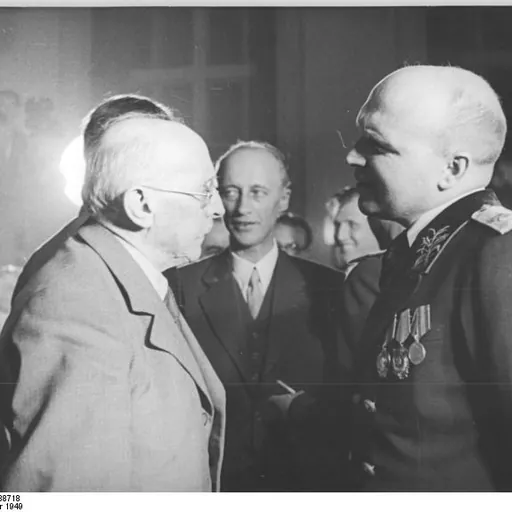
About Hugo Hickmann
Lived 1877 – 1955 (aged 77). Hugo Hickmann was a German politician and theologian.
Hugo Hickmann (born Dessau 3 September 1877; died 30 May 1955 Langebrück) was a German politician.
He was politically active for long enough to have a ringside seat in the later 1940s as West Germany and East Germany became separate countries, and East Germany quickly reverted to the pattern of the previous administration by becoming a one-party state. Neither of these developments seemed as inevitable or obvious at the time as they later became with the benefit of hindsight: Hugo Hickmann was resolute in his opposition to both of them.
Life
Early years Hickmann was born in a small town in the Duchy of Anhalt, some 70 km (45 miles) north of Leipzig. His father was Hugo Woldemar Hickmann (1841-1922), a prominent Lutheran pastor. His grandfather was a doctor. One aunt was a minor novelist and there were several teachers among his nearer kinsfolk. In terms of the Marxist class classifications popular in the 1940s and 50s, Hickmann was born into the Bourgeoisie. He attended secondary school in Freiberg between 1892 and 1899, then going on to study Theology at the universities of Leipzig, Marburg and Tübingen from 1899 till 1903.
After passing his public exams in 1903 he became a trainee teacher at small school in Roßwein, and went on to teach at a school in Riesa from 1904 till 1906. Between 1906 and 1908 he was involved in teacher training at workshops and seminars in Dresden. Hickmann never married.
Middle years In 1908 he took a job teaching theology at the Queen Carola Secondary School in Leipzig, also working at the university from where, in 1917, he received his professorship.
Hickmann was also extremely active in church matters. In 1926 he became vice-president of the evangelical-Lutheran regional synod for Saxony. a position he would retain till 1933. was established in Dresden in order to encourage self-help among church members in response to the high level of financial distress that had followed the war, the impact of the national reparations bill and the ensuing hyperinflation. Church funds should "once more be used only for genuinely church related purposes". The LKG was the first evangelical-church credit institute in Germany. The institution's objective was not to be maximize profits, but rather to use any revenue surpluses to protect favourable terms for LKG members in the front-line of business activity in the region.
The National Socialist power seizure which took place in January 1933 saw Hickmann relieved of his church offices. These were the assumptions and goals for Germany shared by Hugo Hickmann,
Members of the People's council were uneasily startled by an unprecedented statement of dissent, but Hickmann persisted, implicitly pointing out that (apart from a couple of representative Communist party members from West Germany) the assembled delegates were in no position to mandate any constitutional arrangements except in that part of Germany where they were backed by the Soviet army:
"A decision regarding a settled constitution can only be a task for a German national assembly."
Hickmann also held political office during this period on a regional level, elected to a newly recreated Regional assembly for Saxony in 1946. He became an assembly vice-president, retaining that position till February 1950. to the SED (party) created powerful enemies. After the enforced resignation in 1947 of Jakob Kaiser as CDU party chairman the SED manifested an ever more obvious determination to bring the East German CDU into line.
A speech by Hickmann to the regional assembly in Dresden on 6 January 1950 intensified the ongoing political attacks against him. He questioned the leading role of the SED, defended the private sector economy and warned strongly against the separation of the German Democratic Republic from West Germany. He demanded independence for the political parties and expressed his satisfaction that at least in West Germany, under the leadership of the Christian Democrat Konrad Adenauer, a Christian state existed. The Saxony branch of the CDU now found itself at the top of the SED hitlist. On 23 January 1950 the SED faction in the Dresden regional assembly where Hickmann had delivered his trenchant speech earlier in the month ranted at the CDU members with the words "Hängt sie auf, die Sau!" (roughly:"Hang the pig"), and demanded Hickmann's resignation. Within the (East German) CDU the party newspaper suddenly found itself with a new editor while party functionaries at all levels were placed under intensified pressure to adhere to the agenda of the ruling SED. Hickmann resigned from the CDU on 30 January 1950. and in place by March 1948. The Regional assembly of Saxony, along with other similar institutions in other parts of East Germany, was dissolved in July 1952 (but effectively restored in 1992).
Officially Hugo Hickmann, who in 1950 celebrated his 73rd birthday, now retained just one official position, as Chairman of the Bible Society in Saxony. But he also remained till his death the most important linkman for the "Exiled CDU" in Saxony.
Don’t just read it —
keep it.
Full-length biographies made to live with: read them, listen on the way to work, watch them tonight.
- E-book
- Audio
- Video
Instant download · yours to keep · every purchase keeps this site free
Important facts
People in Hugo Hickmann's life
Named in this biography and alive at the same time

Related people
Same field, nearest in time





Contemporaries
People whose lives overlapped Hugo Hickmann's


Frequently asked questions
Who was Hugo Hickmann?
German politician (1877–1955)
When was Hugo Hickmann born?
Hugo Hickmann was born on 3 September 1877 in Meissen.
When did Hugo Hickmann die?
Hugo Hickmann died on 30 May 1955 in Langebrück.
What was Hugo Hickmann's occupation?
Hugo Hickmann was a politician and theologian.
What nationality was Hugo Hickmann?
Hugo Hickmann was German.
Sources & further reading
Cite this page
APA: Biography.guide. (2026). Hugo Hickmann. https://biography.guide/hugo-hickmann/
MLA: "Hugo Hickmann." Biography.guide, https://biography.guide/hugo-hickmann/.
Chicago: "Hugo Hickmann." Biography.guide. https://biography.guide/hugo-hickmann/.
Data last updated: 2026-09-22 · Spot an error? Report a correction.
Page generated 2026-09-27 05:10 UTC