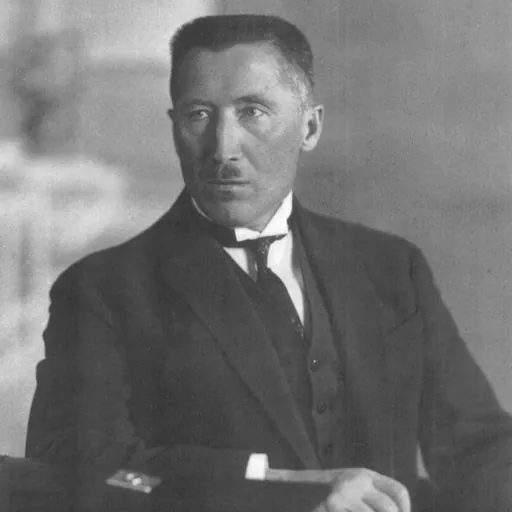
About Hugo Celmiņš
Lived 1877 – 1941 (aged 63). Hugo Celmiņš was a Latvian and Russian politician, diplomat, military officer, journalist and head of government.
Hugo Celmiņš (30 October 1877 – 30 July 1941) was a Latvian politician, a public employee, agronomist, twice the Prime Minister of Latvia (19 December 1924 – 23 December 1925, and 1 December 1928 – 26 March 1931). Arrested and deported to the USSR after the Soviet occupation of Latvia in 1940, imprisoned in Moscow's Lefortovo Prison. On 30 July 1941 shot and buried in the mass graves of Kommunarka shooting ground. Hugo Celmiņš was one of those who developed agrarian reform in Latvia.
Early life Hugo Celmiņš was born on 30 October 1877 in the Lubāna parish (now Madona Municipality) as the youngest son in the family. H. Celmiņš studied from 1887 to 1891 at Lubānas Ministry School, then at the Gorku School of Agriculture. In 1898, after his military service, he was seen in reserve as an officer. Entered the Polytechnic Institute of Riga in 1899, completed in 1903 with a first-class agronome degree. In 1900, he was one of the founders of the student fraternity. Then worked as an agronomist and teacher in Russia. In 1913 and 1914, while studying at the University of Bern, Switzerland, developed a doctoral thesis but failed to defend since the war began and had to go to the front. In June 1919, he volunteered for the Jāņa Baloža brigade, fought against Bermondt, earning the rank of captain's service and the Order of Lāčplēsis.
Prime minister
First term The eighth Latvian government, led by Voldemārs Zāmuels, resigned on 2 December 1924. The President of Latvia Jānis Čakste nominated the politician who was known as the compiler and leader of the new cabinet, the member of the Latvian Farmers’ Union, Hugo Celmiņš.
Second term The second cabinet of Hugo Celmiņš was drawn up immediately after the third Saeima elections. The government commenced its activities on 1 December 1928. Bad harvest had a negative impact on the overall economic situation in the country. The number of unemployed people increased and the number of livestock decreased significantly. To overcome the economic crisis, the government of Hugo Celmiņš offered to cut government budget spending, providing income through loans rather than raising taxes. One of the government's goals was to increase agricultural productivity and profitability. Farmers received special subsidies from the state budget, and the state ensured that prices for agricultural products were increased artificial domestically. To overcome the agricultural crisis cheap loans and different benefits for farms were accepted too. In internal policy, the government committed itself to ensure peace and order within the country and strict guarding of Latvia's borders. The emphasis was also placed on the establishment of a well-trained and patriotic army. Foreign policy, like in his first term, was aimed to develop closer cooperation between the Baltic states and to play an active role in the League of Nations.
After the loss of the post of Prime Minister, Hugo Celmiņš was elected the Head of the City of Riga on 23 April 1931. At that time, several important objects were built in Riga - the Freedom Monument, the Brothers' Cemetery.
Titles, honours, awards
Order of Lāčplēsis (3rd Class) Order of the Three Stars (1st Class, 2nd Class, 3rd Class) Order of the Cross of the Eagle (1st Class) Order of the Lithuanian Grand Duke Gediminas (1st Class) Order of the White Rose of Finland (1st Class) Order of Polonia Restituta (1st Class) Legion of Honour
Don’t just read it —
keep it.
Full-length biographies made to live with: read them, listen on the way to work, watch them tonight.
- E-book
- Audio
- Video
Instant download · yours to keep · every purchase keeps this site free
Important facts
People in Hugo Celmiņš's life
Named in this biography and alive at the same time

Related people
Same field, nearest in time





Contemporaries
People whose lives overlapped Hugo Celmiņš's




Frequently asked questions
Who was Hugo Celmiņš?
Latvian politician (1877-1941)
When was Hugo Celmiņš born?
Hugo Celmiņš was born on 30 October 1877 in Lubāna Parish.
When did Hugo Celmiņš die?
Hugo Celmiņš died on 30 July 1941 in Moscow.
What was Hugo Celmiņš's occupation?
Hugo Celmiņš was a politician, diplomat, military officer, journalist and head of government.
What nationality was Hugo Celmiņš?
Hugo Celmiņš was Latvian and Russian.
Sources & further reading
Cite this page
APA: Biography.guide. (2026). Hugo Celmiņš. https://biography.guide/hugo-celmins/
MLA: "Hugo Celmiņš." Biography.guide, https://biography.guide/hugo-celmins/.
Chicago: "Hugo Celmiņš." Biography.guide. https://biography.guide/hugo-celmins/.
Data last updated: 2026-09-22 · Spot an error? Report a correction.
Portrait: Wikimedia Commons · author & licence
Page generated 2026-09-27 05:04 UTC