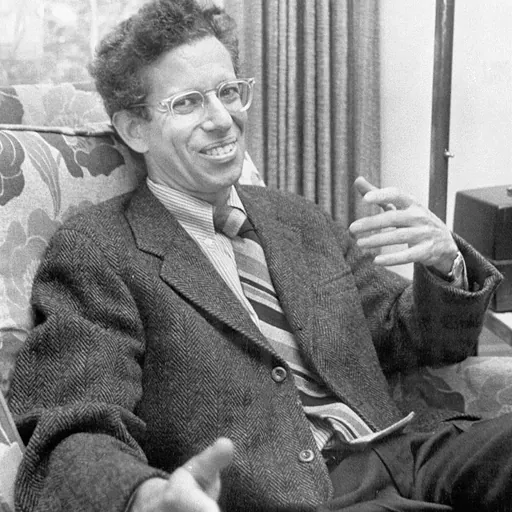
About Howard Temin
Lived 1934 – 1994 (aged 59). Howard Temin was an American virologist, geneticist, biochemist, physician, university teacher and biologist, known for Reverse transcriptase.
Howard Martin Temin (December 10, 1934 – February 9, 1994) was an American geneticist and virologist. He discovered reverse transcriptase in the 1970s at the University of Wisconsin–Madison, for which he shared the 1975 Nobel Prize in Physiology or Medicine with Renato Dulbecco and David Baltimore.
Early life and education Temin was born in Philadelphia, Pennsylvania, to Jewish parents, Annette (Lehman), an activist, and Henry Temin, an attorney. As a high school student at Central High School in Philadelphia, he participated in the Jackson Laboratory's Summer Student Program in Bar Harbor, Maine. The director of the program, C.C. Little, told his parents that Temin was "unquestionably the finest scientist of the fifty-seven students who have attended the program since the beginning...I can't help but feel this boy is destined to become a really great man in the field of science."
Temin's parents raised their family to have values associated with social justice and independent thinking, which was evident throughout his life. For Temin's bar mitzvah, the family donated money that would have been spent on the party to a local camp for displaced persons. Temin was also the valedictorian of his class and he devoted his speech to relevant issues at the time including the recent hydrogen bomb activity and the news of sending a man to the moon. These results implied that the infecting Rous sarcoma virus was somehow generating complementary double-stranded DNA. Temin's description of how tumor viruses act on the genetic material of the cell through reverse transcription was revolutionary. This upset the widely held belief at the time of a popularized version of the "Central Dogma" of molecular biology posited by Nobel laureate Francis Crick, one of the co-discoverers of the structure of DNA (along with James Watson and Rosalind Franklin). Crick had claimed only that sequence information cannot flow out of protein into DNA or RNA, but he was commonly interpreted as saying that information flows exclusively from DNA to RNA to protein . Many highly respected scientists disregarded his work and declared it impossible. Despite the lack of support from the scientific community, Temin continued to search for evidence to support his idea. In 1969, Temin and a postdoctoral fellow, Satoshi Mizutani, began searching for the enzyme that was responsible for the phenomenon of viral RNA being transferred into proviral DNA. In 1975, Baltimore and Temin shared the Nobel Prize of Physiology or Medicine. Both scientists completed their initial work with RNA-dependent DNA polymerase with the Rous sarcoma virus.
The discovery of reverse transcriptase is one of the most important of the modern era of medicine, as reverse transcriptase is the central enzyme in several widespread viral diseases such as AIDS and Hepatitis B. Reverse transcriptase is also an important component of several important techniques in molecular biology, such as the reverse transcription polymerase chain reaction, and diagnostic medicine.
Mentoring Temin has mentored some PhD students, including Edward F. Fritsch, co-author of one of the most influential books in molecular biology: Molecular Cloning: A Laboratory Manual
Awards and honors Temin was a member of the American Academy of Arts and Sciences (1973), the United States National Academy of Sciences (1974), and the American Philosophical Society (1978). In 1992 Temin received the National Medal of Science. Temin was elected a Foreign Member of the Royal Society (ForMemRS) in 1988.
Following winning the Nobel Prize, Temin focused his research mainly on studying the viral sequences that control the packaging of viral RNA, developing a new vaccine for HIV, and studying the mechanisms of retroviral variation. On one occasion, Howard Temin gave a lecture to some of the Jewish Soviet scientists in someone's home. The next morning, almost all of scientists that had attended the lecture were arrested. After they were released, Temin tape-recorded one of the scientist's account of the event and gave the tape to newspapers in the United States so that the situation that Jewish scientists were facing would be publicized.
Death and legacy Temin taught and conducted research at UW-Madison until he died of lung cancer, on February 9, 1994. He was survived by his wife Rayla, a geneticist at UW-Madison, two daughters, and two brothers, Peter Temin, also an academic, and Michael Temin, a lawyer.
Don’t just read it —
keep it.
Full-length biographies made to live with: read them, listen on the way to work, watch them tonight.
- E-book
- Audio
- Video
Instant download · yours to keep · every purchase keeps this site free
Important facts
People in Howard Temin's life
Named in this biography and alive at the same time




Related people
Same field, nearest in time

Contemporaries
People whose lives overlapped Howard Temin's



Frequently asked questions
Who was Howard Temin?
American geneticist
When was Howard Temin born?
Howard Temin was born on 10 December 1934 in Philadelphia.
When did Howard Temin die?
Howard Temin died on 9 February 1994 in Madison.
What was Howard Temin's occupation?
Howard Temin was a virologist, geneticist, biochemist, physician, university teacher and biologist.
What was Howard Temin known for?
Howard Temin was known for Reverse transcriptase.
What nationality was Howard Temin?
Howard Temin was American.
Sources & further reading
· DBpedia: Howard Martin Temin
Cite this page
APA: Biography.guide. (2026). Howard Temin. https://biography.guide/howard-temin/
MLA: "Howard Temin." Biography.guide, https://biography.guide/howard-temin/.
Chicago: "Howard Temin." Biography.guide. https://biography.guide/howard-temin/.
Data last updated: 2026-09-22 · Spot an error? Report a correction.
Portrait: Wikimedia Commons · author & licence
Page generated 2026-09-27 05:01 UTC