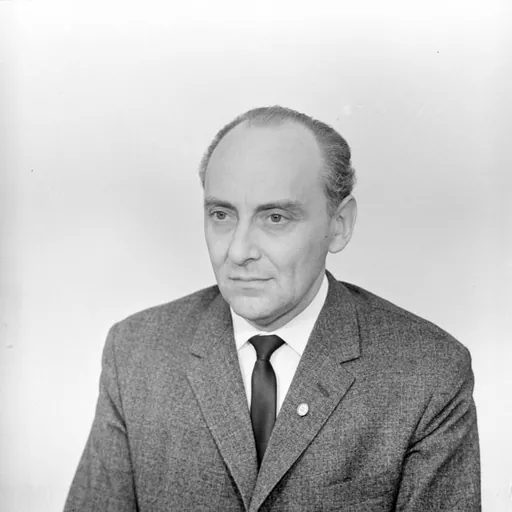
About Horst Schumann
Lived 1924 – 1993 (aged 69). Horst Schumann was a German politician and functionary.
Horst Schumann (6 February 1924 – 28 December 1993) was a German politician and functionary of the Free German Youth (FDJ) and the Socialist Unity Party (SED).
In the German Democratic Republic, he served as the longtime First Secretary of the FDJ from 1959 to 1967 and of the SED in Bezirk Leipzig from 1970 to 1989.
Life and career Schumann's father, Georg Schumann, was a toolmaker, KPD (Communist Party of Germany) functionary, and resistance fighter against National Socialism. In 1933, his father was taken into protective custody by the Gestapo. Even before his father's release, Schumann joined the Hitler Youth in the spring of 1939, allegedly against his will and on the recommendation of Kurt Kresse, a friend of his father, who saw it as an opportunity to disguise the family.
Horst Schumann attended elementary school and learned the trade of piano making from 1938 to 1941. In 1943, he was conscripted into the Wehrmacht and served as an infantry and anti-tank soldier and grenadier. In the last months of the war, Schumann's father was executed for his activities in the resistance. After the war, Schumann was briefly interned in American and Soviet prisoner-of-war camps and, upon his release in July 1945, sought employment in Leipzig.
FDJ First Secretary
In May 1959, Schumann rose to the position of the First Secretary of the Central Council of the FDJ, succeeding Karl Namokel, in 1960, though he left it at the start of the Honecker era in 1971. He was not involved in the decisions regarding the Leipzig Monday Demonstrations on 9 October 1989, as he was on sick leave. His deputy, Second Secretary Helmut Hackenberg, represented him.
On 20 October 1989, the Politburo, now under Egon Krenz, decided to replace Schumann with Bezirk Leipzig SED Science and Education Secretary Roland Wötzel, who was seen as reform-oriented and had participated in the call for non-violence during the large demonstration on 9 October 1989, in Leipzig, known as the "Leipzig Six."
Reunified Germany
Following the political changes, on 5 May 1990, he was charged by the Leipzig District Attorney's Office with incitement to electoral fraud in the municipal elections in May 1989, but his death preempted any potential conviction.
Schumann died in 1993 at the age of 80 in Berlin.
His grave is located in the Friedrichsfelde Central Cemetery in the gravesite for victims of fascism and persecuted by the Nazi regime.
Don’t just read it —
keep it.
Full-length biographies made to live with: read them, listen on the way to work, watch them tonight.
- E-book
- Audio
- Video
Instant download · yours to keep · every purchase keeps this site free
Important facts
People in Horst Schumann's life
Named in this biography and alive at the same time


Related people
Same field, nearest in time





Contemporaries
People whose lives overlapped Horst Schumann's


Frequently asked questions
Who was Horst Schumann?
German politician (1924-1993)
When was Horst Schumann born?
Horst Schumann was born on 6 February 1924 in Berlin.
When did Horst Schumann die?
Horst Schumann died on 28 December 1993 in Berlin.
What was Horst Schumann's occupation?
Horst Schumann was a politician and functionary.
What nationality was Horst Schumann?
Horst Schumann was German.
Sources & further reading
· DBpedia: Horst Schumann (politician)
Cite this page
APA: Biography.guide. (2026). Horst Schumann. https://biography.guide/horst-schumann-politician/
MLA: "Horst Schumann." Biography.guide, https://biography.guide/horst-schumann-politician/.
Chicago: "Horst Schumann." Biography.guide. https://biography.guide/horst-schumann-politician/.
Data last updated: 2026-09-20 · Spot an error? Report a correction.
Portrait: Wikimedia Commons · author & licence
Page generated 2026-09-27 04:58 UTC