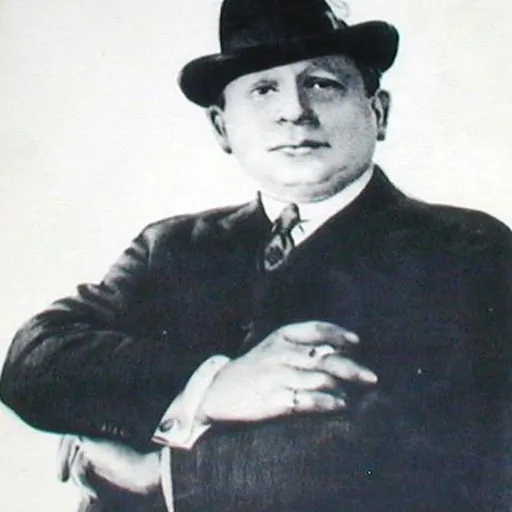
About Horace Goldin
Lived 1873 – 1939 (aged 65). Horace Goldin was a magician, variety artist and magic (illusion).
Horace Goldin (17 December 1873 21 August 1939) was a stage magician who was noted for his rapid presentation style and who achieved international fame with his versions of the sawing a woman in half illusion.
Early life Goldin was of Polish Jewish descent and was born Hyman Elias Goldstein in Vilnius, which was then part of Russia but is now the capital of Lithuania. Sources differ as to his date of birth, some give it as 17 December 1873 and some as an unspecified date in 1874. An accident when he was young left him with a speech impediment. It has been said he showed a talent for magic tricks when he was young after he began learning from a gypsy performer. When he was 16 his family emigrated to the United States and settled in Nashville, Tennessee, where they ran a store. Despite the combination of a strong accent and a speech impediment, young Goldstein managed to make a living as a salesman.
His introduction to a performing career came when he was apprenticed to touring showman Adolph Veidt, who influenced him to take the stage name Horace Goldin. Goldin began performing magic on a part-time basis around 1894, combining tricks and jokes and billing himself as "The Humorous Conjurer". After he received poor reviews from newspapers he tried again with a new act, for which he hired assistants and adopted a rapid presentation style said to have been inspired by seeing German-born magician Imro Fox (1862–1910). Goldin did tricks quickly one after another without speaking and became known as "The Whirlwind Illusionist". With this act he found success in vaudeville and began touring the United States. In 1901 he went to London to perform at the Palace Theatre. His British shows made sufficient impact for him to be invited to do a private show for King Edward VII and royal guests at Sandringham in November 1902. In 1915 he set out on a long tour of the Far East but this ended in disaster in 1918 when a boat carrying his equipment sank at Lahaina, Hawaii. Worse still, Goldin distrusted banks and carried his money with him (reputedly in gold) and that went to the bottom along with his props. He was forced into bankruptcy on returning home. However he was about to enter the most successful phase of his career with his development of the illusion sawing a woman in half.
Some of Goldin's legal tactics resulted in problems even though they were technically successful. One such was his patenting of Sawing a woman in half. He applied for a patent in September 1921 and was awarded U.S. patent number 1,458,575 on 12 June 1923. This gave him legal right to an exclusive monopoly on his invention for 17 years and thus made it easier for him to prevent other magicians from using his methods. However patents require inventors to reveal the workings of their inventions, which meant Goldin could no longer keep his methods completely secret. In the 1930s this brought Goldin into confrontation with the R.J. Reynolds Tobacco Company, the maker of Camel cigarettes, which was running an advertising campaign aimed at debunking the publicity for a competing brand. Reynolds used the slogan "It's fun to be fooled...It's more fun to know" and ran adverts showing the secrets behind famous mysteries. In 1933 they produced one with a picture showing the workings of a version of sawing a woman in half. Goldin sued but the case was eventually dismissed by a federal court in 1938. After that Goldin gave up on litigation over the sawing illusion and focused instead on secrecy. For example, he never patented his later sawing illusion in which a giant buzzsaw blade appears to cut through an assistant.
Death In his later years, Goldin became a British citizen. He died on 21 August 1939 following a show at the Wood Green Empire Theatre in London. Twenty-one years earlier at that venue, a magician named Chung Ling Soo had been killed while performing the bullet catch illusion. Goldin performed the same trick successfully but died in his sleep later.
Publications Mysterious Tricks (1930) It's Fun To Be Fooled (1937)
Selected filmography Stars on Parade (1936)
Don’t just read it —
keep it.
Full-length biographies made to live with: read them, listen on the way to work, watch them tonight.
- E-book
- Audio
- Video
Instant download · yours to keep · every purchase keeps this site free
Important facts
People in Horace Goldin's life
Named in this biography and alive at the same time
Related people
Same field, nearest in time




Contemporaries
People whose lives overlapped Horace Goldin's

Frequently asked questions
Who was Horace Goldin?
British magician (1873–1939)
When was Horace Goldin born?
Horace Goldin was born on 17 December 1873 in Vilnius.
When did Horace Goldin die?
Horace Goldin died on 22 April 1939 in London.
What was Horace Goldin's occupation?
Horace Goldin was a magician, variety artist and magic (illusion).
Sources & further reading
Cite this page
APA: Biography.guide. (2026). Horace Goldin. https://biography.guide/horace-goldin/
MLA: "Horace Goldin." Biography.guide, https://biography.guide/horace-goldin/.
Chicago: "Horace Goldin." Biography.guide. https://biography.guide/horace-goldin/.
Data last updated: 2026-09-22 · Spot an error? Report a correction.
Page generated 2026-09-27 05:10 UTC