
Hōne Tikao
New Zealand Māori kaumātua (elder)
About Hōne Tikao
Lived 1808 – 1852 (aged 43–44). Hōne Tikao was a New Zealand elder.
Hōne Tikao (also known as Piuraki and John (Jack) Love (1808 – June 1852) was an Akaroa Harbour Ngāi Te Kahukura (respected elder) of great physique, strength and intelligence. At age 22, he was captured and enslaved by the war chief Te Rauparaha for many years, and upon release had many whaling adventures, learning to speak English and French. He signed the Treaty of Waitangi in 1840, and Kemp's Deed in 1848, and became a prominent negotiator in the land sales and disputes that took place later.
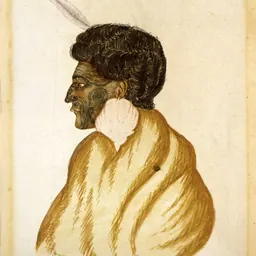
He was tattooed on one side of his face in a curved design. Tikao Bay takes its name from him. Piuraki is his tribal name.
Early life Tikao was born around 1808 on the western shores of Akaroa Harbour. He was the son of the (chief) Tauporiotu and Hakeke, and is a descendant of Manaia and Irakehu (grand-daughter of Te Rakiwhakaputa of Rāpaki). He is described orally by his nephew, Hōne Taare Tīkao, as tall, about in height, with an impressive reach with a (staff).
He was tattooed on one side of his face in a curved design. While this intriguing moko appeared to be partially completed, featuring blue spirals and lines that traced his wrinkle lines on one cheek only, such one-sided tattooing is known as , or sometimes .
Capture and enslavement In the early 1830s, during the time of the North Island Ngāti Toa war chief Te Rauparaha's excursions to conquer the South Island, the Tikao (family), and rest of his hapū were almost annihilated.
According to (elderly man) Hōne Taare Tīkao, Te Rauparaha could not have come at a worse time, as the Kaiapoi and Banks Peninsula hapū were divided against one another, and many had been killed. This bitter family feud had weakened Tikao's people so much that they fell prey to the northern war chief. In another version, they were on a chance visit to the Kaiapoi Pā, when the stockade fell to the Ngāti Toa, towards the end of 1831. In a third version, they were captured in 1832 at the Onawe Pā massacre.
Either way, the Tikao whānau were taken by boat to Te Ruaparaha's island stronghold on Kapiti. Many of his friends and relatives were slaughtered.
Tikao was 22 and his brother Tāmati was 15. Their mother, Hakeke, dove over the side in Kaikoura. She made her way south to Otakou, and spent the rest of her life with relative there. Their father, Tauporiotu, died a slave, and is buried in Wellington.
Tikao attracted attention due to his remarkable physique and strength, earning respect even during his exile, including from his adversaries.
By the 1840s, many of Te Rauparaha's followers embraced Christianity and released their captives. Both brothers were eventually set free from Kapiti Island and crossed Cooks Strait.
Tikao's brother, Tāmati (also known as Pukurau), made his way to Wairua, where he joined Canon Stack's mission and became a lay reader in the church. There he married a distant relative, named Mairehe Rahera, and they had one child Hōne (Teone) Taare Tikao.
Over the course of several years, he sailed around the globe, visiting France and England, while also learning to speak some European languages. His nephew says he "went Home". The use of the word "Home" is interesting. "Home" is how New Zealanders of the day referred to the British Isles.
He eventually became homesick, and sailed home on a French whaler towards the end of 1839.
While in France, he helped the promoters of immigration to his homeland with information and promised them his sympathy and assistance should they land in Akaroa; however, upon reaching Cloudy Bay on his way home, he met with Taiaroa, the Otago chief, and possibly Tāngatahara, and discussed the coming of the two Pākeha nations. He decided to throw his influence on the side of the British, who, he was convinced would be the better ally. It was signed on 30 May 1840, by Tikao, under the name John Love, and Iwikau. Iwikau had also enslaved by Te Rauparaha, but as rangatira of Ngato Rangiamoa, the senior line of the Ngai Tauhuriri hapu, he had been released earlier. His half-brother was Tama-i-hara-nui, who was captured on the brig Elizabeth.
Tikao's name is absent from the historical list of signatures. By this time, he had adopted the English name "John Love," which is the name that appears on the parchment alongside Iwikau's. The inscription beside his signature reads: John Love an intelligent native who calls himself . "Ko te tohu o" roughly translates as "place of signature belonging to". The "rangatira o ngatirakuhua" part translates as "chief of Ngāi Te Kahukura hapū".
Major Bunbury, in his dispatch recording the visit to Akaroa, described Love as a very intelligent well-dressed native who spoke English better than any chief he had met.
At the signing at Onuku Marae, the two signatories were given blankets. Taiaroa, Karetai and other from the south could not speak unilaterally for Akaroa, and when they tried, they aroused considerable tribal antagonism.
According to Ogilvie, signing the treaty did not deter Tikao from being a party to the "sale" of land to Captain Langlois on 14 August 1940. For this Tikao received one shirt, one gun and one pistol as his share. He took these items to Tuauau, the (head) of Akarao, who now did not approve of the "sale" but kept the items all the same. Tuauau, known to the whalers as Tohow "sold" Banks Peninsula to Captain Clayton in 1837, and also signed the Langlois purchase deed. In 1843, Tikao led a demonstration in Akaroa over land settlement issues.
During negotiations around the Kemp's Deed, in the 1850s, Tikao objected to being banished, out of the commercial hub of Akaroa, and he lobbied, without success, for a better deal.
Death Near the end of his life, Tikao returned to Pigeon Bay, where his wife and children were interred, victims of one of the numerous epidemics of diseases introduced by Europeans that devastated the local population. He died in Pigeon Bay in June 1852, age 43 or 44, and was subsequently buried at Kaiapoi.
The identity of the ‘Pouka-lem’ cast is uncertain. Its inscription calls the subject a "native of Otago". It is a possibility that Tikao was visiting, his Akaroa Harbour neighbour and (relation), Tāngatahara and his wife, Heroua, who have been linked to the second and third casts; although it was Tāngatahara's killing of Te Pēhi Kupe at near the Kaiapoi Pā, that triggered the series of revenge attacks during which Tikao was captured and enslaved.
Unlike other casts he made on the Pacific voyage, Dumoutier has not written any (genealogy) on the back of the three casts. In his journal, Dumoutier describes the encounter when some natives came aboard the Astrolabe.
Tikoa, as mentioned above, spoke French, and if it were he, then one presumes Dumoutier would have recorded more than (good) in his journal.
All three casts were photographed in 2010 by Fiona Pardington.
The one identified as Tikao depicts an older noble imposing man, with a full-face tattoo. Tikao would have been about 32 years old at that time.
Further doubts have been raised about the ability to convince men of their (status) to not only have their heads shaved but also to allow plaster applied and to breathe through straws up their nostrils for an hour. The head is considered the most (sacred) part of a person's body. It depicts the head and upper body of a medium-built man in a woven cloak. The subject is bearded, untattooed and concentrating deeply. His face does not resemble the face on the life-cast. He has a full head of hair. The subject is possibly his brother Tamati or a person with the similar name of Tamakeke. The etching, labelled Tikao (full face), is displayed in the Bibliotheque Nationale. The subject's face appears older and more contented than the face in the sketch. His pose, cloak and hairstyle are also different. Once again, the depicted person does not wear a one-sided tattoo.
Don’t just read it —
keep it.
Full-length biographies made to live with: read them, listen on the way to work, watch them tonight.
- E-book
- Audio
- Video
Instant download · yours to keep · every purchase keeps this site free
Important facts
People in Hōne Tikao's life
Named in this biography and alive at the same time


Related people
Same field, nearest in time

Contemporaries
People whose lives overlapped Hōne Tikao's






Frequently asked questions
Who was Hōne Tikao?
New Zealand Māori kaumātua (elder)
When was Hōne Tikao born?
Hōne Tikao was born in 1808 in Akaroa Harbour.
When did Hōne Tikao die?
Hōne Tikao died in 1852 in Banks Peninsula.
What was Hōne Tikao's occupation?
Hōne Tikao was an elder.
What nationality was Hōne Tikao?
Hōne Tikao was New Zealand.
Sources & further reading
Cite this page
APA: Biography.guide. (2026). Hōne Tikao. https://biography.guide/hone-tikao/
MLA: "Hōne Tikao." Biography.guide, https://biography.guide/hone-tikao/.
Chicago: "Hōne Tikao." Biography.guide. https://biography.guide/hone-tikao/.
Data last updated: 2026-09-20 · Spot an error? Report a correction.
Page generated 2026-09-27 05:18 UTC