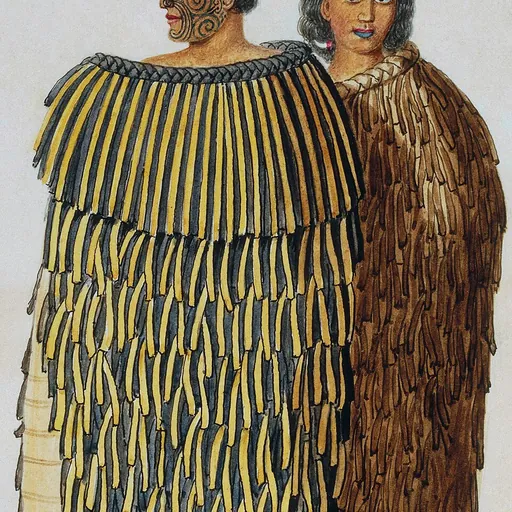
About Hōne Heke
Lived 1807 – 1850 (aged 42–43). Hōne Heke was a New Zealand politician and rangatira.
Hōne Wiremu Heke Pōkai ( 1807 – 7 August 1850), born Heke Pōkai and later often referred to as Hōne Heke, was a highly influential Māori rangatira (chief) of the Ngāpuhi iwi (tribe) and a war leader in northern New Zealand; he was affiliated with the Ngati Rahiri, Ngai Tawake, Ngati Tautahi, Te Matarahurahu and Te Uri-o-Hua hapū (subtribes) of Ngāpuhi. Hōne Heke fought with Hongi Hika, an earlier war leader of the Ngāpuhi, in the Musket Wars. Hōne Heke is considered the principal instigator of the Flagstaff War in 1845–46.
Biography Heke was born at Pakaraka, south of Kerikeri in the Bay of Islands, in 1807. His father was Tupanapana and his mother Te Kona. He was named Heke Pōkai, after his mother's brother Pokaia. He grew up in the Kaikohe area. As a youth, he attended the Church Missionary Society school at Kerikeri in 1824 and 1825 and came under the influence of the missionary Henry Williams. Subsequently, he, his first wife Ono (daughter of Te Pahi) and their two infant children were converted to Christianity. He and his wife were baptised on 9 August 1835, Heke Pōkai taking the Christian names Hoani or Hōne and Wiremu, and Ono taking the name Riria (Lydia). Hōne Heke became a lay preacher in the Anglican church. Riria and the children died soon after and Heke married Hariata (Harriet) Rongo, daughter of Hongi Hika, in the Kerikeri chapel on 30 March 1837. in 1837. Conflicting reports survive as to when Heke signed the Treaty of Waitangi. He may have signed the Waitangi sheet with the other chiefs on 6 February 1840 (and in fact may have been the first rangatira to sign a reduction in the number of visiting ships caused a serious loss of revenue to Ngāpuhi.
The British representative became concerned that Heke and the Ngāpuhi chief Pōmare II flew the American Ensign. Heke and Pomare II had listened to Captain William Mayhew, the Acting-Consul for the United States since 1840, and to other Americans talking about the successful revolt of the American colonies against England over the issue of taxation. Heke obtained an American ensign from Henry Green Smith, a storekeeper at Wahapu who had succeeded Mayhew as Acting-Consul. After the flagstaff was cut down for a second time the Stars and Stripes flew from the carved sternpost of Heke's war-canoe.
Bishop Pompallier, who led the Roman Catholic missionaries, had advised several of the leading Catholic chiefs (such as Rewa and Te Kemara) to be very wary in signing the treaty, so it is not surprising that they had spoken out against the treaty. William Colenso, the CMS missionary printer, in his record of the events of the signing of the Treaty of Waitangi commented that "After some little time Te Kemara came towards the table and affixed his sign to the parchment, stating that the Roman Catholic bishop (who had left the meeting before any of the chiefs had signed) had told him not to "write on the paper, for if he did he would be made a slave."
Following the signing of the treaty the British regarded the authority of the chiefs as subservient to that of the Crown; an interpretation which is not actually written in the Treaty of Waitangi and has not born out in the courts since, as the governor asserted the rule of law, the presence of government officials and troops had resulted in an end to the free-wheeling lawless situation that had prevailed in the North since the 1820s.
Events leading to the outbreak of the Flagstaff War Other matters also caused dissatisfaction among the Ngāpuhi. One item involved the shifting of the capital of the new colony from Okiato to Auckland in 1841. Auckland had experienced a significant economic boom with the discovery of copper at Kawau island. In 1844/45 the copper was worth 7000 pounds, about a third of Auckland's total exports for that period of time. This resulted in a loss of revenue for the people of the Bay of Islands. However it was not until 1844 that Heke sought the support of Te Ruki Kawiti and other leaders of the Ngāpuhi iwi by the conveying of ‘te ngākau’, the custom observed by those who sought help to settle a tribal grievance.
On 8 July 1844 the flagstaff on Maiki Hill at the north end of Kororareka was cut down for the first time by Heke's ally Te Haratua, the chief of Pakaraka. Heke himself had set out to cut down the flagstaff, but had been persuaded by Archdeacon William Williams not to do so. As a signal of his unhappiness with the British, and encouraged by the American traders, in the space of six months Hōne Heke returned to chop the flagpole down three times.
Battle of Kororāreka
The uprising began when the flagpole was cut down for the fourth time at dawn on Tuesday 11 March 1845. A force of about 600 Māori armed with muskets, double-barrelled guns and tomahawks attacked Kororareka. Heke's warriors attacked the guard post, killing all the defenders, and Heke cut down the flagstaff. At the same time, possibly as a diversion, Te Ruki Kawiti and his men attacked the town of Kororareka. The survivors from the 250 soldiers and settlers abandoned the town as bombarded Heke's warriors with cannon. Heke's men then raided the town taking anything useful they could find. Heke's order that the southern part of Korororeka remain untouched resulted in the Anglican and Catholic churches being undamaged. was away, while it is sometimes named as "Te Mawhe", however the hill of that name is some distance to the north-east. In April 1845, during the time that the colonial forces were gathering in the Bay of Islands, the warriors of Heke and Nene fought many skirmishes on the small hill named Taumata-Karamu that was between the two pās, and on open country between Okaihau and Te Ahuahu. Heke's force numbered about three hundred men; Kawiti joined Heke towards the end of April with another hundred and fifty warriors. Opposing Heke and Kawiti were about four hundred warriors that supported Tamati Waka Nene, including the chiefs Makoare Te Taonui and his son Aperahama Taonui, Mohi Tawhai, Arama Karaka Pi and Nōpera Panakareao.
Attack on Heke's Pā at Puketutu
On 8 May 1845 Heke's Pā at Puketutu (Te Mawhe) was attacked by troops from the 58th, 96th and 99th Regiments with marines and a Congreve rocket unit, under the command of Lt Col William Hulme.
The British troops had no heavy guns but they had brought with them a dozen Congreve rockets. The Māori had never seen rockets used and were anticipating a formidable display. The first two missed their target completely; the third hit the palisade, duly exploded and was seen to have done no damage. This display gave considerable encouragement to the Māori. Soon all the rockets had been expended leaving the palisade intact. There followed a savage and confused battle. Eventually the discipline and cohesiveness of the British troops began to prevail and the Māori were driven back inside the pā. But they were by no means beaten, far from it, as without artillery the British had no way to overcome the defences of the pā. Hulme decided to disengage and retreat back to the Bay of Islands.
In the battle, the British suffered 14 killed and 38 wounded. The Māori losses were 47 killed and about 80 wounded.
Battle of Te Ahuahu
After the successful defence of Puketutu (Te Mawhe) Pā on the shores of Lake Omapere, the pā was abandoned, in accordance with Māori custom, as blood had been spilt there, so that the place became tapu.
The hostilities disrupted the food production and in order to obtain provisions for his warriors, in early June 1845 Heke went to Kaikohe and on to Pakaraka to gather food supplies. #tag:ref| Letter of Archdeacon Henry Williams to the Reverend E. G. Marsh. 18 April 1845 (p 115); Letter Mrs. Williams to Mrs. Heathcote, 5 & 8 July 1845 (p. 116) describe Heke's warriors eating the potatoes and other stores at the farm at Pakaraka.
At the Battle of Te Ahuahu on 12 June 1845 Nene's warriors carried the day.
Battle of Ruapekapeka Pā
The siege of Ruapekapeka began on 27 December 1845 and continued until 11 January 1846. This pā had been constructed by Te Ruki Kawiti to apply, and improve on, the defensive design used at Ohaeawai Pā; the external palisades at Ruapekapeka Pā provided a defence against cannon and musket fire and a barrier to attempted assaults on the pā. although Te Ruki Kawiti and a few of his followers remained behind, and appeared to have been caught unaware by the British assault. An assaulting force drove Kawiti and his warriors out of the pā. Fighting took place behind the pā and most casualties occurred in this phase of the battle.
It was later suggested that most of the Māori had been at church as many of them were devout Christians. The Revd. Richard Davis noted in his diary of 14 January 1846
However, later commentators cast doubt as to this explanation of the events of Sunday, 11 January as fighting continued on Sunday at the Battle of Ohaeawai. Another explanation provided by later commentators is that Heke deliberately abandoned the pā to lay a trap in the surrounding bush as this would provide cover and give Heke a considerable advantage. If this is the correct explanation, then the Heke's ambush was only partially successful, as Kawiti's men, fearing their chief had fallen, returned towards the pā and the British forces engaged in battle with the Māori rebels immediately behind the pā.
In any event after four hours of battle, the Māori rebels withdrew.
End of the Flagstaff War Shortly after Ruapekapeka, Heke and Kawiti met their principal Māori opponent, the loyalist chief, Tāmati Wāka Nene, and agreed upon peace. Nene went to Auckland to tell the governor that peace had been won; with Nene insisting that the British accept the terms of Kawiti and Heke that they were to be unconditionally pardoned for their rebellion.
The governor, George Grey presented the end of the rebellion as a British victory. Grey had no respect for the political stance that Heke assumed, saying "I cannot discover that the rebels have a single grievance to complain of which would in any degree extenuate their present conduct and. . . I believe that it arises from an irrational contempt of the powers of Great Britain." Not withstanding this opinion, Heke and George Grey were reconciled at a meeting in May 1848 at Te Waimate mission.
Legacy of Hōne Heke The ingenious design of the Ohaeawai Pā and the Ruapekapeka Pā became known to other Māori tribes. These designs were the basis of what is now called the gunfighter pā that were built during the later New Zealand Wars. The capture of Ruapekapeka Pā can be considered a British tactical victory, but it was purpose-built as a target for the British, and its loss was not damaging; Heke and Kawiti managed to escape with their forces intact.
It is clear that Kawiti and Heke made considerable gains from the war, despite the British victory at Ruapekapeka. After the war's conclusion, Heke enjoyed a considerable surge in prestige and authority. The missionary Richard Davis, writing on 28 August 1846, stated that "amongst his countrymen, as a patriot, he has raised himself to the very pinnacle of honour, and is much respected wherever he goes".
Following the conflict Hōne Heke retired to Kaikohe. There, two years later, he died of tuberculosis on 7 August 1850. The Revd. Richard Davis performed a Christian ceremony and then his second wife Hariata Rongo (a daughter of Hongi Hika) In April 2011 it was announced by David Rankin, (of Te Matarahurahu hapū (subtribe) of the Ngāpuhi and the Hōne Heke Foundation), that the bones of Hōne Heke would be moved and buried at a public cemetery, as the land near the cave was being developed, and in May 2011 he supervised the move; although some Ngāpuhi questioned his right to do so.
A relief sculpture of Heke can be found on the Auckland High Court building walls, and which was sculpted by Anton Teutenberg and unveiled in 1866.
Don’t just read it —
keep it.
Full-length biographies made to live with: read them, listen on the way to work, watch them tonight.
- E-book
- Audio
- Video
Instant download · yours to keep · every purchase keeps this site free
Important facts
People in Hōne Heke's life
Named in this biography and alive at the same time





Related people
Same field, nearest in time




Contemporaries
People whose lives overlapped Hōne Heke's






Frequently asked questions
Who was Hōne Heke?
Māori chief (1807-1850)
When was Hōne Heke born?
Hōne Heke was born in 1807 in Pakaraka.
When did Hōne Heke die?
Hōne Heke died on 6 August 1850 in Kaikohe.
What was Hōne Heke's occupation?
Hōne Heke was a politician and rangatira.
What nationality was Hōne Heke?
Hōne Heke was New Zealand.
Sources & further reading
Cite this page
APA: Biography.guide. (2026). Hōne Heke. https://biography.guide/hone-heke/
MLA: "Hōne Heke." Biography.guide, https://biography.guide/hone-heke/.
Chicago: "Hōne Heke." Biography.guide. https://biography.guide/hone-heke/.
Data last updated: 2026-09-22 · Spot an error? Report a correction.
Portrait: Wikimedia Commons · author & licence
Page generated 2026-09-27 05:02 UTC