
Homer Plessy
American activist
About Homer Plessy
Lived 1862 – 1925 (aged 62–63). Homer Plessy was an American cobbler.
Homer Adolph Plessy (born Homère Patris Plessy; 1858, 1862 or March 17, 1863 (Mamie Locke notes that Plessy may have been 34 at the time of the 1892 incident that led to the Plessy v.) Ferguson case, placing his birth , but also notes that Plessy's tombstone at Saint Louis Cemetery No. 1, New Orleans, claims that he was 63 years old when he died on March 1, 1925, placing his birth . Thomas Brook places his birth in March 1862 without specifying a birthdate. Harvey Fireside claims that Plessy was in his "late twenties" in 1892 implying a birthdate of 1863 or later. Keith Medley claims that Plessy was born on Saint Patrick's Day, 1863 (i.e. March 17, 1863), and that his original middle name, Patris, was in honor of St. Patrick. or on March 17, 1863, under the name Homère Patris Plessy. His father, a carpenter named Joseph Adolphe Plessy, and his mother, a seamstress named Rosa Debergue, were both mixed-race free people of color. Homer's paternal grandfather, Germain Plessy, was a white Frenchman born in Bordeaux circa 1777. Germain Plessy lived in the French Saint-Domingue colony, before moving to New Orleans during the 1790s as part of a group of thousands of European settlers who fled the Haitian Revolution. Germain Plessy later lived with Catherine Mathieu, a free woman of color of French and African ancestry, and they had eight children. According to pre-Civil War records, Homer's maternal grandparents were both of African descent or mixed race.
Joseph Adolphe Plessy died in 1869. Two years later in 1871, Homer's mother married Victor M. Dupart, a clerk for the U.S. Postal Service who supplemented his income by working as a shoemaker. He also joined the Unification Movement of 1873, a civil rights movement promoting political equality, racial unity, and an end to discrimination in Reconstruction-era Louisiana.
Keith Medley notes that Plessy grew up in a society in which black men had gained unprecedented civil rights in Louisiana. Beginning in 1868, all black men could vote if they paid a poll tax. The state implemented a racially integrated school system in 1869. The state legislature legalized interracial marriage in 1868. And more than 200 black men held elected offices at the state and local levels in the 1870s. However, Medley writes that many of those gains eroded following the withdrawal of U.S. federal troops from the former Confederacy in 1877. When white Democrats returned to power in the late 1870s, they began to defund public education for black people.
Plessy worked as a shoemaker During the 1880s, he worked at Patricio Brito's shoe-making business in New Orleans's French Quarter. He married nineteen-year-old Louise Bordenave at St. Augustine Church on July 14, 1888; Brito served as a witness. In 1889, he and his wife moved to Faubourg Tremé, and he registered to vote in the Sixth Ward's Third Precinct. He was also a Freemason and served as Secretary of the Supreme Council of Louisiana of the Scottish Rite.
Medley writes that Plessy's political involvement began in the post-Reconstruction 1880s. In 1887, he served as vice-president of the fifty-person Justice, Protective, Educational, and Social Club, a group dedicated to reforming public education in New Orleans. Not only had Louisiana abolished racially integrated schools in 1879, but many of the public schools in New Orleans were unable to stay open in the 1880s due to a lack of funding. In response, the organization published a pamphlet declaring its intention to collect and build a community library and appealing to the Louisiana state government for "our fair share of public education" with safeguards against "fraud and manipulation, thereby insuring [sic] good teachers, a full term and all necessary articles for the maintenance of schools, which at this moment we have not."
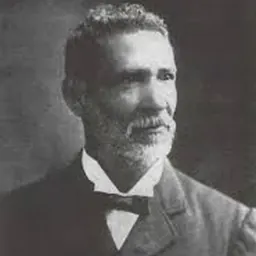
There is no known photograph of Homer Plessy, though a photograph of P. B. S. Pinchback, a former governor of Louisiana, has been misattributed as Plessy.
Plessy v. Ferguson
Orchestrating a test case A placard marks the place in New Orleans where Chris C. Cain arrested Homer Plessy on June 7, 1892.
In 1890, the State of Louisiana passed the Separate Car Act, which required separate accommodation for black and white people on railroads, including separate railway cars. A group of 18 prominent black, creole of color, and white creole New Orleans residents formed the Comité des Citoyens (Committee of Citizens) to challenge the law. Many staff members of The New Orleans Crusader, a black Republican newspaper, were among the group's members, including publisher Louis A. Martinet, writer Rodolphe Desdunes, and managing editor L. J. Joubert, who served as president of the Justice, Protective, Educational, and Social Club at the same time Plessy was vice president.
The group contacted attorney and civil rights advocate Albion W. Tourgée, who agreed to help them bring a test case to court in order to force the judiciary to determine the constitutionality of Jim Crow laws. In his correspondence with Martinet, Tourgée suggested finding a plaintiff who had "not more than one-eight colored blood" and could pass as white. The attorney hoped that by selecting a person of ambiguous racial identity, he might exploit the Louisiana legislature's failure to define race and to force the court to consider the inconclusiveness of scientific evidence on definitive racial categories.
Tourgée also suggested finding a female plaintiff, because he believed the courts might be more sympathetic to a woman being ejected from a railroad car. However, the Comité des Citoyens instead recruited musician Daniel Desdunes, the son of group member Rodolphe Desdunes. Martinet contacted several railroad companies to inform them of the group's intentions. The railroads overwhelmingly opposed the Separate Car Act because it raised their operating costs by forcing them to use additional cars that might only be at half capacity. Some companies enforced the law, while others did not. Martinet eventually enlisted the Louisville and Nashville Railroad Company to participate in the group's plan. On February 24, 1892, Daniel Desdunes purchased a first-class ticket on a train bound for Mobile, Alabama. After he sat in a "whites only" car, the conductor stopped the train, and a private detective hired by the Comité des Citoyens arrested Desdunes. The prosecution dropped their case against Desdunes in May 1892, however, after the Louisiana State Supreme Court ruled that the Separate Car Act did not apply to interstate railroad trips. Martinet contacted the East Louisiana Railroad, one of the companies that opposed the law, and declared their intentions to stage an act of civil disobedience. He also hired the services of private detective Chris C. Cain to arrest Plessy and ensure that he was charged with violating the Separate Car Act and not with a misdemeanor such as disturbing the peace.
On June 7, 1892, Plessy bought a first-class ticket on the East Louisiana Railroad running between the Press Street Depot in New Orleans and Covington, Louisiana, an approximately 30-mile journey that would have taken two hours. When conductor J. J. Dowling, who was also in on the staged act, came to collect Plessy's ticket, he told Plessy to leave the "whites only" car. The Court also rejected Tourgée's argument that segregation laws marked black Americans with "a badge of inferiority," and said that racial prejudice could not be overcome by legislation.
Brown's opinion ended with a note on the subject of Plessy's racial identity under the law. He wrote that while the question of whether Plessy was legally black or white may have bearing on the outcome of the criminal case, legal definitions of racial categories were an issue of state law not before the U.S. Supreme Court. Ultimately, Brown deferred to Louisiana law to determine whether Plessy was legally black or white.
Later life
After the Supreme Court ruling, Plessy's criminal trial went ahead in Ferguson's court in Louisiana on February 11, 1897.
The shoemaking profession declined in the late 19th and early 20th centuries due to large-scale industrial production, so Plessy later took jobs as a laborer, warehouseman, clerk, and insurance premium collector for the black-owned People's Life Insurance Company. in New Orleans. His obituary read: "Homer Plessy — on Sunday, March 1, 1925, at 5:10 a.m. beloved husband of Louise Bordenave." He was interred in the Debergue-Blanco family tomb in Saint Louis Cemetery No. 1 in New Orleans, Louisiana. Though the Plessy case did not involve education, it formed the legal basis of separate school systems for the following fifty-eight years.
In 2009, Keith Plessy and Phoebe Ferguson, relatives of Plessy and Ferguson, respectively, created the Plessy and Ferguson Foundation for Education and Reconciliation. The foundation placed a historical marker at the corner of Press and Royal Streets in New Orleans, near the site of Homer Plessy's arrest. A portion of Press Street was renamed after Plessy in 2018.
On January 5, 2022, Louisiana governor John Bel Edwards granted Plessy a posthumous pardon. The pardon was issued in accordance with the 2006 Avery C. Alexander Act, which was passed by the Louisiana Legislature to expedite the pardon process for individuals who were criminalized and convicted under Louisiana laws created for the purpose of maintaining or enforcing racial separation or discrimination of individuals.
Don’t just read it —
keep it.
Full-length biographies made to live with: read them, listen on the way to work, watch them tonight.
- E-book
- Audio
- Video
Instant download · yours to keep · every purchase keeps this site free
Important facts
People in Homer Plessy's life
Named in this biography and alive at the same time


Related people
Same field, nearest in time




Contemporaries
People whose lives overlapped Homer Plessy's




Frequently asked questions
Who was Homer Plessy?
American activist (1863–1925)
When was Homer Plessy born?
Homer Plessy was born in 1862 in New Orleans.
When did Homer Plessy die?
Homer Plessy died on 1 March 1925 in New Orleans.
What was Homer Plessy's occupation?
Homer Plessy was a cobbler.
What nationality was Homer Plessy?
Homer Plessy was American.
Sources & further reading
Cite this page
APA: Biography.guide. (2026). Homer Plessy. https://biography.guide/homer-plessy/
MLA: "Homer Plessy." Biography.guide, https://biography.guide/homer-plessy/.
Chicago: "Homer Plessy." Biography.guide. https://biography.guide/homer-plessy/.
Data last updated: 2026-09-20 · Spot an error? Report a correction.
Page generated 2026-09-27 04:57 UTC