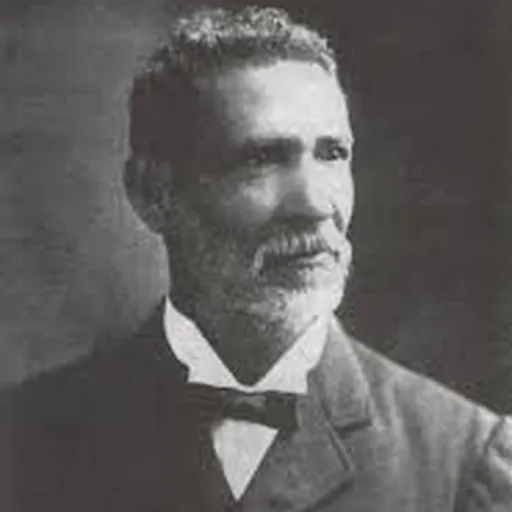
About Rodolphe Desdunes
Lived 1849 – 1928 (aged 78). Rodolphe Desdunes was an American poet and historian.
Rodolphe Lucien Desdunes (; November 15, 1849 – August 14, 1928) was a Louisiana Creole civil rights activist, poet, historian, journalist, and customs officer primarily active in New Orleans, Louisiana.
In Louisiana, Desdunes served as a militiaman during the Reconstruction era and fought in the Battle of Liberty Place. Later, he was a member of L'Union Louisianaise and wrote for the weekly of the same name. He also wrote for the daily paper, the Crusader, and taught at the Couvent School in New Orleans.
In 1890, Desdunes was among the founders of the Comité des Citoyens, which fought the 1890 Separate Car Act through legal challenges, leading to the US Supreme Court Case, Plessy vs Ferguson (1896). He also wrote an important French-language history of Creoles in America called Nos Hommes et Notre Histoire, the first such book written in French by a member of the Louisiana Creoles of Color.
Later in life he moved to Omaha, Nebraska, where his son Daniel had settled.
Life
Rodolphe Lucien Desdunes was born November 15, 1849, as one of at least five children of Pierre Jérémie Desdunes and Henriette Angélique (Sonty) Gaillard; siblings were Pierre Aristide, Joseph, Elmore, and Sarazin.
Their father, Pierre, lived in New Orleans at least as early as 1840 and was probably born in the city. The Desdunes family were Saint Dominican Creole refugees who fled from Saint-Domingue (now Haiti) during the 1791 Haitian Revolution, at which time they gained asylum in New Orleans. Rodolphe's education was likely provided by family and family friends Armand Lanusse and Joanni Questy, as well as at the Couvent School.
Rodolphe's brother Pierre Aristide also became involved in civil rights as an adult. By profession, he was a poet, a cigar maker, a carpenter, and owner of a tobacco plantation. He fought in the American Civil War. He served on the board of directors of the Couvent School, which had been created by Marie Couvent in 1848. In 1873 Aristide married Louise Mathilde Denebourg.
Rodolphe married Mathilde Cheval, and they lived for some time with her mother, also named Mathilde. Before 1880, they had children Daniel (born in about 1873), Agnes (about 1873), Louise (about 1874), Coritza (born in 1876), and Wendelle (born winter 1876-1877). The Chevals may have descended from early Cheval settlers of the Tremé district, Pierre and Léandre.
In 1879, Rodolphe started a relationship with Clementine Walker, born in 1860 and a daughter of John and Ophelia Walker. Rodolphe and Clementine had at least four children, Mary Celine (March 25, 1879), John Alexander (1881), Louise (1889), and Oscar Alphonse (1892). Clementine died on September 23, 1893. Mary Celine later became known as Mamie Desdunes and was a blues pianist. Clementine lived near Jelly Roll Morton's godmother, and Jérémie and Henriette Desdunes were neighbors of Morton's mother. From this proximity, Morton learned the song he recorded as "Mamie's Blues" or "2:19 Blues" and attributed it to Mamie, singing, "Can’t give a dollar, give a lousy dime,/ I wanna feed that hungry man of mine." Other associates of Mamie included performer Bunk Johnson and promoters Hattie Rogers and Lulu White. Mamie married George Degay in 1898, and died of tuberculosis on December 4, 1911.
Oscar was also a musician. After his nephew Clarence's death in 1933, Oscar played with his band, the Joyland Revellers.
Rodolphe had three other daughters, possibly by Clementine, named Edna, Lucille, and Jeanne (born about 1893).
The "Louisiana Outrages", as illustrated in Harper's Weekly, 1874. Clash between the (racially integrated) Police and the (segregationist) White League on Canal Street
Militia In the early 1870s during Reconstruction, Desdunes was a member of the New Orleans Police Department. In 1874, under the command of former Confederate General and then adjutant general of the Louisiana Militia James Longstreet, Desdunes was among the injured in the Battle of Liberty Place, fought between the pro-Republican city, state, and federal forces, and a pro-Democratic, largely ex-Confederate group called the White League.
Political and civil service Desdunes began to attend law courses at Straight University in the early 1870s.
Desdunes was appointed in 1879 as secretary of the parish vice committee upon the resignation of Charles A. Baquie., was an active member of the Odd Fellows, and translated rituals of his lodge, La Creole, into French. Also, he was a member of Lodge Amité Sincere No. 27. He was a frequent contributor to Republican politics. In 1892, he was a speaker in a Louisiana Republican organizational rally, calling on blacks to support more moderate candidates with strong Louisiana ties. In 1897, Desdunes's activity included the support of Louisiana State Senator Henry Demas, denouncing lynching, calling for more schools, opposing the poll tax, and denouncing the constitutional convention, which he felt sought to deprive black suffrage. He was a member of the Republican Committee until 1900. In 1891 Desdunes was appointed chief clerk of the sub treasury in New Orleans.
In 1908, as a part of his Customs department duties, Desdunes was supervising the weighing of cargo on a ship when granite dust blew into his eyes, blinding him. He retired the following year and moved to Omaha, Nebraska, to live with his son, Daniel, who was a musician and activist there.
In 1884, Rodolphe and his brother, Aristide, as well as Paul Trévigne, Arthur Estèves, and Louis André Martinet, as a part of a group called L'Union Louisiannais, reopened the Couvent School. Both Desdunes brothers served on the board of directors and Rodolphe also taught. In 1887, a French-language weekly paper was produced in New Orleans under the same name (L'Union Louisiannais) with Eugene Lucy (president), Homer Plessy (Vice President), Rodolphe Desdunes (recording secretary and solicitor), Pierre Chevalier (treasurer), and O. Bart (solicitor). In 1889, Martinet formed the Republican newspaper, the Crusader, and Desdunes was a frequent contributor. Publishing in both French and English, the Crusader took up the civil rights cause.
Desdunes was a part of the American Citizens' Equal Rights Association of Louisiana in 1890, protesting to the state assembly against legislation that imposed second-class status on blacks. He also wrote for other papers in Louisiana, such as the Business Herald in Donaldsonville in 1904.
Comité des Citoyens Desdunes was incensed by the 1890 Separate Car Act, writing in an 1891 letter to the editor in the Crusader, "Among the many schemes devised by the Southern statesman to divide the races, none is so audacious and so insulting as the one which provides separate cars for black and white people on the railroads running through the state. It is like a slap in the face of every member of the black race, whether he has the full measure or only one-eighth of that blood." Aristide, Rodolphe and Daniel Desdunes, Louis Martinet, Eugene Luscy, Paul Bonseigneur, L. J. Joubert, P. B. S. Pinchback, Caesar Antoine, Homer Plessy and others formed the Comité des Citoyens to organize black civil rights efforts. Rodolphe enlisted his eldest son, Daniel, to violate the act to allow for its challenge in the courts. On February 24, 1892, Daniel boarded a train bound for Mobile, Alabama. While stopped at the corner of Elysian Fields and Claiborne in New Orleans, Daniel was arrested. However, Judge John Howard Ferguson ruled that the Separate Car Act could not be enforced for interstate travel because the US Constitution granted the federal government the authority to regulate only interstate travel and commerce.
The Comité then challenged the law again, this time focusing on intrastate travel, and Plessy volunteered to break the law. When the case, Plessy vs. Ferguson, finally reached the U. S. Supreme Court in 1896, it was found that Plessy's rights had not been violated, Desdunes writing, "our defeat sanctioned the odious principle of the segregation of the races." The Comité des Citoyens activists Albion Tourgee and James C. Walker defended in both cases. About that time, both the Comité and the Crusader disbanded.
Desdunes was very interested in the history and art of Creoles in Louisiana. From July through October 1895, Desdunes published translated excerpts from Joseph Saint-Rémy’s five volume work, Pétion et Haïti, for the New Orleans Crusader.
In Omaha, he continued to work on his poetry, submitting his work to various outlets. He also became close to others in the Omaha black community, particularly Father John Albert Williams, who praised Desdunes as "Omaha's Blind Negro Poet" in the Omaha World-Herald. His poems in the Herald included praise for black soldiers serving in World War I, "To the French High Commission (Hommage de la population de couleur.)", and a tribute to Nebraska entitled "Aksarben, Eloge", both of which appeared in 1917.
Death He lived in his own house in Omaha with his wife, and died on August 14, 1928, of cancer of the larynx. His remains were sent to New Orleans and he was interred in a family tomb in St. Louis Cemetery No. 2.
Don’t just read it —
keep it.
Full-length biographies made to live with: read them, listen on the way to work, watch them tonight.
- E-book
- Audio
- Video
Instant download · yours to keep · every purchase keeps this site free
Important facts
People in Rodolphe Desdunes's life
Named in this biography and alive at the same time





Related people
Same field, nearest in time

Contemporaries
People whose lives overlapped Rodolphe Desdunes's



Frequently asked questions
Who was Rodolphe Desdunes?
Civil rights activist, poet, historian, journalist
When was Rodolphe Desdunes born?
Rodolphe Desdunes was born on 15 November 1849 in New Orleans.
When did Rodolphe Desdunes die?
Rodolphe Desdunes died on 14 August 1928 in Omaha.
What was Rodolphe Desdunes's occupation?
Rodolphe Desdunes was a poet and historian.
What nationality was Rodolphe Desdunes?
Rodolphe Desdunes was American.
Sources & further reading
· Wikipedia: Rodolphe Desdunes
Cite this page
APA: Biography.guide. (2026). Rodolphe Desdunes. https://biography.guide/rodolphe-desdunes/
MLA: "Rodolphe Desdunes." Biography.guide, https://biography.guide/rodolphe-desdunes/.
Chicago: "Rodolphe Desdunes." Biography.guide. https://biography.guide/rodolphe-desdunes/.
Data last updated: 2026-09-22 · Spot an error? Report a correction.
Portrait: Wikimedia Commons · author & licence
Page generated 2026-09-27 04:57 UTC