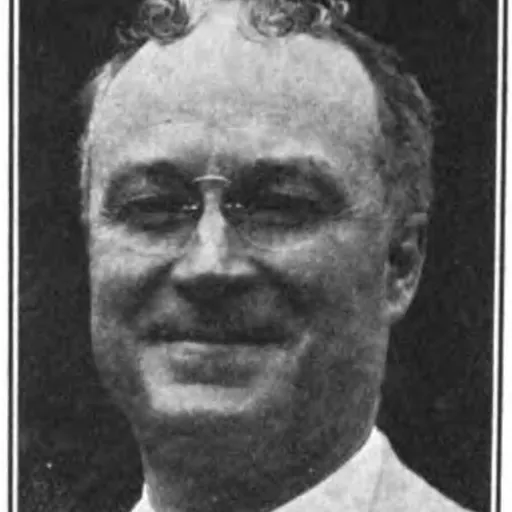
About Homer Clyde Snook
Lived 1878 – 1942 (aged 64). Homer Clyde Snook was a chemist and physicist.
Homer Clyde Snook (25 March 1878 – 23 September 1942) was an American electrical engineer and inventor. He developed the Snook apparatus, the first interrupterless device produced for X-ray work.
Life and times Homer Clyde Snook was born in 1878, at Antwerp, Ohio, to Judge Wilson H. Snook and Nancy Jane Snook (née Graves). He had 4 siblings, brothers Otto W. and Ward Hunt, and sisters Lee May and Ethel Maud. On 24 June 1903, Snook, age 24, occupation listed as science expert, form Philadelphia, married May Eusebia McKee (born 17 May 1877), age 26, occupation listed as at home, from Warren, Ohio. He was the son of Wilson H. Snook and Nannie Graves. The bride was the daughter of John McKee and Mary E. Kline. The ceremony took place at Warren, Ohio by Minister S.W. McFadden.
In 1908, Snook applied for and was issued a passport on 25 July 1908 “to go abroad temporarily;” with the intent “to return to the United States within six months”. The application was to travel alone. He listed his residence as Philadelphia with the occupation of electrical engineer. The description of applicant included: age: 30 years; stature: 5 feet inches; forehead: broad; eyes: brown; nose: straight thick; mouth: medium; chin: broad, full; hair: dark curly; complexion: fair; face: well filled broad. Snook requested that the passport be sent to 417 Mariner and Merchant Building in Philadelphia. Records indicate that Snook took at least two trips to England, where he worked with a manufacturer to have the Snook apparatus produced. In October 1908, Snook departed Liverpool, England and arrived at New York City aboard the . On 1 June 1910, Snook arrived in New York aboard the having sailed from Southampton, England.
On 12 September 1918, near the close of World War I, Homer Clyde Snook registered for the Draft at East Orange, New Jersey. He recorded his address as 45 North Arlington Avenue in East Orange, New Jersey. Snook reported his nearest relative as his wife, Mary McKee Snook at the same location. His age in years was recorded as 40 and race as white. With date of birth as March 25, 1878. He declared to be a native born U.S. citizen. His present occupation was electrical engineer and employed by the Western Electric Co. located at 463 West Street in New York, N.Y. Description of registrant was listed as medium height, stout build, brown eye color and gray hair color.
In 1942, at the start of World War II, Homer Clyde Snook registered for the Draft. His residence was recorded as 45 Woodland Avenue in Summit, New Jersey with the same mailing address. The name and address of person who will always know your address was listed as Mrs. H. Clyde Snook at the same address. His employer was recorded as self and place of employment as the same address. His age in years was 64, place of birth as Antwerp, Ohio on March 25, 1878. The draft registration card, D.S.S. Form 1, stated the requirement for who must register: “Men born on or after April 28, 1877 and on or before February 16, 1897”.
Education From 1898 to 1900, Snook taught physics at Ohio Wesleyan University. The school's catalog listed him as an assistant in physics. In 1900, Snook became a member of Phi Delta Theta. The Ohio Beta chapter at Ohio Wesleyan University listed Snook as an electrical expert at 1000 Chestnut Street in Philadelphia, Pennsylvania. In 1900, Snook graduated from Ohio Wesleyan University and received the Bachelor of Arts degree. In 1902, he graduated from Allegheny College with a Master of Arts degree. In 1910, Ohio Wesleyan University conferred the honorary degree of Master of Science on Snook.
Career From 1900 to 1901, Snook taught physics and chemistry in the high school for the Soldiers' and Sailors' Orphans Home at Xenia, Ohio. From 1901 to 1902, he was assistant professor of chemistry at Allegheny College in Meadville, Pennsylvania. He worked as a salesman and electrical expert, with the James W. Queen & Company in Philadelphia, from 1902 until 1903. In 1907, Snook manufactured the first interrupterless transformer. In 1907, Snook introduced the Snook apparatus, the first interrupterless device produced for X-ray work. The Snook apparatus was manufactured in England. the first time that sound level was measured taking into account the loudness response of the human ear (with Fletcher's and Weber's hearing curves).
In 1925 he moved to Bell Telephone Laboratories, and in 1927 became a consulting engineer. For his works into the acoustics field, he became Fellow of the Acoustical Society of America ASA in 1931.
Professional service Allegheny College, Professor of Physics and Chemistry American Association for the Advancement of Science American Institute of Electrical Engineers American Roentgen Ray Society Engineers’ Club of Philadelphia National Academy of Sciences National Research Council
Awards and honors In 1910, Ohio Wesleyan University conferred the honorary degree of Master of Science on Snook. Art of electrical signaling. U.S. Patent No. 736,884. Stereoscopic apparatus. U.S. Patent No. 758,117. Wireless telegraphy. U.S. Patent No. 768,778. Electrical measuring instrument. U.S. Patent No. 768,957.
1910s X-ray system. U.S. Patent No. 954,056. Stereoscopic apparatus. U.S. Patent No. 997,338. X-ray tube and vacuum control therefor. U.S. Patent No. 1,010,197. Fluoroscopic apparatus. U.S. Patent No. 1,117,266. Vacuum regulation. U.S. Patent No. 1,117,267. Stereoscopic x-ray system. U.S. Patent No. 1,123,942. Polyphase x-ray system. U.S. Patent No. 1,131,870. Vacuum regulation. U.S. Patent No. 1,143,327. Stereoscopic x-ray system. U.S. Patent No. 1,163,959. X-ray tube. U.S. Patent No. 1,165,138. Evacuation process. U.S. Patent No. 1,166,792. Rectifying apparatus. U.S. Patent No. 1,180,329. X-ray system. U.S. Patent No. 1,233,137. Vacuum regulation. U.S. Patent No. 1,247,027. High-tension rectifying apparatus. U.S. Patent No. 1,251,126. Vacuum regulation. U.S. Patent No. 1,267,706.
1920s Vacuum pump. U.S. Patent No. 1,434,851. Electrical cut-out. U.S. Patent No. 1,480,225. Oscillation generator. U.S. Patent No. 1,579,895. Electric ignition system. U.S. Patent No. 1,589,489. Low-impedance electric discharge device. U.S. Patent No. 1,629,009. System for converting sound waves into electrical waves. U.S. Patent No. 1,690,255.
1930s Method of casting ingots. U.S. Patent No. 1,892,044. Ingot casting method. U.S. Patent No. 1,961,399. Ingot casting apparatus. U.S. Patent No. 1,998,258. Microscopy. U.S. Patent 2,153,010.
1940s Microscopy. U.S. Patent 2,218,270.
Publications Snook, H. Clyde. (1905). An amperemeter for high potential currents. Journal of the Franklin Institute, 159(3), 191-198. Snook, H. Clyde. (1907). The secondary current of the induction coil. Journal of the Franklin Institute, 164(4), 273-283. Snook, H. Clyde. (1908). A new roentgen generator. Archives of the Roentgen Ray, 13(7), 186-188. Snook, H. Clyde. (1912). Correspondence: To the Editor of the Archives of the Roentgen Ray. Archives of the Roentgen Ray, 17(2), 82-84. Snook, H. Clyde. (1913). Some recent developments in radiography. Journal of the Franklin Institute, 175(1), 1-13. Snook, H. Clyde. (1915). New Instruments: New Hydrogen X-Ray Tube. Archives of the Roentgen Ray, 19(10), 372-373. Snook, H. Clyde. (1915). New Hydrogen X-Ray Tube. Scientific American, 79, 71-71. Snook, H. Clyde. (1925). Automobile-noise Measurement. B-140-1. Bell Telephone Laboratories. Snook, H. Clyde. (October 1925). Hearts or What Men Live By, the story of the electrical stethoscope. Bell Laboratories Record. 1(2): 1.
Don’t just read it —
keep it.
Full-length biographies made to live with: read them, listen on the way to work, watch them tonight.
- E-book
- Audio
- Video
Instant download · yours to keep · every purchase keeps this site free
Important facts
People in Homer Clyde Snook's life
Named in this biography and alive at the same time


Related people
Same field, nearest in time






Contemporaries
People whose lives overlapped Homer Clyde Snook's



Frequently asked questions
Who was Homer Clyde Snook?
American electrical engineer and inventor
When was Homer Clyde Snook born?
Homer Clyde Snook was born on 25 March 1878.
When did Homer Clyde Snook die?
Homer Clyde Snook died on 23 September 1942.
What was Homer Clyde Snook's occupation?
Homer Clyde Snook was a chemist and physicist.
Sources & further reading
· Wikipedia: Homer Clyde Snook
Cite this page
APA: Biography.guide. (2026). Homer Clyde Snook. https://biography.guide/homer-clyde-snook/
MLA: "Homer Clyde Snook." Biography.guide, https://biography.guide/homer-clyde-snook/.
Chicago: "Homer Clyde Snook." Biography.guide. https://biography.guide/homer-clyde-snook/.
Data last updated: 2026-09-20 · Spot an error? Report a correction.
Portrait: Wikimedia Commons · author & licence
Page generated 2026-09-27 04:58 UTC