
About Hisako Hibi
Lived 1907 – 1991 (aged 84). Hisako Hibi was an American painter, known for Tanforan Assembly Center and Topaz War Relocation Center.
Hisako Shimizu Hibi (May 14, 1907 – October 25, 1991) was a Japanese-born American Issei painter and printmaker. Hibi attended the California School of Fine Arts in San Francisco, California, where she garnered experience and recognition in the fine arts and community art-exhibition.
After internment, Hibi moved to New York City, where she obtained U.S. citizenship and pursued further education by enrolling in courses at the Museum of Modern Art. On June 30, 1947, Hibi's husband, George Matsusaburo, died from cancer shortly after his sixty-fifth birthday. Subsequently, Hibi returned to San Francisco, where she continued to exhibit her work in galleries, garnered recognition, and explored various alternative art styles before her eventual passing in 1991.
Early years (1907–1941) Hisako Hibi was born on May 14, 1907, in Torihama, a farming village located in the Fukui Prefecture, Japan. Hibi was born into a Buddhist family.
Following graduation, Hibi studied western-style oil painting at the California School of Fine Arts and participated in annual exhibitions at the San Francisco Art Association.
While at the school, she met fellow student and painter George Matsusaburo Hibi, who was more than twenty years her senior, and the two were married in 1930. In 1933, the couple moved first to Mount Eden, and then to Hayward, California, where they raised their children, Ibuki Hibi Lee and Satoshi Hibi. Throughout the 1930s and early 40s, Hibi exhibited with fellow artists including Elmer Bischoff, David Park, Karl Kasten, and Earle Loran, all of whom are renowned and were active in California.
Internment (1942–1945)
In 1942, over 100,000 Japanese Americans underwent mandatory displacement of life, vocation, and recreation through the Executive Order 9066. With forced removal imminent, Hibi and her husband donated their paintings to different venues in the Hayward community, to express their thanks because they couldn't bring the work with them to internment camps for the duration of World War II. The Hibi family was first moved to the Tanforan Assembly Center in May and then to a more permanent camp at Topaz, Utah in September. Photographer and friend to the Hibi family, Dorothea Lange took a snapshot on May 8, 1942 of Hibi and her daughter Ibuki as they stood next to what was left of their belongings. In this photo, Ibuki Hibi, five years old, and her mother, Hisako Hibi, hold onto dolls as they await the internment busses that transport them to the Tanforan Assembly Center.
During their internment, Japanese Americans faced restrictions on owning or using cameras, and so turned to other artistic media. Hisako Hibi, known for her artistic prowess, became involved in teaching children's art classes at both Tanforan and Topaz. Hisako Hibi, and other internment artist, Miné Okubo, found art as a means to express community discontent as well as a way to create a historical record of life in internment. Their artistic strides effectively defied government restrictions being placed around photography and camp documentation and played a crucial role in capturing these experiences.
While raising her two children in the camp, Hisako documented her experiences through her paintings, an example being Laundry Room (1944). The painting depicts how the camp bathing facilities were inadequate for the inmates, which resulted in the mothers improvising a bathing area by washing their children in the laundry room.
Postwar years (1946–1991) After the war, the Hibis relocated to New York City. When George Hibi died in 1947, Hibi took up work as a seamstress in a garment factory to support herself and her children. She later returned to school, studying under Victor D'Amico at the Museum of Modern Art, which influenced her painting style as it became increasingly abstract.
In 1953, Hibi became a U.S. citizen, taking advantage of the Immigration and Nationality Act of 1952. A year later, she moved back to San Francisco with her daughter, Ibuki Hibi Lee, while her son, Satoshi Hibi, went to Utah for college. In 1954, Hibi worked as a housekeeper for Marcell Labaudt, who directed the Lucien Labaudt Gallery. During this time, she was able to work in a studio in Labaudt's garage. under the leadership of Chiura Obata within the first month of internment. Following the Obata family's departure from the camp in 1943, Matsusaburo and Hisako Hibi assumed leadership of the Topaz Art School. The Hibis led the institution with their strong desire to bridge Eastern and Western traditions through the medium of art.
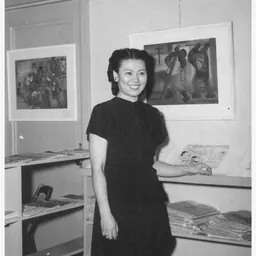
Hibi demonstrates painting at Tanforan Assembly Center (1942). The painting is entitled Barrack 9, Apt. 6, San Bruno, California.
While interned in Tanforan and Topaz, Hibi created seventy-two paintings and taught classes in drawing, painting (oil and watercolor) and sculpture to students at the Topaz Art School, which was the resumption of the Tanforan Art School. Many of her oil paintings from the camp years depict the intimate daily life of mothers at work, the cold sterility of the barracks, and images such as persimmons and New Year's rice cakes, that symbolized a nostalgia for a previous life. In 1943, she received a prize for a still life of flowers that was exhibited in a show of work made by incarcerated artists that was held at the Friends Center in Cambridge, Massachusetts. In 1985, the San Francisco Arts Commission presented Hibi with an Award of Honor, and mounted a major solo exhibition Hisako Hibi, Her Path at the Somar Gallery. She was an early member of the Asian American Women Artists Association. (November 15, 2024–August 17, 2025), the Pennsylvania Academy of the Fine Arts (October 2, 2025–January 4, 2026), Monterey Museum of Art (February 5, 2026–April 19, 2026), and Japanese American National Museum (late 2026). The accompanying catalog, Pictures of Belonging: Miki Hayakawa, Hisako Hibi, and Miné Okubo, edited by ShiPu Wang, was published in December 2023.
Legacy Hibi's memoir, Peaceful Painter: Memoirs of an Issei Woman Artist was edited by her daughter, Ibuki H. Lee, and published posthumously in 2004 by Heyday Books, along with an accompanying exhibition at the Japanese American National Museum.
Although Hibi's art has featured in many well known exhibits, such as the Smithsonian American Art Museum, much of it has been lost or displaced. A neighbor from Hayward, who stored several of the family's paintings during internment, died in 1954, depleting what is known to be left of Hibi's early works.
Don’t just read it —
keep it.
Full-length biographies made to live with: read them, listen on the way to work, watch them tonight.
- E-book
- Audio
- Video
Instant download · yours to keep · every purchase keeps this site free
Important facts
Family & relationships
People in Hisako Hibi's life
Named in this biography and alive at the same time




Related people
Same field, nearest in time


Contemporaries
People whose lives overlapped Hisako Hibi's




Frequently asked questions
Who was Hisako Hibi?
Japanese-born American painter (1907-1991)
When was Hisako Hibi born?
Hisako Hibi was born on 14 May 1907 in Japan.
When did Hisako Hibi die?
Hisako Hibi died on 25 October 1991 in San Francisco.
What was Hisako Hibi's occupation?
Hisako Hibi was a painter.
What was Hisako Hibi known for?
Hisako Hibi was known for Tanforan Assembly Center and Topaz War Relocation Center.
What nationality was Hisako Hibi?
Hisako Hibi was American.
Sources & further reading
Cite this page
APA: Biography.guide. (2026). Hisako Hibi. https://biography.guide/hisako-hibi/
MLA: "Hisako Hibi." Biography.guide, https://biography.guide/hisako-hibi/.
Chicago: "Hisako Hibi." Biography.guide. https://biography.guide/hisako-hibi/.
Data last updated: 2026-09-22 · Spot an error? Report a correction.
Page generated 2026-09-27 05:25 UTC