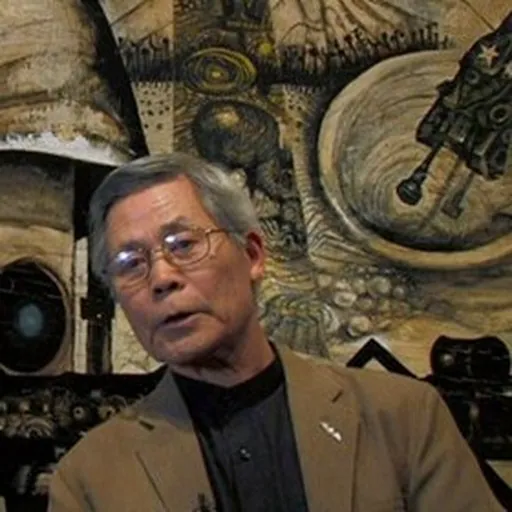
About Hiroshi Nakamura
Lived 1932 – 2026 (aged 93). Hiroshi Nakamura was a Japanese painter.
was a Japanese artist who worked in 'reportage' and surrealist styles. Nakamura attended Nihon University and was involved in many artist groups and social movements such as the Zen'ei Bijutsu-kai (Avant-garde Art Society) and the Seinen Bijutsuka Rengō. He is often associated with Reportage Painting, the movement that sought to report on the social issues that arose out of the postwar context by engaging first-hand with the local peoples and their struggles. His Suganaga No. 4 of 1955 exemplifies the concern and style of Reportage that is considered significant. As postwar reconstruction of Japan progressed, Nakamura's interest in Reportage evolved into an interrogation of the artist's role in "viewing" the fundamentals of the political and social realms. Into the 1960s, in collaboration with Kōichi Tateishi, Nakamura devised the concept of Kankō geijutsu (sightseeing art) and, as an extension, he individually developed a painting style centering around trains and female students in uniform situated in an eerie surrealistic dream-like world. Among other influences, he was inspired by Sergei Eisenstein's montage theory and Akira Kurosawa's films which contributed to his signature distortion of perspective that he developed through his career. At the age of nineteen, he left his hometown of Hamamatsu, Shizuoka prefecture and moved to Tabata, Tokyo, where he enrolled in the Asagaya School of Art and Design. After a few months, Nakamura transferred schools to Nihon University to study in the Art Department where he was introduced to the history of the Russian Revolution and the thinking of Karl Marx by fellow students. In a similar gesture toward collectivization in art, he also became involved in a painting "circle" of workers at the National Railways facility in Shinagawa. Socialist and anti-imperialist in spirit, many of Nakamura's early works of Reportage art, like "Sunagawa No.5" "Coal Storage" (1955) critiqued the U.S. military presence in Japan. Nakamura had attended the Diego Rivera exhibition at the Tokyo National Museum in 1955, whose influence may be seen in the depiction of workers in these earlier works.
"Sunagawa No.5", perhaps Nakamura's most famous painting, portrays a protest during the Sunagawa Struggle in response to the planned expansion of Tachikawa Airfield. The painting is a two-point perspective scene showing the clashing between Japanese authorities and a coalition of workers, women, buddhist monks, and other protestors. The Japanese authorities, imposing and emotionless, stream rightward from the left-most vanishing point where they confront the protesters at the center of the composition. Streaming leftward from the right-most vanishing point, the protesters are rendered in contrast to the authorities as expressive and determined. Nakamura witnessed this struggle first-hand as a protestor and twenty three-year-old student of Nihon University. The title refers to the site of the protest during the Sunagawa Struggle that Nakamura experienced, with No. 5 being short for 5-chome (the fifth block) of Sunagawa. Conscious of reportage painting's time-sensitivity in its endeavor to mobilize and educate members of the Japanese public, Nakamura completed the painting a few months after returning from the protest. In this same year Nakamura painted "The Base" and "Gunned Down," both of which depict the killing of 46 year old Naka Sakai by a U.S. soldier guarding a military base in Gunma Prefecture. This may be attributed in part to Nakamura's shifting political identity in response to developments in Japan.
Beyond Reportage In the second half of the 1950s Nakamura's work turned away from the Reportage painting toward what Doryun Chong describes as the "metaphorical and allegorical." This shift in Nakamura's work might also be described as a turn toward montage. This enabled Nakamura to explore a more individual response to social and political phenomena than the public representation of politics seen in his Reportage works.
Many social shifts were occurring in Japan at this time that contributed the new political attitude that Nakamura assumed in his paintings. These include the failure of the anti-Anpo protests in 1960, Japan's economic boom of the 1960s and 70s, and the completion of the Shinkansen coincidental to the 1964 Tokyo Olympics.
This may be demonstrated in Nakamura's trilogy, Period of War (Sensōki), Period of Peace (Heiwaki), and Upheaval (Nairanki), all painted in 1958. In the 1960s, his work took a more surrealist turn, with common motifs being cyclops-like high school girls and technologies of locomotion such as planes and trains. Works like Circular Train A (Telescope Train) (Enka ressha A [Boenkyo ressha]), 1968, showcase the exaggerated perspective of his paintings, with this well-known effect in Nakamura's painting being dubbed the "lens effect." Together they defined painting as "seeing light," the literal translation of the word "kankō" (観光), meaning "sightseeing" in Japanese. The group attempted to insert painting and performances into pedestrian, public settings. This was their Promenading-On-The-Street exhibition (Rojō hokō-ten). During the late 1960s, Nakamura developed his own theory of painting as well, understanding paintings as "tableau machines." As Justin Jesty writes, the "tableau machine" was "a concept that foregrounds the way the painted surface manufactures visual interest and instigates a process of attraction that pulls the viewer in." This school was developed with the publisher Gendai Shicho-sha in 1969.
Don’t just read it —
keep it.
Full-length biographies made to live with: read them, listen on the way to work, watch them tonight.
- E-book
- Audio
- Video
Instant download · yours to keep · every purchase keeps this site free
Important facts
People in Hiroshi Nakamura's life
Named in this biography and alive at the same time



Related people
Same field, nearest in time


Contemporaries
People whose lives overlapped Hiroshi Nakamura's


Frequently asked questions
Who was Hiroshi Nakamura?
Japanese artist
When was Hiroshi Nakamura born?
Hiroshi Nakamura was born on 20 September 1932 in Hamamatsu.
When did Hiroshi Nakamura die?
Hiroshi Nakamura died on 8 January 2026 in Tokyo.
What was Hiroshi Nakamura's occupation?
Hiroshi Nakamura was a painter.
What nationality was Hiroshi Nakamura?
Hiroshi Nakamura was Japanese.
Sources & further reading
· DBpedia: Hiroshi Nakamura (artist)
Cite this page
APA: Biography.guide. (2026). Hiroshi Nakamura. https://biography.guide/hiroshi-nakamura-painter/
MLA: "Hiroshi Nakamura." Biography.guide, https://biography.guide/hiroshi-nakamura-painter/.
Chicago: "Hiroshi Nakamura." Biography.guide. https://biography.guide/hiroshi-nakamura-painter/.
Data last updated: 2026-09-24 · Spot an error? Report a correction.
Portrait: Wikimedia Commons · author & licence
Page generated 2026-09-27 05:08 UTC