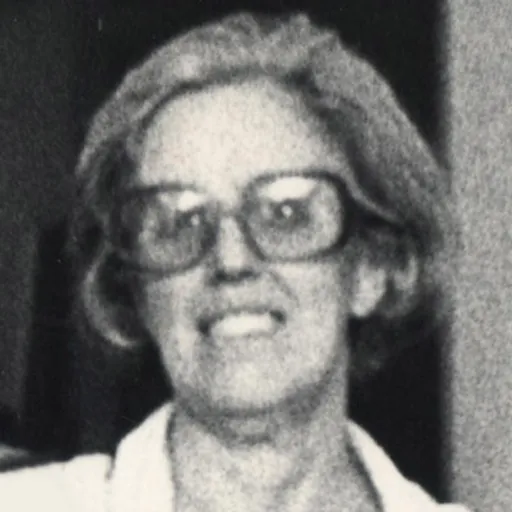
About Hilda López
Lived 1922 – 1996 (aged 73). Hilda López was an Uruguayan visual artist, painter, sculptor, draftsperson and artist.
Hilda López (27 September 1922 – 2 June 1996) was a Uruguayan painter and sculptor. She was best known for her abstract, gestural paintings and drawings from the 1960s, as well as for her political activism following the 1973 Uruguayan coup d'état. López's work first came to public attention in the 1960s after exhibitions in Montevideo and the United States, and she soon became an influential name in Uruguay's Informalism movement. López represented Uruguay in the São Paulo Art Biennial, and her work is part of the collection of the National Museum of Visual Arts in Uruguay.
Biography Hilda López was born in Montevideo on 27 September 1922. Her family settled in Mataojo, Lavalleja Department, to attend to her father's business.
In 1941, she entered the School of Plastic Arts of the Universidad del Trabajo in Montevideo, where she received painting lessons with Manuel Rosé and engraving with . In 1952, she entered the workshop of , and in 1958 she began to work with Lino Dinetto.
In 1946, she married Alberto Angenscheidt, and they had two children.
In 1960, López held her first solo exhibition at the Zaffaroni Gallery. From that moment on, she participated in numerous exhibitions and received awards for her works that became part of the country's public collections.
Spanish sculptor Jorge Oteiza's presence in Montevideo had a great influence on her work. His theories about Romero Brest's vacuum aesthetics and informalism prompted López to develop her own plastic universe.
In 1964, López traveled to Portugal accompanying an exhibition of Uruguayan artists. She remained there and had a relationship with the Portuguese painter Henriques Tavares. When the relationship ended, she returned to Montevideo.
In 1965, she provided the Uruguayan submission to the São Paulo Art Biennial. She participated in the occupation of the Municipal Subway in protest of the appointment of representatives of the Municipal Salon of Plastic Arts. In 1972, she participated in the reconstruction of Section 20 of the Communist Party in the Paso Molino neighbourhood.
In 1973, with the closure of official artistic training courses by the de facto government, López began to teach. Her workshop, as well as those of , Nelson Ramos, and Hugo Longa, persevered in difficult times and influenced the next generation of Uruguayan artists, achieving the continuity of the national artistic process during the dictatorial period. In 1986, she made a mural in stone and cement in homage to the victims of the dictatorship at the Central Headquarters of the Communist Party of Uruguay.
She died in Montevideo on 2 June 1996.
Work
The series created by the artist reflects difficult times in the life of her country. Grafías (1963) shows her dexterity and temperament in ink on paper. Retratos y Coral (1978) comprises works in oil and charcoal, portraits of friends and colleagues symbolically emblematic. Los Adioses (1978) shows abandoned suitcases that evoke the melancholy of the uprooting caused by exile. Pueblos (1981) denotes the human emptiness, and Campo (1983) the social hardships of the interior of the country. El problema principal es la pobreza (1988) rounds off a testimonial sequence of the painful period of the military dictatorship in her country.
The series, made in 1962 on large format canvases used planographic ink, filling in her creative intention through expressive gesture. The ambiguous character between figuration and abstraction recorded by her works generate evocative spaces of melancholy, uprooting, and reflection.
One of her best-known works, Autorretrato con golilla roja, made in 1978 and now part of the collection of the National Museum of Visual Arts, is defined in its expressive composition by the cutting red spot of the ruff, on the monochromatism of the figure. The symbolic climate of the work reflects the situation that her country was experiencing at that time. In the series Los Adioses and Pueblos, her informalist gestures are transformed into subtlety and line suggestion. Her work transits the border between figuration and abstraction, with a palette of coordinated colours, almost monochromatic, that alludes to oppression, jail, exile, and the fear to which Uruguayan society was subjected in times of dictatorship.
Expositions 1959: 23rd National Salon and 11th Municipal Salon 1960: Individual exhibition at Galería Zaffaroni 1961: Arcobaleno Award, Punta del Este 1961: Instituto Di Tella, Buenos Aires 1961: Pan American Union, Chicago 1962: 1st Córdoba Biennial, Argentina 1962: Algunos pintores abstractos, Center of Arts and Letters 1963: Grafías 63, Amigos del Arte, Montevideo 1963: Joint exhibit with María Freire and Amalia Nieto at the Círculo de Bellas Artes 1964: 7 artistas de Uruguay, Galería Divulgaçao, Lisbon, Portugal 1965: São Paulo Art Biennial, Brazil 1965: Galería Sudarmericana, New York 1966: Uruguayan Center of Cultural Promotion, Galería de la Ciudadela, Montevideo 1967: Galería U, Montevideo 1969: Urbanismo, Galería Portón de San Pedro, Montevideo 1976: Galería Alcali, Montevideo 1978: Retratos, Alianza Francesa, Montevideo 1979: Los Adioses, Cinemateca Uruguaya 1981: Pueblos, Galería Latina, Montevideo 1983: Campo, Galería Latina, Montevideo 1988: Retrospective at , Montevideo 1988: El problema principal es la pobreza, installation at Cinemateca Uruguaya 1991: Rostros, Rastros, Restos, Galería Latina, Montevideo
Awards Acquisition Award, 12th Municipal Salon, Montevideo (1960) Acquisition Award, 13th Municipal Salon, Montevideo (1961) Acquisition Award, 14th Municipal Salon, Montevideo (1962) Acquisition Award, 15th Municipal Salon, Montevideo (1967)
Don’t just read it —
keep it.
Full-length biographies made to live with: read them, listen on the way to work, watch them tonight.
- E-book
- Audio
- Video
Instant download · yours to keep · every purchase keeps this site free
Important facts
People in Hilda López's life
Named in this biography and alive at the same time





Related people
Same field, nearest in time




Contemporaries
People whose lives overlapped Hilda López's





Frequently asked questions
Who was Hilda López?
Uruguayan painter and sculptor (1922–1996)
When was Hilda López born?
Hilda López was born on 22 September 1922 in Montevideo.
When did Hilda López die?
Hilda López died on 2 June 1996 in Montevideo.
What was Hilda López's occupation?
Hilda López was a visual artist, painter, sculptor, draftsperson and artist.
What nationality was Hilda López?
Hilda López was Uruguayan.
Sources & further reading
Cite this page
APA: Biography.guide. (2026). Hilda López. https://biography.guide/hilda-lopez/
MLA: "Hilda López." Biography.guide, https://biography.guide/hilda-lopez/.
Chicago: "Hilda López." Biography.guide. https://biography.guide/hilda-lopez/.
Data last updated: 2026-09-22 · Spot an error? Report a correction.
Portrait: Wikimedia Commons · author & licence
Page generated 2026-09-27 05:02 UTC