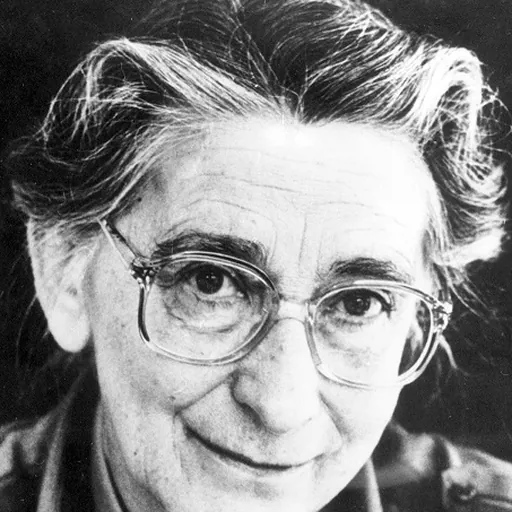
About Hetty Voûte
Lived 1918 – 1999 (aged 80). Hetty Voûte was a Dutch resistance fighter, student and dutch Resistance.
Henriëtte ("Hetty") Voûte (June 12, 1918–January 16, 1999) was a Dutch Resistance fighter who was declared Righteous Among the Nations by Yad Vashem on 24 March 1988 for her work rescuing Dutch Jewish children whose parents had been deported to Nazi concentration camps during World War II.
Under increasing scrutiny by Nazi sympathizers, she was forced to go into hiding in February 1943 for personal safety reasons, but resumed her rescue and resistance work within weeks, deeming the lives of the children she was helping as important as, or more important than her own. Arrested in June 1943 for her rescue work as a member of the Utrechts Kindercomité (Utrecht Children’s Committee or UKC), she was incarcerated, and moved from one jail to another until being transferred to the detention camp at Herzogenbusch in Vught. She was then later deported to the Ravensbrück concentration camp in Germany. Surviving until the camp was liberated, she returned home to the Netherlands, married and had children. Her siblings were: Jan Lodewijk Voûte (1904–1962), who was also known as “Lodie”; Paul Antoine Voûte (1906–1971); Jan Reinier Voûte (1908–1993); Allard Voûte (1910–1974); Nicolaas Gerard Voûte (1913–1998); and Pauline Hermine Elisabeth Voûte (1916–1979).
After completing her studies at the Stedelijk Gymnasium, she enrolled as a biology major in 1937 at Utrecht University, a state-sponsored academic institution in the Netherlands.
Her brother, Paul Voûte, M.D., a respected physician, also assisted her with her child rescue efforts during this time.
By the summer of 1942, Hetty Voûte was also actively engaged in procuring ration cards for the increasing number of Jewish children being sheltered through the UKC's support network. Among her suppliers was Menachem Pinkhof, one of the Jewish members of the Westerweel group. She then also began traveling throughout the Netherlands to secure additional cards, and built a secure supply network by convincing officials at 12 distribution centers to authorize the issuance of ration cards in conjunction with each UKC child's registration papers. By November 1942, she was in charge of the UKC’s administration, and was responsible for safeguarding the codebook which documented the names and addresses of the Jewish children being hidden by the UKC. She also escorted children to their respective safehouses and, when no hiding places were available, found temporary shelters for children in need.
As awareness built of her rescue work, Hetty Voûte came under increasing scrutiny by Dutch and Nazi officials. After nearly being arrested in February 1943, she was forced to temporarily halt her activities and go into hiding, staying with Adrie Knappert in Ommen, Overijssel immediate for several weeks until the immediate danger passed. During the summer of 1943, her luck finally ran out. When she went to the Utrecht train station to retrieve her bicycle on the evening of 12 June, she was arrested there by the Geheime Staatspolizei (the Nazi Secret State Police unit known more commonly as the Gestapo), and sent to jail. Her friend and fellow UKC collaborator, Gisela Wieberdink-Soehnlein, was then also arrested and jailed the next day.
Forced to "sit on a pile of coal for two days and two nights in the rain," said Voûte, they realized once they were finally allowed in that their living conditions would be abysmal. Required to stand for hours during the morning and evening "Appell" as prisoners names were checked against camp rosters, they were often beaten during those reviews. Assigned to a work detail at the Siemens factory, they were given only "watery soup with some cabbage in it" for lunch, "and for dinner, more soup and a piece of hard bread." At night, they slept on "hard mattresses filled with a little fetid straw" in dirty, lice-infested barracks. The conditions then deteriorated further. By 1945, as awareness dawned that Germany would lose the war, the guards stopped feeding the surviving prisoners, and ramped up their mass extermination efforts. His remains were returned to the Netherlands for interment at the General Cemetery in Noordwijk on 5 November 1962.
Her brother, Paul Antoine Voûte, M.D. (1906–1971), who had been a respected physician in The Hague at the start of World War II and was imprisoned for helping Hetty Voûte with her child rescue activities during the war, continued to practice medicine, and he and his wife Margaret were declared to be Righteous Among the Nations by Yad Vashem on 28 March 2012.
Jan Reinier Voûte (1908–1993), the third of the Voûte children, had been a lawyer with Amsterdam firm of Loeff and Van der Ploeg, Lawyers & Notaries prior to the war, went on to serve as a member of the Provincial States of North Holland from 1966 to 1980, and as a member of the Senate of the States General from 1976 to 1980. Chairman of the foundation supporting Amsterdam's Rembrandt House Museum, he also founded and chaired the Dutch-Indonesia Society, and was knighted on 21 September 1978 as an officer in the Order of Orange-Nassau.
Death Henriëtte (Hetty) Voûte died in Amsterdam, the Netherlands on 16 January 1999.
As a young girl we would enter an unknown home of unknown people. We would not mention our name, but the parents would confide their children to us....
That was 46 years ago. These children are today men and women about 50 years of age, and a number of them have played roles in the construction and defense of the state.
We would not have been able to do this alone.... Each one of these people helped in searching for addresses where children could disappear, in transporting them, and supplying ration cards....
Don’t just read it —
keep it.
Full-length biographies made to live with: read them, listen on the way to work, watch them tonight.
- E-book
- Audio
- Video
Instant download · yours to keep · every purchase keeps this site free
Important facts
People in Hetty Voûte's life
Named in this biography and alive at the same time
Related people
Same field, nearest in time




Contemporaries
People whose lives overlapped Hetty Voûte's


Frequently asked questions
Who was Hetty Voûte?
Dutch resistance fighter (1918-1999)
When was Hetty Voûte born?
Hetty Voûte was born on 12 June 1918 in Utrecht.
When did Hetty Voûte die?
Hetty Voûte died on 16 January 1999 in Amsterdam.
What was Hetty Voûte's occupation?
Hetty Voûte was a resistance fighter, student and dutch Resistance.
What nationality was Hetty Voûte?
Hetty Voûte was Dutch.
Sources & further reading
Cite this page
APA: Biography.guide. (2026). Hetty Voûte. https://biography.guide/hetty-voute/
MLA: "Hetty Voûte." Biography.guide, https://biography.guide/hetty-voute/.
Chicago: "Hetty Voûte." Biography.guide. https://biography.guide/hetty-voute/.
Data last updated: 2026-09-23 · Spot an error? Report a correction.
Portrait: Wikimedia Commons · author & licence
Page generated 2026-09-27 05:08 UTC