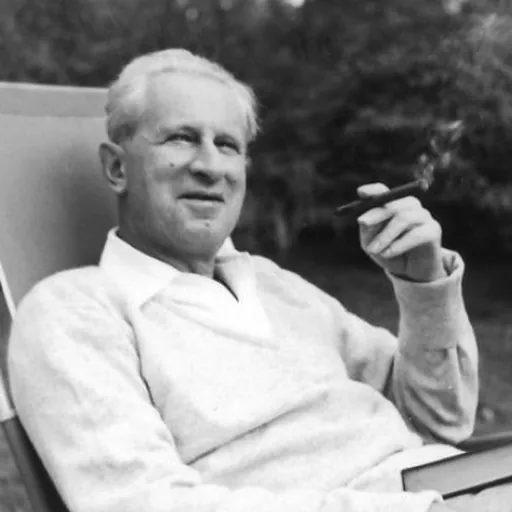
Herbert Marcuse
German philosopher, sociologist, and political theorist
About Herbert Marcuse
Lived 1898 – 1979 (aged 81). Herbert Marcuse was an American and German philosopher, sociologist, political theorist, university teacher and political scientist.
Herbert Marcuse ( ; ; July 19, 1898 – July 29, 1979) was a German and American philosopher, social critic, and political theorist, associated with the Frankfurt School of critical theory. Born in Berlin, Marcuse studied at the Friedrich Wilhelm University of Berlin and then at the University of Freiburg, where he received his PhD under the supervision of Martin Heidegger. He was a prominent figure in the Frankfurt-based Institute for Social Research, which later became known as the Frankfurt School. In his written works, he criticized capitalism, modern technology, Soviet Communism, and popular culture, arguing that they represent new forms of social control.
In the 1960s and the 1970s, he became known as the pre-eminent theorist of the New Left and the student movements of West Germany, France, and the United States; some consider him "the Father of the New Left".
The best-known works of Herbert Marcuse are Eros and Civilization (1955) and One-Dimensional Man (1964). His Marxist scholarship inspired many radical intellectuals and political activists in the 1960s and 1970s, and has from then on considerably influenced left-wing political thinking in the Western world. The name "Marcuse" itself, however, remains obscure outside of specialized contexts where critical theory is taught or referenced.
Biography Early years Herbert Marcuse was born July 19, 1898, in Berlin, to Carl Marcuse and Gertrud Kreslawsky. Marcuse's family was a German upper-middle-class Jewish family that was well integrated into German society. Marcuse moved from Berlin to the suburb of Charlottenburg, the center of West Berlin. Marcuse's formal education began at Mommsen Gymnasium and continued at the Kaiserin-Augusta Gymnasium in Charlottenburg from 1911 to 1916.
In 1919, he attended the Friedrich Wilhelm University of Berlin, taking classes for four semesters. In 1920, he transferred to the University of Freiburg to concentrate on German literature, philosophy, politics, and economics. titled Hegel's Ontology and the Theory of Historicity (Hegels Ontologie und die Theorie der Geschichtlichkeit, 1932). Written during the Hegel Renaissance across Europe, it focused on Hegel's ontology of life and history, and his idealist theory of spirit and dialectic.
Institute for Social Research In 1932, Marcuse stopped working with Heidegger, who joined the Nazi Party in 1933. Marcuse understood that he would not qualify as a professor under the Nazi regime. It was during his time at Brandeis that he wrote his most famous work, One-Dimensional Man (1964).
Marcuse was a friend and collaborator of the political sociologist Barrington Moore Jr. and of the political philosopher Robert Paul Wolff. He was also a friend of the Columbia University sociology professor C. Wright Mills, one of the founders of the New Left movement. In his "Introduction" to One-Dimensional Man, Marcuse wrote: "I should like to emphasize the vital importance of the work of C. Wright Mills."
In the post-war period, Marcuse rejected the theory of class struggle and the Marxist concern with labor, instead claiming, according to Leszek Kołakowski, that since "all questions of material existence have been solved, moral commands and prohibitions are no longer relevant." He regarded the realization of man's erotic nature as the true liberation of humanity, which inspired the utopias of Jerry Rubin and others.
Marcuse's critiques of capitalist society (especially his 1955 synthesis of Marx and Sigmund Freud in Eros and Civilization, his 1964 book One-Dimensional Man, and his 1965 essay "Repressive Tolerance") resonated with the concerns of the student movement in the 1960s because of his willingness to speak at student protests. Marcuse soon became known in the media as "Father of the New Left." Marcuse brushed the media's branding of him as "Father of the New Left" aside lightly,
Marriages
Marcuse married three times. His first wife was mathematician Sophie Wertheim (1901–1951), whom he married in 1924 and had his first son Peter with in 1928. Before emigrating to New York in 1934, they resided in Freiburg, Berlin, Geneva, and Paris. They lived in Los Angeles/Santa Monica and Washington, D.C., in the 1930s and 1940s. In 1951, Sophie Wertheim died due to cancer. Marcuse later married Inge Neumann (1914–1973), the widow of his close friend Franz Neumann (1900–1954). After his second wife Inge died in 1973, Marcuse married Erica Sherover (1938–1988), a former graduate student at the University of California, in 1976.
Children In his first marriage with Sophie Wertheim, they had one son, Peter Marcuse, born in 1928. Peter Marcuse was a professor emeritus of urban planning at Columbia University in New York. Although Marcuse did not have any children with Inge Neumann Marcuse, he helped raise her two sons, Thomas Neumann and Michael Neumann. Thomas (now Osha) is a Berkeley-based writer, activist, lawyer, and muralist. Michael works as a philosophy professor at Trent University in Peterborough, Ontario, Canada.
Marcuse's granddaughter was the novelist Irene Marcuse and his grandson, Harold Marcuse, is a professor of history at the University of California, Santa Barbara.
Death
In July 1979, Marcuse spoke at the Frankfurt Römerberggespräche in Germany. At the invitation of second-generation Frankfurt School theorist Jürgen Habermas, he was then to visit the Max Planck Institute for the Study of the Scientific-Technical World in Starnberg, where he had delivered lectures and participated in discussions from 1974 to 1979 On his way there, however, he suffered a stroke and died on July 29, 1979, ten days after his eighty-first birthday.
In 2003, after Marcuse's ashes were rediscovered in the United States, they were buried in the Dorotheenstädtischer cemetery in Berlin.
Philosophy and views
Marcuse's concept of repressive desublimation, which has become well-known, refers to his argument that postwar mass culture, with its profusion of sexual provocations, serves to reinforce political repression. If people are preoccupied with inauthentic sexual stimulation, their political energy will be "desublimated"; instead of acting constructively to change the world, they remain repressed and uncritical. Marcuse advanced the prewar thinking of critical theory toward a critical account of the "one-dimensional" nature of bourgeois life in Europe and America. His thinking has been seen as an advance of the concerns of earlier liberal critics such as David Riesman.
Two aspects of Marcuse's work are of particular importance. First, his use of language more familiar from the critique of Soviet or Nazi regimes to characterize developments in the advanced industrial world. Second, his grounding of critical theory in a particular use of psychoanalytic thought.
Marcuse's early Heideggerian Marxism During his years in Freiburg, Marcuse wrote a series of essays that explored the possibility of synthesizing Marxism and Heidegger's fundamental ontology, as begun in the latter's work Being and Time (1927). This early interest in Heidegger followed Marcuse's demand for "concrete philosophy," which, he declared in 1928, "concerns itself with the truth of contemporaneous human existence." These words were directed against the neo-Kantianism of the mainstream, and against both the revisionist and orthodox Marxist alternatives, in which the subjectivity of the individual played little role. Though Marcuse quickly distanced himself from Heidegger following Heidegger's endorsement of Nazism, thinkers such as Jürgen Habermas have suggested that an understanding of Marcuse's later thinking demands an appreciation of his early Heideggerian influence.
Marcuse and capitalism Marcuse's analysis of capitalism derives partially from one of Karl Marx's main concepts: Objectification, which under capitalism becomes alienation. Marx believed that capitalism was exploiting humans; that by producing objects of a certain character, laborers became alienated, and this ultimately dehumanized them into functional objects themselves.
Marcuse took this belief and expanded it. He argued that capitalism and industrialization pushed laborers so hard that they began to see themselves as extensions of the objects they were producing. At the beginning of One-Dimensional Man Marcuse writes, "The people recognize themselves in their commodities; they find their soul in their automobile, hi-fi set, split-level home, kitchen equipment," meaning that under capitalism (in consumer society), humans become extensions of the commodities that they buy, thus making commodities extensions of people's minds and bodies. Affluent mass technological societies, he argues, are controlled and manipulated. In societies based upon mass production and mass distribution, the individual worker has become merely a consumer of its commodities and entire commodified way of life. Modern capitalism has created false needs and false consciousness geared to the consumption of commodities: it locks one-dimensional man into the one-dimensional society which produced the need for people to recognize themselves in their commodities.
The very mechanism that ties the individual to his society has changed, and social control is anchored in the new needs that it has produced. Most important of all, the pressure of consumerism has led to the total integration of the working class into the capitalist system. Its political parties and trade unions have become thoroughly bureaucratized and the power of negative thinking or critical reflection has rapidly declined. The working class is no longer a potentially subversive force capable of bringing about revolutionary change.
Marcuse evolved a theory over the years that stated modern technology is repressive naturally. He believed that in both capitalist and communist societies, workers did not question the manner in which they lived due to the mechanism of repression of technological advances. The use of technology allowed people to not be aware of what is occurring around them such as the fact that they might soon be out of their jobs because these technologies are carrying out their same jobs quicker and cheaper. He claimed the modern-day workers were not as rebellious as before during the Karl Marx era (19th century). They just freely conformed to the system they were under for the sake of satisfying their needs and survival. Since they had conformed, the people's revolution that Marcuse felt was necessary never happened.
As a result, rather than looking to the workers as the revolutionary vanguard, Marcuse put his faith in an alliance between radical intellectuals and those groups not yet integrated into one-dimensional society: the socially marginalized, the substratum of the outcasts and outsiders, the exploited and persecuted of other ethnicities and other colors, the unemployed and the unemployable. These were the people whose standards of living demanded the ending of intolerable conditions and institutions and whose resistance to one-dimensional society would not be diverted by the system. Their opposition was revolutionary even if their consciousness was not. Angela Davis, Charles J. Moore, Abbie Hoffman, Rudi Dutschke, Germaine Greer, and Robert M. Young (see the List of Scholars and Activists link below). Among those who critiqued him from the left were Marxist-humanist Raya Dunayevskaya, fellow German emigre Paul Mattick, both of whom subjected One-Dimensional Man to a Marxist critique, and Noam Chomsky, who knew and liked Marcuse "but thought very little of his work." In his 1965 essay "Repressive Tolerance," Marcuse argues that genuine tolerance does not permit support for "repression", since doing so ensures that marginalized voices will remain unheard. He characterizes tolerance of repressive speech as "inauthentic". Instead, he advocates a form of tolerance that is intolerant of repressive (namely right-wing) political movements:
Marcuse later expressed his radical ideas through three pieces of writing. He wrote An Essay on Liberation in 1969, in which he celebrated liberation movements such as those in Vietnam, which inspired many radicals. In 1972 he wrote Counterrevolution and Revolt, which argues that the hopes of the 1960s were facing a counterrevolution from the right. In 1968, California Governor Ronald Reagan and other conservatives objected to his reappointment, but the university decided to let his contract run until 1970. He devoted the rest of his life to teaching, writing and giving lectures around the world. His efforts brought him attention from the media, which claimed that he openly advocated violence, although he often clarified that only "violence of defense" could be appropriate, not "violence of aggression." He continued to promote Marxian theory, with some of his students helping to spread his ideas. He published his final work The Aesthetic Dimension in 1977 on the role of art in the process of what he termed "emancipation" from bourgeois society. mentioning this in a Stanford lecture, "I believe the Women's Liberation Movement is perhaps the most important and potentially the most radical political movement that we have – even if the consciousness of this fact has not yet penetrated the Movement as a whole". Many themes and ambitions from Marcuse's work found embodiment in socialist feminism, especially ideas developed in Eros and Civilization. The legacy of the 1960s, of which Marcuse was a vital part, lives on, and the great refusal is still practiced by oppositional groups and individuals.
Marcuse's thought remains influential in the 21st century. In the introduction to an issue of the journal New Political Science dedicated to Marcuse, Robert Kirsch and Sarah Surak described his influence as "alive and well, vibrant across multiple fields of inquiry across many areas of social relations". Marcuse's concept of repressive tolerance attracted renewed attention following the 9/11 attacks. Repressive tolerance is also relevant to 21st-century campus protests and the Black Lives Matter movement.
Marcuse is not widely remembered outside of contexts where critical theory is taught or referenced. in English 1987. Studie über Autorität und Familie (1936) in German, republished 1987, 2005. Marcuse wrote just over 100 pages in this 900-page study. Reason and Revolution: Hegel and the Rise of Social Theory (1941) Eros and Civilization: A Philosophical Inquiry into Freud (1955) Soviet Marxism: A Critical Analysis (1958) One-Dimensional Man: Studies in the Ideology of Advanced Industrial Society (1964) A Critique of Pure Tolerance (1965) Essay "Repressive Tolerance," with additional essays by Robert Paul Wolff and Barrington Moore Jr. Negations: Essays in Critical Theory (1968) An Essay on Liberation (1969) Five Lectures (1969) Counterrevolution and Revolt (1972) The Aesthetic Dimension: Toward a Critique of Marxist Aesthetics (1978)
Essays "Neue Quellen zur Grundlegung des Historischen Materialismus" (1932) "Repressive Tolerance" (1965) "On the Problem of the Dialectic" (1976) "Protosocialism and Late Capitalism: Toward a Theoretical Synthesis Based on Bahro's Analysis" (1980)
Don’t just read it —
keep it.
Full-length biographies made to live with: read them, listen on the way to work, watch them tonight.
- E-book
- Audio
- Video
Instant download · yours to keep · every purchase keeps this site free
Important facts
People in Herbert Marcuse's life
Named in this biography and alive at the same time





Related people
Same field, nearest in time

Contemporaries
People whose lives overlapped Herbert Marcuse's



Frequently asked questions
Who was Herbert Marcuse?
German philosopher, sociologist, and political theorist (1898–1979)
When was Herbert Marcuse born?
Herbert Marcuse was born on 19 July 1898 in Berlin.
When did Herbert Marcuse die?
Herbert Marcuse died on 29 July 1979 in Starnberg.
What was Herbert Marcuse's occupation?
Herbert Marcuse was a philosopher, sociologist, political theorist, university teacher and political scientist.
What nationality was Herbert Marcuse?
Herbert Marcuse was American and German.
Sources & further reading
Cite this page
APA: Biography.guide. (2026). Herbert Marcuse. https://biography.guide/herbert-marcuse/
MLA: "Herbert Marcuse." Biography.guide, https://biography.guide/herbert-marcuse/.
Chicago: "Herbert Marcuse." Biography.guide. https://biography.guide/herbert-marcuse/.
Data last updated: 2026-09-22 · Spot an error? Report a correction.
Portrait: Wikimedia Commons · author & licence
Page generated 2026-09-27 05:03 UTC