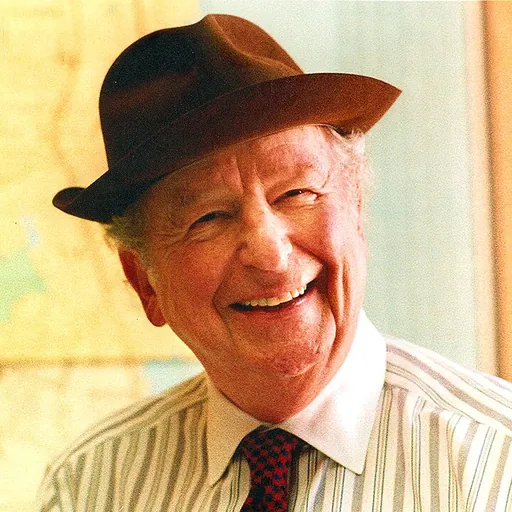
About Herb Caen
Lived 1916 – 1997 (aged 80). Herb Caen was an American journalist and columnist.
Herbert Eugene Caen (; April 3, 1916 February 1, 1997) was a San Francisco humorist and journalist whose daily column of local goings-on and insider gossip, social and political happenings, and offbeat puns and anecdotes—"A continuous love letter to San Francisco" —appeared in the San Francisco Chronicle for almost sixty years (excepting a relatively brief defection to The San Francisco Examiner) and made him a household name throughout the San Francisco Bay Area.
"The secret of Caen's success", wrote the editor of a rival publication, was:
Caen had considerable influence on popular culture, particularly its language. He coined the term beatnik in 1958 and popularized hippie during San Francisco's 1967 Summer of Love. He popularized obscureoften playfulterms such as Frisbeetarianism, and ribbed nearby Berkeley as Berserkeley for its often-radical politics.
Although Caen relied on "an army of reliable tipsters", all items were fact-checked.
"Mr. San Francisco" in his Chronicle office in the early 1990s
Now and then an item (usually a joke or pun) was credited to a mysterious "Strange de Jim", whose first contribution ("Since I didn't believe in reincarnation in any of my other lives, why should I have to believe in it in this one?") appeared in 1972. Sometimes suspected to be a Caen alter ego, de Jim (whose letters bore no return address, and who met Caen only onceby chance) was revealed after Caen's death to be a Castro District writer who, despite several coy interviews with the press, remains publicly anonymous.
Caen took special pleasure in "seeing what he could sneak by his editorshis 'naughties, such as this item about a shopper looking for a Barbie doll: Does Barbie come with Ken?' he asked the perky saleswoman. 'Actually no,' she answered slyly. 'Barbie comes with G.I. Joeshe fakes it with Ken.
On Sundays, current items were set aside in favor of "Mr. San Francisco's"
An occasional column was given over to serious matters, such as a May 1, 1960, piece on the upcoming execution of Caryl Chessman, which included Caen's recollection of witnessing a hanging as a young reporter:
On December 12, 1960, Caen wrote:
Powers received almost a hundred cards, most from the San Francisco Bay Area.
A collection of essays, Baghdad-by-the-Bay (a term he had coined to reflect San Francisco's exotic multiculturalism) was published in 1949, and Don't Call It Friscoafter a local judge's 1918 rebuke to an out-of-town petitioner ("No one refers to San Francisco by that title except people from Los Angeles")appeared in 1953. The Cable Car and the Dragon, a children's picture book, was published in 1972.
In 1993, he told an interviewer that he declined to retire because "my name wouldn't be in the paper and I wouldn't know if I was dead or alive," adding that his obituary would be his last column: "It will trail off at the end, where I fall face down on the old Royal with my nose on the 'I' key."
Honors and death
In April 1996 Caen received a special Pulitzer Prize (which he called his Pullet Surprise) for "extraordinary and continuing contribution as a voice and conscience of his city." (Fellow Chronicle columnist Art Hoppe, who had sworn an oath with Caen twenty-five years earlier not to accept a Pulitzer, released him from the oath without being asked.) The following month doctors treating him for pneumonia discovered he had inoperable lung cancer. He told his readers: "In a lightning flash I passed from the world of the well to the world of the unwell, where I hope to dwell for what I hope is a long time. The point is not to be maudlin or Pollyanna cheerful. This is serious stuff."
June 14, 1996, was officially celebrated in San Francisco as Herb Caen Day. After a motorcade and parade ending at the Ferry Building, Caen was honored by "a pantheon of the city's movers, shakers, celebrities and historical figures" including television news legend Walter Cronkite. Noting that several San Francisco mayors (sitting or retired) were at liberty to attend, Caen quipped, "Obviously, the Grand Jury hasn't been doing its job."
Among other honors a promenade along the city's historic bayfront Embarcadero was christened —a reference to what Caen called his "three-dot journalism" for the ellipses separating his column's short items. This was particularly appropriate given the recent demolition of an eyesore against which Caen had long campaigned: the elevated Embarcadero Freeway, built astride the Embarcadero forty years earlier and derided by Caen as "The Dambarcadero". A tribute was inserted in the Congressional Record.
Caen continued to write, though less frequently. He died February 1, 1997. to Aquatic Park, where his will had provided for a fireworks display—climaxed by a pyrotechnic image of the manual typewriter he had long called his "Loyal Royal".
"No other newspaper columnist ever has been so long synonymous with a specific place... Part of his appeal seemed to lie in the endless bonhomie he projected," said his New York Times obituary, comparing him to Walter Winchell "but with the malice shorn off".
Don’t just read it —
keep it.
Full-length biographies made to live with: read them, listen on the way to work, watch them tonight.
- E-book
- Audio
- Video
Instant download · yours to keep · every purchase keeps this site free
Important facts
People in Herb Caen's life
Named in this biography and alive at the same time



Related people
Same field, nearest in time


Contemporaries
People whose lives overlapped Herb Caen's



Frequently asked questions
Who was Herb Caen?
American newspaper columnist
When was Herb Caen born?
Herb Caen was born on 3 April 1916 in Sacramento.
When did Herb Caen die?
Herb Caen died on 1 February 1997 in San Francisco.
What was Herb Caen's occupation?
Herb Caen was a journalist and columnist.
What nationality was Herb Caen?
Herb Caen was American.
Sources & further reading
Cite this page
APA: Biography.guide. (2026). Herb Caen. https://biography.guide/herb-caen/
MLA: "Herb Caen." Biography.guide, https://biography.guide/herb-caen/.
Chicago: "Herb Caen." Biography.guide. https://biography.guide/herb-caen/.
Data last updated: 2026-09-22 · Spot an error? Report a correction.
Portrait: Wikimedia Commons · author & licence
Page generated 2026-09-27 04:59 UTC