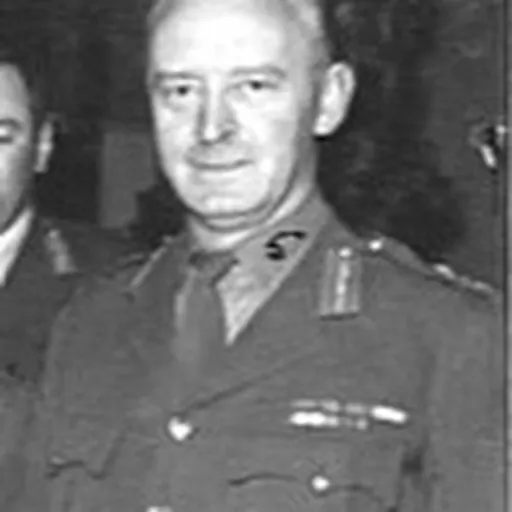
About Henry Wynter
Lived 1886 – 1945 (aged 58). Henry Wynter was an Australian military personnel.
Lieutenant General Henry Douglas Wynter, (6 June 1886 – 7 February 1945) was an Australian Army officer who rose to the rank of lieutenant general during the Second World War. Official Historian Gavin Long described him as "perhaps the clearest and most profound thinker the Australian Army of his generation had produced."
Wynter joined the Australian Army as a reservist in 1907 before becoming a regular officer in 1911. On duty in Queensland when the Great War broke out in 1914, he joined the 11th Infantry Brigade in 1916 as its brigade major. He served on a series of staff posts on the Western Front. After the war attended the Staff College, Camberley and Imperial Defence College.
Wynter's public criticism of the government's Singapore strategy led to his being reduced in rank and sent to Queensland. In 1938 he assumed command of the Army Command and Staff College. In 1940 he accepted a reduction in rank to become the Deputy Adjutant and Quartermaster General of I Corps. Wynter embarked for the Middle East in May 1940 with the advance party of I Corps but the convoy he was travelling with was diverted to the United Kingdom. He was appointed to command the AIF there, with a key role in the defence of southern England. In October 1940 his force became the nucleus of a new 9th Division, which he was appointed to command. Ill-health forced him to return to Australia, where he became Lieutenant General Administration.
Education and early life Henry Douglas Wynter was born on 5 June 1886 at Gin Gin, Queensland, the sixth surviving child of Henry Philip Walter Wynter, a sugarcane farmer, and his Maria Louisa née Maunsell. He was educated at Maryborough Grammar School, where he served in the Australian Army Cadets.
Wynter was a lieutenant of Cadets from 1 July 1906 to 2 February 1907. On 26 February 1907 he was commissioned as a second lieutenant in a Militia unit, the Wide Bay Infantry Regiment. He was promoted to lieutenant on 24 March 1908 and captain on 24 June 1909. On 1 February 1911 Wynter transferred to the Administrative and Instructional Staff of the 1st Military District (Queensland), nominally with the rank of probationary lieutenant, but he was allowed to retain his Militia rank of captain. He was promoted to captain in the Permanent Military Forces on 1 July 1913. At this time Wynter noticed his eyesight was deteriorating, and he was supplied with glasses. arriving on 20 July 1916. was awarded the Distinguished Service Order and made a Companion of the Order of St Michael and St George.
Between the wars Wynter returned to Australia, disembarking in Sydney on 19 February 1920. His AIF appointment was terminated on 18 April 1920 and he reverted to his permanent rank of major. He was entitled to retain his AIF rank as an honorary rank but would not be promoted to the substantive rank until 1 October 1931. Wynter was posted to the 4th Military District (South Australia) but his sojourn in Australia was brief. On 19 November 1920 he re-embarked for the United Kingdom to attend the Staff College, Camberley. On returning to Australia in 1923, Wynter was posted to Army Headquarters in Melbourne as a staff officer. In 1925, he became Director of Mobilisation, responsible for the development of war plans. Wynter attended the Imperial Defence College in 1930.
Parkhill lost his seat in the 1937 election and Lavarack recalled Wynter, who had been promoted to colonel on 1 July 1937, Wynter joined the Second Australian Imperial Force on 22 April 1940, and was given the AIF serial number QX6150. Up until a couple of days before it arrived, the convoy had been under the command of Brigadier Leslie Morshead of the 18th Infantry Brigade but on 18 April, Wynter discovered that the Military Board back in Australia had promoted him to major general and appointed him to command the AIF in the United Kingdom. Wynter decided that, given the immediate danger of a German invasion of the United Kingdom, his force had to be ready to fight. He therefore reorganised the troops available to form a second infantry brigade. The 18th Infantry Brigade became the Southern Command Striking Force, with a key role in the defence of southern England. However, the anticipated invasion did not eventuate.
In September Wynter was informed that his force would become the nucleus of a new 9th Division and on 23 October 1940 he was appointed to command it. Wynter and 18th Infantry Brigade departed the United Kingdom for the Middle East in November 1940. In January 1941, the medical authorities deemed him medically unfit for further duty and ordered his return to Australia for treatment. He arrived back in Sydney on 12 April 1941 and his AIF appointment was terminated on 6 July 1941.
Wynter assumed command of Eastern Command on 12 December 1941. In Blamey's reorganisation of the Army in April 1942, Wynter was appointed Lieutenant General Administration (LGA) at Allied Land Headquarters in Melbourne. As such he was in charge of all of the Army's logistical activities. His principal subordinates were the Adjutant General, Major General Victor Stantke; the Quartermaster General, Major General James Cannan; and the Master General of the Ordnance, Major General Leslie Beavis.
Suffering from high blood pressure, Wynter relinquished his post of LGA on 19 September 1944. The next day he was placed on the Supernumerary List pending retirement. He was admitted to the 115th General Hospital in Heidelberg, Victoria where he died on 7 February 1945. The medical officer listed the cause of death as uremia and hypertension. He was buried with military honours in Springvale cemetery.
Don’t just read it —
keep it.
Full-length biographies made to live with: read them, listen on the way to work, watch them tonight.
- E-book
- Audio
- Video
Instant download · yours to keep · every purchase keeps this site free
Important facts
People in Henry Wynter's life
Named in this biography and alive at the same time

Related people
Same field, nearest in time




Contemporaries
People whose lives overlapped Henry Wynter's


Frequently asked questions
Who was Henry Wynter?
Australian general (1886-1945)
When was Henry Wynter born?
Henry Wynter was born on 5 June 1886 in Gin Gin.
When did Henry Wynter die?
Henry Wynter died on 7 February 1945 in Heidelberg.
What was Henry Wynter's occupation?
Henry Wynter was a military personnel.
What nationality was Henry Wynter?
Henry Wynter was Australian.
Sources & further reading
Cite this page
APA: Biography.guide. (2026). Henry Wynter. https://biography.guide/henry-wynter/
MLA: "Henry Wynter." Biography.guide, https://biography.guide/henry-wynter/.
Chicago: "Henry Wynter." Biography.guide. https://biography.guide/henry-wynter/.
Data last updated: 2026-09-22 · Spot an error? Report a correction.
Portrait: Wikimedia Commons · author & licence
Page generated 2026-09-27 05:03 UTC