
About Henry Lipson
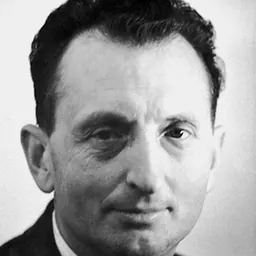
Lived 1910 – 1991 (aged 81). Henry Lipson was a British physicist and crystallographer, known for Beevers–Lipson strip and X-ray diffraction.
Henry Solomon Lipson CBE FRS (11 March 1910 – 26 April 1991) was a British physicist. He was Professor of Physics, Manchester Institute of Science and Technology, 1954–77, then professor emeritus.
Background Lipson was born in Liverpool, England, into a family of Polish Jewish immigrants. His father was a steelworker at the Shotton works in Flintshire. His mother was very insistent about the importance of education and ensured that he attended Hawarden Grammar School where he won a scholarship and exhibition to study physics at Liverpool University. He graduated with First Class Honours in 1930 and stayed on to do research at Liverpool into crystal structures using x-ray diffraction.
Lipson married Jane Rosenthal on 13 December 1937, and they raised two daughters: Ann (b. 1938), who studied physics at the University of Manchester, then became a teacher, and Judith (1943–1990), who studied metallurgy at the University of Sheffield, and died of leukaemia. In 1991 the Lipsons were on a family visit to Haifa, Israel, where their son Stephen was Professor of Physics at the Technion. Henry Lipson suffered a heart attack and died on 26 April of that year, and was buried in Haifa.
University of Cambridge In 1936, Bragg invited Lipson to move to Manchester, and he later followed Bragg in moves to Teddington and then, when Bragg became Cavendish Professor in 1937, to Cambridge.
Beevers–Lipson strips, co-invented with Arnold Beevers, at the Museum of the History of Science, Oxford, part of the Crystals special exhibition in 2014.
In practical terms, Lipson was in charge of the crystallography group in Cambridge, and took on a key role in nurturing young scientists. Whilst at the Cavendish he became convinced by contact with P. P. Ewald of the importance of the Fourier transform in X-ray crystallography.
Manchester Institute of Science and Technology He was awarded a Liverpool DSc in 1939 and a Cambridge MA in 1942, but he never really integrated into University of Cambridge life and he moved to the Manchester College of Technology (later University of Manchester Institute of Science and Technology) in 1945 as head of the physics department.
The position carried no title or status, but under his direction it quickly became a world centre for crystallographic research pioneering optical approaches to x-ray diffraction based on the Fourier transform. In 1954 he was made a professor and in 1957 he was made a Fellow of the Royal Society. Lipson was a critic of Darwinism but did not deny that species have evolved. The New Scientist quoted him as saying "I do not accept the Genesis account of creation as anything more than pleasing fantasy. My idea of creation is much subtler, but since it is not scientific (in the sense that it cannot be tested) I shall not expound it here."
Selected publications
Don’t just read it —
keep it.
Full-length biographies made to live with: read them, listen on the way to work, watch them tonight.
- E-book
- Audio
- Video
Instant download · yours to keep · every purchase keeps this site free
Important facts
People in Henry Lipson's life
Named in this biography and alive at the same time

Related people
Same field, nearest in time




Contemporaries
People whose lives overlapped Henry Lipson's






Frequently asked questions
Who was Henry Lipson?
physicist (1910–1991)
When was Henry Lipson born?
Henry Lipson was born on 11 March 1910 in Liverpool.
When did Henry Lipson die?
Henry Lipson died on 26 April 1991 in Haifa.
What was Henry Lipson's occupation?
Henry Lipson was a physicist and crystallographer.
What was Henry Lipson known for?
Henry Lipson was known for Beevers–Lipson strip and X-ray diffraction.
What nationality was Henry Lipson?
Henry Lipson was British.
Sources & further reading
Cite this page
APA: Biography.guide. (2026). Henry Lipson. https://biography.guide/henry-lipson/
MLA: "Henry Lipson." Biography.guide, https://biography.guide/henry-lipson/.
Chicago: "Henry Lipson." Biography.guide. https://biography.guide/henry-lipson/.
Data last updated: 2026-09-20 · Spot an error? Report a correction.
Page generated 2026-09-27 05:19 UTC