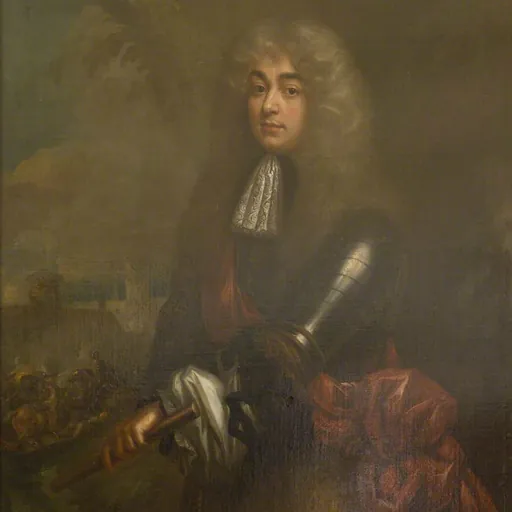
About Henry Jermyn, 1st Baron Dover
Lived 1636 – 1708 (aged 71–72). Henry Jermyn, 1st Baron Dover was a politician.
Henry Jermyn, 3rd Baron Jermyn and 1st Baron Dover, 1st Jacobite Earl of Dover PC (c. 1636 – 6 April 1708) was an English courtier, peer and favourite of James II.
Jermyn was born into a Royalist gentry family shortly before the English Civil War. During the exile of the royal family and after the Stuart Restoration in 1660, he was a member of the court of Charles II of England thanks to the influence of his powerful uncle, Henry Jermyn, 1st Earl of St Albans. At court he surpassed his uncle in reputation for profligacy and was the sometime lover of Anne Hyde, Lady Castlemaine, Lady Shrewsbury, Frances Jennings and possibly Mary, Princess Royal and Princess of Orange.
A convert to Roman Catholicism, he was a childhood friend of James, Duke of York and received many honours upon James' accession to the throne in 1685. He remained loyal to James after the Glorious Revolution in 1688 and fought as a Jacobite during the Williamite War in Ireland, but in 1690 he pledged his loyalty to William and Mary. He was referred to in the Memoirs of the Count de Grammont as "Little Jermyn" and "the favoured of Venus and the desperate duellist".
Early life and family Jermyn was the second son of Thomas Jermyn, of Rushbrooke, Suffolk, who died in 1659, and his wife Rebecca Rodway, who married secondly Henry Brouncker, 3rd Viscount Brouncker. Jermyn was raised as a Protestant within the established Church of England.
Courtier under Charles II Jermyn joined his father in exile from England after 1645. Lord St Albans, who was secretary to the Queen Dowager until her death in 1669, obtained places at the exiled royal court for his nephews, Jermyn and his elder brother Thomas. Jermyn was given a position as a page in the household of James, Duke of York, despite the strong disapproval of Charles II.
By the mid-1650s, Jermyn had gained a reputation for promiscuity and profligacy. Described as "very handomse", "very athletic, an accomplished swordsman and an enthusiastic soldier", he was also a life-long gambler. Historians generally discount these rumours, but Charles II took them seriously, and reprimanded his sister for her lack of discretion, but with no effect; Mary sharply reminded her brother that his own love affairs hardly entitled him to judge her moral conduct. Charles was especially angry because of the similar rumours that Jermyn's uncle Lord St Albans had secretly married the Queen Dowager.
Restoration of the monarchy
Jermyn was a young man, aged 24, at the time of the restoration of Charles to the throne in 1660. James appointed him his master of horse and he rode in the royal retinue at Charles' coronation on 22 April 1661, despite the disapproval of Lord Clarendon. In May 1662, he escorted Catherine of Braganza through the English Channel to Portsmouth for her marriage to the king. He recovered, but his second Giles Rawlins was killed by Howard's second Colonel Carey Dillon, later the 5th Earl of Roscommon. The cause of the dispute is said to have been the rivalry between Jermyn and Howard for the affections of Lady Shrewsbury, who was notorious for the number of her lovers. Having previously offended the king by courting his sister Mary, Jermyn proceeded to give further offence by having an affair with Lady Castlemaine, by then the chief royal mistress, and in December 1662 he was banished from court for six months. In 1667, Pepys recorded that King Charles was "jealous of Jermyn" because Lady Castlemaine was in love with him, and that she was furious with Jermyn because he was allegedly planning to marry Mary, Countess of Falmouth and Dorset (another of Charles' mistresses). As a result, following the passing of the Test Act 1673, Jermyn was forced to resign his position in James' household and was granted a conciliatory pension of £500. Jermyn hosted extravagant parties at Cheveley, especially when the royal court was attending Newmarket Racecourse, and he is known to have entertained the Duke of York and John Evelyn at the house. The new Lord Dover was able to return to court as a Gentleman of the Bedchamber to the king, where he became an ally of the Earl of Castlemaine, Ignatius White and the Earl of Tyrconnell. This group collectively influenced James to stay true to his Catholic faith in the face of growing criticism from parliament.
In May 1686, James created a troop in the Life Guards (4th Troop) specifically for Catholics and made Lord Dover its colonel. The same year James appointed him Lieutenant-General of the Royal Guard. However, rather than create a new corps of English Catholic army officers loyal to James, to help cover his gambling debts Dover sold half of the available commissions to refugee Huguenot gentlemen. On 17 August 1686, Dover was one of the first Catholics to be admitted to the Privy Council of England since the reign of Mary I. ) to the role was met with some ridicule. The same year, he was among those Catholic officials who were exempted from taking their oaths of office. While his loyalty was never in question at this stage, he was not afraid to speak his mind to James, or to disagree with him in public. Dover accompanied James when he landed in Ireland in March 1689 to launch the military effort to reclaim the throne. On 20 June 1689 he was included in the act of attainder passed by the English parliament, and ordered to give himself up by a certain day. While returning to Ireland in November 1689 on a French warship alongside Ignatius White, he narrowly escaped capture off the Isles of Scilly.
His friendship with James over, Dover resigned in June 1690 and recommended that James should make peace with William III and join the alliance against France. This only served to worsen the relationship between Dover and the deposed king. Dover petitioned Tyrconnell for a passport to leave Ireland, but Tyrconnell refused.
Later life Despite legally remaining an outlaw, in 1698 the king granted him a special licence to remain in England. Following Lady Dover's death in 1726, the Cheveley estate and several London properties were inherited by Dover's great-nephew, Sir Jermyn Davers, 4th Baronet.
Dover Street in London's Mayfair was named after Lord Dover after he participated in a development syndicate led by Sir Thomas Bond, 1st Baronet in 1683.
Don’t just read it —
keep it.
Full-length biographies made to live with: read them, listen on the way to work, watch them tonight.
- E-book
- Audio
- Video
Instant download · yours to keep · every purchase keeps this site free
Important facts
People in Henry Jermyn, 1st Baron Dover's life
Named in this biography and alive at the same time



Related people
Same field, nearest in time


Contemporaries
People whose lives overlapped Henry Jermyn, 1st Baron Dover's




Frequently asked questions
Who was Henry Jermyn, 1st Baron Dover?
English noble (1636–1708)
When was Henry Jermyn, 1st Baron Dover born?
Henry Jermyn, 1st Baron Dover was born in 1636.
When did Henry Jermyn, 1st Baron Dover die?
Henry Jermyn, 1st Baron Dover died on 6 April 1708.
What was Henry Jermyn, 1st Baron Dover's occupation?
Henry Jermyn, 1st Baron Dover was a politician.
Sources & further reading
· Wikipedia: Henry Jermyn, 1st Baron Dover
· DBpedia: Henry Jermyn, 1st Baron Dover
Cite this page
APA: Biography.guide. (2026). Henry Jermyn, 1st Baron Dover. https://biography.guide/henry-jermyn-1st-baron-dover/
MLA: "Henry Jermyn, 1st Baron Dover." Biography.guide, https://biography.guide/henry-jermyn-1st-baron-dover/.
Chicago: "Henry Jermyn, 1st Baron Dover." Biography.guide. https://biography.guide/henry-jermyn-1st-baron-dover/.
Data last updated: 2026-09-22 · Spot an error? Report a correction.
Portrait: Wikimedia Commons · author & licence
Page generated 2026-09-27 05:02 UTC