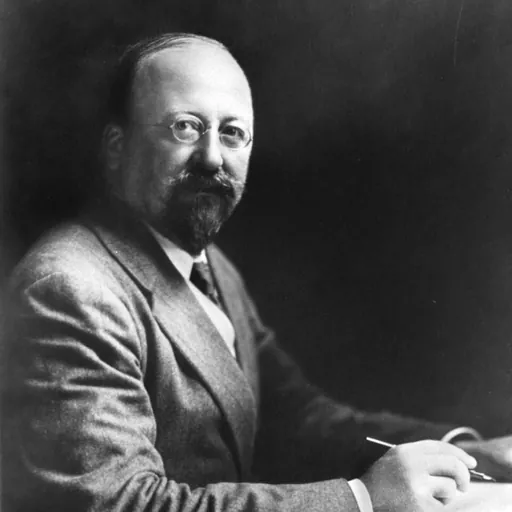
About Henry Head
Lived 1861 – 1940 (aged 79). Henry Head was a British psychiatrist, neurologist, physiologist and physician.
Sir Henry Head, FRS as the eldest son of Henry Head and his wife Hester Beck and one of eleven children. 'Harry', as he was called throughout his childhood,
Early in his childhood, Head's family moved from Stoke Newington to Stamford Hill where they inhabited a house decorated for them by William Morris. Henry had, by this time, attended two-day schools and he now enrolled as a weekly boarder at Friends' School, Grove House, Tottenham. It was here that he met his first mentor, Mr. Ashford, a master at the school. Head described Ashford as "one of the best teachers of natural science I have ever encountered." This was the man, he said, to whom he "[owed] the fact that [he] was firmly grounded in the elements of natural science at an age when boys at an ordinary school in my day were ignorant of its existence." Perhaps it is to Ashford that we owe the direction Head’s later studies took, though it is clear that Head had a natural propensity for scientific learning, even at this early age.
Looking at Head's life and the clearly scientific route that it took, it is often easy to forget that he was also to become a poet. Through his mother he had gained a love of literature and this would do much to direct his choice of acquaintances in later life when he was to become firm friends with authors (most notably to Thomas Hardy) and a mentor to the poet Siegfried Sassoon. This passion was also to initiate another, as in literature he and his future wife Ruth (a writer in her own right) were to find common ground. and decided to travel abroad once more, this time to inspect laboratories in Germany. Dissatisfied with some that he visited, he decided to travel to Prague to visit Ewald Hering. He was immediately impressed, both by the facilities and the man and indeed the feeling seems to have been mutual as Hering invited Head to stay with him at once.
While Head's main interests are clear, he never limited himself solely to one particular area of study. In his second paper on the subject of pain produced by visceral disease (Head, 1894), again based upon evidence from the hospitals he had worked in, we find him covering a wide field of medicine; considerable attention is paid to diseases of the heart and lungs. He was a general physician with a speciality in physiology, driven by experience into an interest in pain which later led him to find a neurological basis for sensation in general. While his academic interests varied and evolved, professionally he was a general physician from first to last. states that "as a teacher he had himself a wide and devoted following". His ward rounds were often crowded with students, attracted, as Brain puts it, by his "gift of exposition, enthusiasm, and sense of the dramatic." He endeared people to him with mannerisms which Sherrington states to have been "very symbols of him." One example of Head's confidence and unflappability occurred when he was listening to a female patient's heart. Without warning the patient threw her arms around the doctor and kissed him. Without hesitation, Head turned to his students, telling them calmly that this was "typical, gentlemen, typical". and his poetry also gives considerable insight into Head's great desire for a child of his own. In his poem "Long Ago I used to Pray", for example, he takes on the perspective of a woman yearning for 'the fierce joy of motherhood' and presents a sympathetic view of her plight. Head's deeply personal poems also could be said to suggest that Ruth had at some point been pregnant (maybe more than once ) and perhaps even to term.
Whatever the case, it is clear that nature was unkind to them but Ruth remained optimistic, stating that this had been more than compensated for by the part he had played in her life.
From these investigations, Head and Campbell made two important discoveries. Firstly, they demonstrated the cutaneous distribution in man of each afferent root, a valuable aid to the localisation of diseases of the spinal cord and its roots. Secondly, they revealed the mechanism of 'referred pain' so often associated with visceral disease.
What they found was that many herpetic areas representing the peripheral distribution of single roots or individual sections of the cord, corresponded closely with areas of referred pain from diseases of different internal organs. This led Head to conclude that irradiation of abnormal afferent impulses produces a state of excessive irritability in the grey matter of the dorsal horn at the level which they enter it. As a result of this, impulses from the skin that pass through it are exaggerated or disordered so that a stimulus that would not usually provoke a painful reaction does so. After Rivers's premature death in 1922, Head adopted the mentoring role that he had once occupied, comforting a distraught Sassoon with remembrances of their friend and reassurances that nothing mattered except life. It was Sassoon who suggested that the Heads go to live in Dorset as a neighbour of their mutual friend Thomas Hardy. but through the force of his personality and the lasting remembrance of his courage, he left a legacy to humanity:
(Died of His Wounds, Henry Head, 1918)
Don’t just read it —
keep it.
Full-length biographies made to live with: read them, listen on the way to work, watch them tonight.
- E-book
- Audio
- Video
Instant download · yours to keep · every purchase keeps this site free
Important facts
Family & relationships
People in Henry Head's life
Named in this biography and alive at the same time



Related people
Same field, nearest in time



Contemporaries
People whose lives overlapped Henry Head's



Frequently asked questions
Who was Henry Head?
British neurologist (1861–1940)
When was Henry Head born?
Henry Head was born on 4 August 1861 in Stoke Newington.
When did Henry Head die?
Henry Head died on 8 October 1940 in Reading.
What was Henry Head's occupation?
Henry Head was a psychiatrist, neurologist, physiologist and physician.
What nationality was Henry Head?
Henry Head was British.
Sources & further reading
Cite this page
APA: Biography.guide. (2026). Henry Head. https://biography.guide/henry-head/
MLA: "Henry Head." Biography.guide, https://biography.guide/henry-head/.
Chicago: "Henry Head." Biography.guide. https://biography.guide/henry-head/.
Data last updated: 2026-09-23 · Spot an error? Report a correction.
Portrait: Wikimedia Commons · author & licence
Page generated 2026-09-27 05:05 UTC