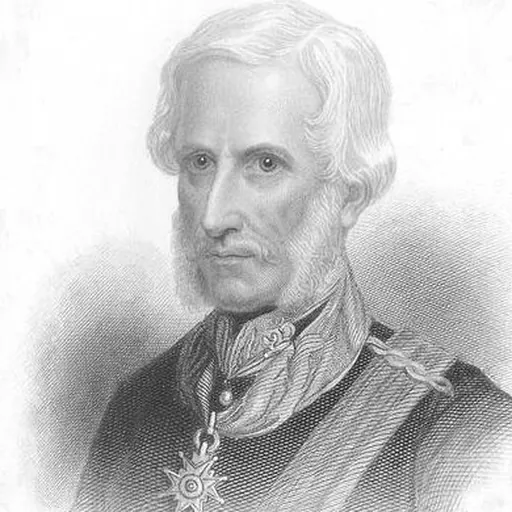
About Henry Havelock
Lived 1795 – 1857 (aged 62). Henry Havelock was a British military officer.
Major-General Sir Henry Havelock (5 April 1795 – 24 November 1857) was a British general who is particularly associated with India and his recapture of Cawnpore during the Indian Rebellion of 1857.
Early life Henry Havelock was born at Ford Hall, Bishopwearmouth (now in Sunderland), the son of William Havelock, a wealthy shipbuilder, and Jane, daughter of John Carter, solicitor, of Stockton-on-Tees. He was the second of four brothers, all of whom entered the army. The family moved to Ingress Park, Greenhithe, Kent, when Henry was still a child, and here his mother died in 1811. From January 1800 until August 1804 Henry attended Dartford Grammar School as a parlour boarder with the Master, Rev John Bradley, after which he was placed with his elder brother in the boarding-house of Dr. Raine, headmaster of Charterhouse School until he was 17. Among his contemporaries at Charterhouse were Connop Thirlwall, George Grote, William Hale, Julius Hare, and William Norris (Recorder of Penang), the last two being his special friends. Shortly after leaving Charterhouse his father lost his fortune by unsuccessful speculation, sold Ingress Hall, and removed to Clifton. Before embarkation he studied the Persian and Hindustani languages with success under John Borthwick Gilchrist. During the voyage a brother officer, Lieutenant James Gardner, awakened in Havelock religious convictions which had slumbered since his mother's death, but henceforth became the guiding principle of his life.
First Afghan War Engraving of General Havelock from 1886 book True Stories of the Reign of Queen Victoria by Cornelius Brown. By the time Havelock took part in the First Anglo-Afghan War in 1839, he had been promoted to the rank of captain. He was present as aide-de-camp to Willoughby Cotton at the capture of Ghazni, on 23 May 1839, and at the occupation of Kabul. After a short period in Bengal to secure the publication of his Memoirs of the Afghan Campaign, he returned to Kabul in charge of recruits, and became interpreter to General William George Keith Elphinstone.
Indian Rebellion of 1857–1859
In that year, he was selected by Sir James Outram to command a division in the Anglo-Persian War, during which he was present at the action of Muhamra against the forces of Nasser al-Din Shah under command of Khanlar Mirza. Peace with Persia freed his troops just as the Indian Rebellion broke out; and he was chosen to command a column to quell disturbances in Allahabad, to support Sir Henry Lawrence at Lucknow and Wheeler at Cawnpore, and to pursue and utterly destroy all mutineers and insurgents.
Trafalgar Square statue
There is a statue of Havelock (by William Behnes) in Trafalgar Square, London. The plaque on the plinth reads:
In 2000, there was a controversy when the then mayor of London, Ken Livingstone suggested that the Trafalgar Square statue, together with that of General Charles James Napier, be replaced with "more relevant" figures.
Mowbray Park statue
William Behnes also designed the statue of Havelock at the top of Building Hill in Mowbray Park, Sunderland. Two cannon (replicas of cannon presented to Sunderland after the Crimean War in 1857) stand beside the statue, facing north commanding the view over the park. The statue, however, looks west towards Havelock's birthplace. The inscription reads: "Born 5. April 1795 at Ford Hall Bishopwearmouth Died 24. November 1857 at Dil-Koosa Lucknow".
Other Havelock MRT station and Havelock Road along Singapore River, Singapore Havelock Island (now Swaraj Dweep) in the Andaman Islands was also named in his honour. Several public Houses in England are named "The General Havelock": The Haydon Bridge pub sign bears his portrait, as does the East Sleekburn one; in addition, there is a road/street called Havelock Mews next to the latter. Havelock Road in Luton is claimed to be named after him. The road appears on The 1887 1st edition and 1901 2nd edition OS maps Havelock Guest House in Jersey. The New Zealand towns of Havelock, on the South Island, and Havelock North, on the North Island, are named after him. The Ontario town of Havelock is named after him. Havelock Parish, New Brunswick and the community of Havelock, New Brunswick. Havelock Road in Southall, London, was to be renamed Guru Nanak Road in 2021. Havelock, North Carolina, a city in coastal North Carolina The town of Havelock, Nebraska, which was incorporated in 1893 but was later annexed by the City of Lincoln, was named after him. The former area of the town is still known today as the Havelock neighborhood in Lincoln. Havelock Street in Sunnyside, San Francisco, California established in 1880. The "Havelock Grand March", sanctioned for a performance by the band of the Scots Fusilier Guards at Windsor, was composed in his memory.
In fiction Havelock, referred to as Gravedigger Havelock, appears as a character in several of the Flashman novels by George MacDonald Fraser - Flashman, Flashman and the Mountain of Light and Flashman in the Great Game. He is portrayed as a very competent officer and an exceptionally religious man.
Published works
Don’t just read it —
keep it.
Full-length biographies made to live with: read them, listen on the way to work, watch them tonight.
- E-book
- Audio
- Video
Instant download · yours to keep · every purchase keeps this site free
Important facts
People in Henry Havelock's life
Named in this biography and alive at the same time




Related people
Same field, nearest in time
Contemporaries
People whose lives overlapped Henry Havelock's





Frequently asked questions
Who was Henry Havelock?
British Army general (1795–1857)
When was Henry Havelock born?
Henry Havelock was born on 5 April 1795 in Bishopwearmouth.
When did Henry Havelock die?
Henry Havelock died on 24 November 1857 in Alambagh.
What was Henry Havelock's occupation?
Henry Havelock was a military officer.
What nationality was Henry Havelock?
Henry Havelock was British.
Sources & further reading
Cite this page
APA: Biography.guide. (2026). Henry Havelock. https://biography.guide/henry-havelock/
MLA: "Henry Havelock." Biography.guide, https://biography.guide/henry-havelock/.
Chicago: "Henry Havelock." Biography.guide. https://biography.guide/henry-havelock/.
Data last updated: 2026-09-21 · Spot an error? Report a correction.
Portrait: Wikimedia Commons · author & licence
Page generated 2026-09-27 04:58 UTC