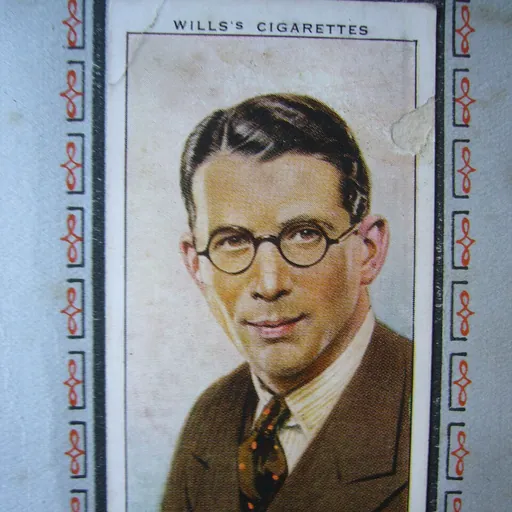
About Henry Hall
Lived 1898 – 1989 (aged 91). Henry Hall was a British bandleader, conductor, composer, actor and music arranger.
Henry Robert Hall (2 May 1898 – 28 October 1989) was an English bandleader who performed regularly on BBC Radio during the British dance band era of the 1920s and 1930s, through to the 1960s.
Early life and career Henry Hall was born in Peckham, South London, England. Henry and Margery had two children during their marriage, Mike and Betty.
In June 1924, on the opening night of the Gleneagles Hotel, Hall persuaded the BBC to broadcast the event on radio, At 5.15pm each weekday, Hall's radio programme from Broadcasting House gathered a huge following across the nation. His signature tune was "It's Just the Time for Dancing", and he usually concluded with his own composition "Here's to the Next Time".
In 1932 he recorded the songs "Hush, Hush, Hush, Here Comes the Bogeyman" and "Teddy Bears' Picnic" with his BBC Orchestra, featuring singer Val Rosing on vocals. During the same year he directed "The BBC Dance Orchestra".
In 1937, the BBC Dance Orchestra played at the opening of the Gaumont State Cinema in Kilburn, London.
Later years During the Second World War, Hall played for the troops, and gave concerts and shows in factories all over Britain. Many of these concerts came in the form of "Guest Night" broadcasts. From June to November, 1943, "Guest Night" was replaced by "Henry Hall's Rhythm Entertainment" intended to provide radio entertainment for troops overseas.
After the war he developed his show business interests, becoming something of an agent and producer. A blue plaque commemorates Hall at 38 Harman Drive in Cricklewood, London, where he lived between 1932 and 1959.
Popular culture Hall unknowingly lent his name to a work shift at Frickley Colliery in South Yorkshire. Miners at the colliery who worked the unpopular night shift referred to the shift as Henry Hall's shift or simply Henry's, as the shift began at 6pm, the same time as Hall started his show on the radio. When he died, the local football club Frickley Athletic, who had close ties with the colliery, marked the occasion in their matchday programme with a page, dedicated to Hall, entitled "No More Henry's".
The song "Home" by Henry Hall and His Gleneagles Hotel Band is used in the 1980 Stanley Kubrick film The Shining as well as in its sequel from 2019, Doctor Sleep, directed by Mike Flanagan.The song was remastered by Keith Gooden and Geoff Milne in room 517 at Decca in London and is available on the release, ” And The Bands Played On” ( Cat: DDV5001/2)
Don’t just read it —
keep it.
Full-length biographies made to live with: read them, listen on the way to work, watch them tonight.
- E-book
- Audio
- Video
Instant download · yours to keep · every purchase keeps this site free
Important facts
People in Henry Hall's life
Named in this biography and alive at the same time


Related people
Same field, nearest in time


Contemporaries
People whose lives overlapped Henry Hall's




Frequently asked questions
Who was Henry Hall?
British composer (1898-1989)
When was Henry Hall born?
Henry Hall was born on 2 May 1898 in Peckham.
When did Henry Hall die?
Henry Hall died on 28 October 1989 in Eastbourne.
What was Henry Hall's occupation?
Henry Hall was a bandleader, conductor, composer, actor and music arranger.
What nationality was Henry Hall?
Henry Hall was British.
Sources & further reading
· DBpedia: Henry Hall (bandleader)
Cite this page
APA: Biography.guide. (2026). Henry Hall. https://biography.guide/henry-hall-bandleader/
MLA: "Henry Hall." Biography.guide, https://biography.guide/henry-hall-bandleader/.
Chicago: "Henry Hall." Biography.guide. https://biography.guide/henry-hall-bandleader/.
Data last updated: 2026-09-21 · Spot an error? Report a correction.
Portrait: Wikimedia Commons · author & licence
Page generated 2026-09-27 04:59 UTC