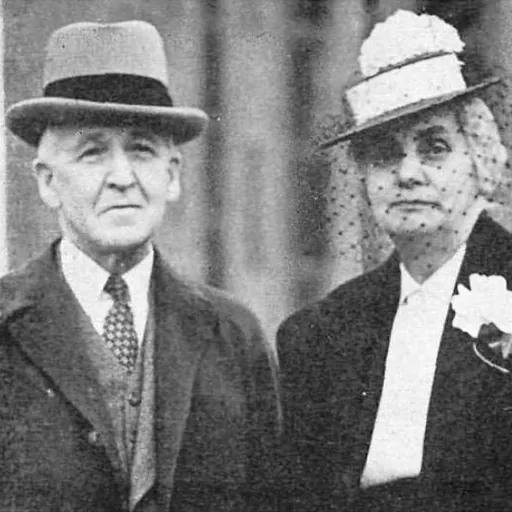
About Henry H. Blood
Lived 1872 – 1942 (aged 69). Henry H. Blood was an American politician and governor.
Henry Hooper Blood (October 1, 1872 – June 19, 1942) was an American businessman and the seventh governor of Utah.
Biography Henry was born to William Hooper Blood, a farmer and city councilman, and Jane Wilkie Hooper. Blood was known for putting his state on a "pay as you go" basis. He has been compared to Calvin Coolidge because of his commitment to the economy, but the difference between them was that Blood was a dedicated Democrat and a faithful follower of the New Deal. He served two terms starting in 1933 and ending in 1941. He won his second term in 1936 against Herbert B. Maw, a liberal Democrat, Ray E. Dillman, a Republican, and Ogden Mayor Harman, an independent progressive. His time in office was during an extremely hard time for the United States because of the depression. In 1937 Blood approved many bills to be passed but warned about the future cost of retirement funds, vocational and adult education programs, and a junior college in Price which is now the College of Eastern Utah. The depression hit Utah pretty hard leaving it struggling as one of the top states for citizen's relief. The situation got even worse in 1934 when Utah had its worst recorded drought in history. Utahns were left without food, clothing, shelter, and employment. Hundreds of letters from Utahns were sent to Governor Blood's office every day.
Road to recovery By instituting new programs, decreasing state employees' wages, and slashing state departments' size, Blood began his long journey to economic recovery. In addition, he supported and followed President Roosevelt's New Deal. Programs such as Public Works Administration, Home Owners Loan Association, and more helped support Utah. The results of these programs were public buildings and irrigation, which provided relief and employment.
Notable occurrences While Blood was governor Utah became the thirty-sixth state to ratify the twenty-first amendment ending Prohibition. He was the first governor to occupy the governor's mansion donated by the Kearns family to the state in 1937. In 1939 he vetoed the proposals for junior colleges in Richfield and Roosevelt, as well as low-income housing, while cautioning about the expense. Also he worked to improve Utah's horrible highway safety record.
Final years Blood accepted a call to serve as a mission president in California for the LDS Church in January 1941. He died in Salt Lake City in 1942 from a cerebral hemorrhage.
Don’t just read it —
keep it.
Full-length biographies made to live with: read them, listen on the way to work, watch them tonight.
- E-book
- Audio
- Video
Instant download · yours to keep · every purchase keeps this site free
Important facts
People in Henry H. Blood's life
Named in this biography and alive at the same time


Related people
Same field, nearest in time





Contemporaries
People whose lives overlapped Henry H. Blood's
Frequently asked questions
Who was Henry H. Blood?
Governor of Utah (1872-1942)
When was Henry H. Blood born?
Henry H. Blood was born on 1 October 1872 in Kaysville.
When did Henry H. Blood die?
Henry H. Blood died on 19 June 1942 in Salt Lake City.
What was Henry H. Blood's occupation?
Henry H. Blood was a politician and governor.
What nationality was Henry H. Blood?
Henry H. Blood was American.
Sources & further reading
Cite this page
APA: Biography.guide. (2026). Henry H. Blood. https://biography.guide/henry-h-blood/
MLA: "Henry H. Blood." Biography.guide, https://biography.guide/henry-h-blood/.
Chicago: "Henry H. Blood." Biography.guide. https://biography.guide/henry-h-blood/.
Data last updated: 2026-09-22 · Spot an error? Report a correction.
Portrait: Wikimedia Commons · author & licence
Page generated 2026-09-27 05:03 UTC