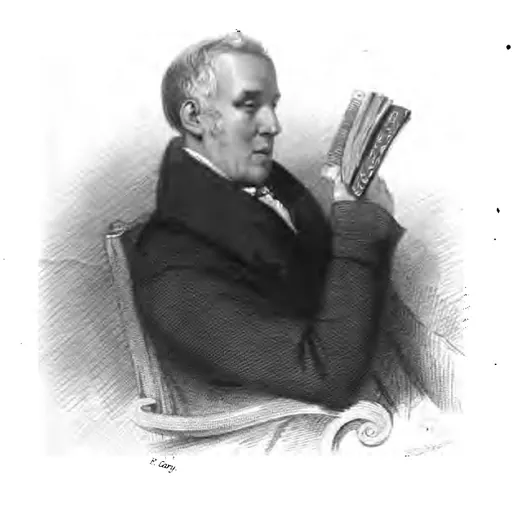
About Henry Francis Cary
Lived 1772 – 1844 (aged 71). Henry Francis Cary was a British linguist, translator, writer, philologist and cleric, known for Blank verse.
The Reverend Henry Francis Cary (6 December 1772 – 14 August 1844) was a British author and translator, best known for his blank verse translation of The Divine Comedy of Dante.
Biography Henry Francis Cary was born in Gibraltar, on 6 December 1772. He was the eldest son of Henrietta Brocas and William Cary. Henrietta was the daughter of Theophilus Brocas, Dean of Killala and William, at the time, was a captain of the First Regiment of Foot. His grandfather, Henry Cary was archdeacon, and his great grandfather, Mordecai Cary, bishop of that diocese.
He was educated at Rugby School and at the grammar schools of Sutton Coldfield and Birmingham, as well as at Christ Church, Oxford, which he entered in 1790 and studied French and Italian literature. While at school he regularly contributed to the Gentleman's Magazine, and published a volume of Sonnets and Odes. He took holy orders and in 1797 and became vicar of Abbots Bromley in Staffordshire. He held this benefice until his death. In 1800 he also became vicar of Kingsbury in Warwickshire.
At Christ Church he studied French and Italian literature, his command of which is evidenced in his notes to his translation of Dante. The version of the Inferno was published in 1805 together with the original text.
Cary moved to London in 1808, where he became reader at the Berkeley Chapel and subsequently, lecturer at Chiswick and curate of the Savoy Chapel. His version of the whole Divina Commedia in blank verse appeared in 1814. It was published at Cary's own expense, the publisher refusing to undertake the risk, since the publication of the Inferno in 1805 had been a failure.
The translation was brought to the notice of Samuel Rogers by Thomas Moore. Rogers made some additions to an article on it by Ugo Foscolo in the Edinburgh Review. This article, and praise bestowed on the work by Coleridge in a lecture at the Royal Institution, led to a general acknowledgment of its merit. Cary's Dante gradually took its place among standard works, passing through four editions in his lifetime.
In 1826, he was appointed assistant-librarian at the reading room of the British Museum, a post he held for about eleven years.
In 1833, Cary was granted six months' leave of absence because of illness and travelled with his manservant and his son, Francis, to Italy visiting Amiens, Paris, Lyons, Aix, Nice, Mentone, Genoa, Pisa, Florence, Sienna, Rome (a month), Naples, Bologna, Verona, Venice (a month), Innsbruck, Munich, Nuremberg, Frankfurt, Cologne, Rotterdam, The Hague, Amsterdam, Brussels, Ghent, and Bruges.
His friend Charles Lamb was a regular visitor at his workplace. On 10 May 1834, Lamb wrote,
In 1824, Cary published a translation of The Birds of Aristophanes, and, about 1834, he published his translation of the Odes of Pindar. He resigned from the museum because the appointment of keeper of the printed books, which should have been his in the ordinary course of promotion, was refused to him when it fell vacant. In 1841 a crown pension of £200 a year, obtained through the efforts of Samuel Rogers, was conferred on him.
Cary's Lives of the early French Poets, and Lives of English Poets (from Samuel Johnson to Henry Kirke White), intended as a continuation of Johnson's Lives of the Poets, were published in collected form in 1846. He died in Charlotte St., St. George's, Bloomsbury, London, in 1844 and was buried in Poets' Corner, Westminster Abbey.
A memoir was published by his son, Judge Henry Cary, in 1847. Another son, Francis Stephen Cary, became a well-known art teacher, succeeding Henry Sass as the head of his art academy in London.
Don’t just read it —
keep it.
Full-length biographies made to live with: read them, listen on the way to work, watch them tonight.
- E-book
- Audio
- Video
Instant download · yours to keep · every purchase keeps this site free
Important facts
Family & relationships
People in Henry Francis Cary's life
Named in this biography and alive at the same time




Related people
Same field, nearest in time




Contemporaries
People whose lives overlapped Henry Francis Cary's




Frequently asked questions
Who was Henry Francis Cary?
Gibraltarian translator (1772-1844)
When was Henry Francis Cary born?
Henry Francis Cary was born on 6 December 1772 in Gibraltar.
When did Henry Francis Cary die?
Henry Francis Cary died on 14 August 1844 in London.
What was Henry Francis Cary's occupation?
Henry Francis Cary was a linguist, translator, writer, philologist and cleric.
What was Henry Francis Cary known for?
Henry Francis Cary was known for Blank verse.
What nationality was Henry Francis Cary?
Henry Francis Cary was British.
Sources & further reading
· Wikipedia: Henry Francis Cary
Cite this page
APA: Biography.guide. (2026). Henry Francis Cary. https://biography.guide/henry-francis-cary/
MLA: "Henry Francis Cary." Biography.guide, https://biography.guide/henry-francis-cary/.
Chicago: "Henry Francis Cary." Biography.guide. https://biography.guide/henry-francis-cary/.
Data last updated: 2026-09-23 · Spot an error? Report a correction.
Portrait: Wikimedia Commons · author & licence
Page generated 2026-09-27 05:06 UTC