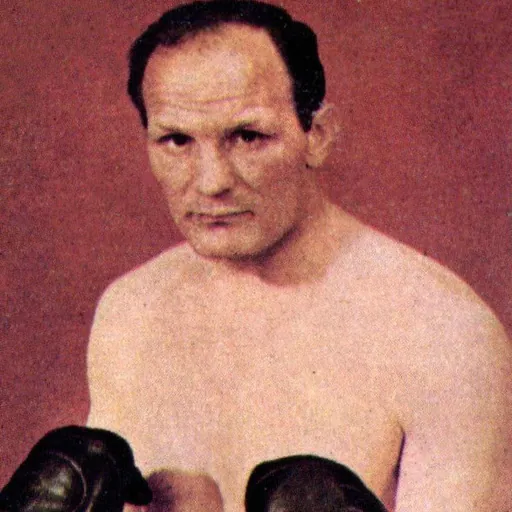
About Henry Cooper
Lived 1934 – 2011 (aged 76). Henry Cooper was a British boxer.
Sir Henry Cooper (3 May 19341 May 2011) was a British professional boxer. He was undefeated in British and Commonwealth heavyweight championship contests for twelve years and held the European heavyweight title for three years. In a 1963 fight against Cassius Clay (later known as Muhammad Ali), he famously knocked Clay down in round 4, before the fight was stopped by the referee, Tommy Little, in round 5 because of a cut to Cooper's left eye.
In 1966 he fought Ali for a second time. Ali was now world heavyweight champion. However, Cooper again lost by TKO. Cooper was twice voted BBC Sports Personality of the Year and, after retiring in 1971 following a controversial loss to Joe Bugner, remained a popular public figure. He is the only British boxer to have been awarded a knighthood.
Early life
Cooper was born on Thursday, 3 May 1934 in Lambeth, London and elder brother Bern, Cooper started his boxing career in 1949, as an amateur with the Bellingham Boxing Club based at Athelney St School in Bellingham, which had been founded and was run by Albert Colley, and won seventy-three of eighty-four contests. At the age of seventeen he won the first of two ABA light-heavyweight titles before National Service in the Royal Army Ordnance Corps as Private Service Number 22486464.
1952 Olympics Cooper represented Great Britain as a light heavyweight boxer at the 1952 Helsinki Olympics. His results were: Round of 32-bye, Round of 16-lost to Anatoly Perov (Soviet Union) by decision, 1–2.
Professional boxing career
Style Although Cooper was left-handed, he used the "orthodox" stance, with his strongest (left) hand and foot forward, rather than the reversed "southpaw" stance more usually adopted by a left-handed boxer. Opponents were thus hit hardest with punches which Cooper could throw from his front hand, closest to the opponent. At its most effective, his hook - dubbed "Enry's 'Ammer" ("Henry's hammer") - had an upward uppercut-like trajectory. A formidable left jab, from which he could hook quickly, completed his offensive repertoire. While cut-prone and no great defensive technician, Cooper compensated by forcing the action in his bouts. After developing a left shoulder problem in the latter half of his career, he adjusted to put more power on right-handed punches.
British and Commonwealth Champion For Cooper 1959 was a banner year: he took the British and Commonwealth titles from Brian London in 15 rounds and received the last 9-carat gold Lonsdale Belt after successful defences against Dick Richardson (KO 5), Joe Erskine (TKO 5, TKO 12, and TKO 9), and Johnny Prescott (RTD 10). Another points win over London brought an offer to fight Floyd Patterson for his world heavyweight title, but this was turned down by Cooper (or Wicks). Subsequently, a spare pair of gloves was always required at ringside. On the 40th anniversary of the fight, Ali telephoned Cooper to reminisce.
In 1966 Cooper fought Ali for the heavyweight championship, for a second time at Arsenal Stadium, Highbury. However, Ali was now alert to the danger posed by Cooper's left and more cautious than he had been in the previous contest; he held Cooper in a vice-like grip during clinches, and when told to break leapt backward several feet. Cooper announced his retirement shortly afterwards. Cooper refused to speak to Gibbs for many years but eventually agreed to shake his hand while they were at a charity event.
Opinion on modern boxers In Cooper's later years, he retired from commentary on the sport as he became "disillusioned with boxing", wanting "straight, hard and fast boxing that he was used to from his times." While acknowledging that he was from a different era and would not be fighting as a heavyweight today, Cooper was nonetheless critical of the trend for heavyweights to bulk up as he thought it made for one-paced and less entertaining contests. In his final year, he said that he did not think boxing was "as good as it was", naming Joe Calzaghe, Ricky Hatton, and Amir Khan as "the best of their era", but asserting that "if you match them up with the champions of thirty or forty years ago I don't think they're as good".
Life outside boxing In the 1960s Cooper appeared in several public information films concerning road safety, promoting the use of zebra crossings: such as "The Story of Elsie Billing". After his retirement from boxing, he maintained a public profile with appearances in the BBC quiz show A Question of Sport and various advertisements, most famously in those for Brut aftershave. He appeared as boxer John Gully in the 1975 film Royal Flash and in his latter years featured in a series of UK public service announcements urging vulnerable groups to go to their doctors for vaccination against influenza called Get your Jab in First!
Cooper became a "Name" at Lloyd's of London, but in the 1990s he was reportedly one of those who suffered enormous personal losses because of the unlimited liability which a "Name" was then responsible for, being forced to sell his Lonsdale belts.
Awards and honours Cooper was the first to win the BBC Sports Personality of the Year award twice, in 1967 for going unbeaten and in 1970, when Cooper had become the British, Commonwealth, and European heavyweight champion. He is the only British boxer to win three Lonsdale Belts outright.
Cooper was appointed an Officer of the Order of the British Empire (OBE) in the 1969 New Year Honours for services to boxing, awarded a Papal Knighthood in 1978, and was knighted in the 2000 New Year Honours, again for services to boxing. He is also celebrated as one of the great Londoners in the "London Song" by Ray Davies on his 1998 album The Storyteller. He was the subject of This Is Your Life in 1970 when he was surprised by Eamonn Andrews at Thames Television's Euston Road Studios.
Professional boxing record
Don’t just read it —
keep it.
Full-length biographies made to live with: read them, listen on the way to work, watch them tonight.
- E-book
- Audio
- Video
Instant download · yours to keep · every purchase keeps this site free
Important facts
People in Henry Cooper's life
Named in this biography and alive at the same time


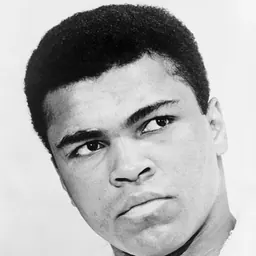


Related people
Same field, nearest in time

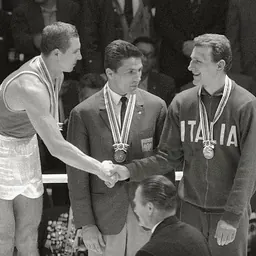


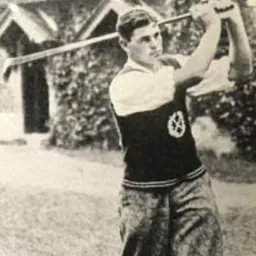
Contemporaries
People whose lives overlapped Henry Cooper's





Frequently asked questions
Who was Henry Cooper?
British boxer (1934–2011)
When was Henry Cooper born?
Henry Cooper was born on 3 May 1934 in London.
When did Henry Cooper die?
Henry Cooper died on 1 May 2011 in Limpsfield.
What was Henry Cooper's occupation?
Henry Cooper was a boxer.
What nationality was Henry Cooper?
Henry Cooper was British.
Sources & further reading
Cite this page
APA: Biography.guide. (2026). Henry Cooper. https://biography.guide/henry-cooper-boxer/
MLA: "Henry Cooper." Biography.guide, https://biography.guide/henry-cooper-boxer/.
Chicago: "Henry Cooper." Biography.guide. https://biography.guide/henry-cooper-boxer/.
Data last updated: 2026-09-22 · Spot an error? Report a correction.
Portrait: Wikimedia Commons · author & licence
Page generated 2026-09-27 05:03 UTC