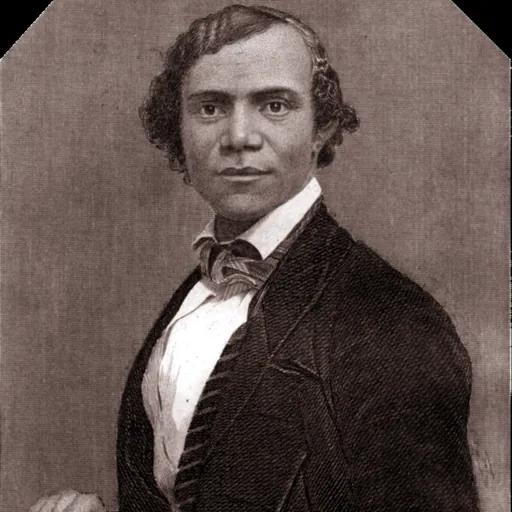
About Henry Bibb
Lived 1815 – 1854 (aged 39). Henry Bibb was an American writer and abolitionist.
Henry Walton Bibb (May 10, 1815– August 1, 1854), was an American author and abolitionist who was born into slavery. Bibb told his life story in his Narrative of the Life and Adventures of Henry Bibb, An American Slave, which included many failed escape attempts followed finally by success when he escaped to Detroit. After leaving Detroit to move to Canada with his family, due to issues with the legality of his assistance in the Underground Railroad, he founded the abolitionist newspaper, Voice of the Fugitive. He lived in Canada until his death.
Biography Bibb was born on May 19, 1816, to an enslaved woman, Mildred Jackson, on a Shelby County, Kentucky plantation. a relative of George M. Bibb, a Kentucky state senator. Williard Greenwood, a slaveholder, sold his six siblings away to different buyers. Bibb was hired out by his father for his wages. After wishing to learn to read the Bible he received some education at a school operated by Miss Davis, until the school was shut down by locals. He was taught to read and write by Monroe.
The passage of the Fugitive Slave Act of 1850 increased the danger to Bibb and his second wife, Mary E. Miles. The act made it illegal to help escaped slaves. To ensure their safety, the Bibbs migrated with his mother to Canada and settled in Sandwich, Upper Canada, now Windsor, Ontario. In 1851, he set up the first black newspaper in Canada, The Voice of the Fugitive. The paper helped develop a more sympathetic climate for blacks in Canada as well as helped new arrivals to adjust.
Henry and Mary E. Bibb were huge supporters of Canadian emigration and together they managed the Refugee Home Society, which they helped found in 1851 with Josiah Henson. Mary established a school for children.
Due to his fame as an author, Bibb was reunited with three of his brothers, who separately had also escaped from slavery to Canada. In 1852, he published their accounts in his newspaper. His cause of death was listed as congestion of the brain. The abolishment of slavery in Canada was finalized on that date in 1833, and the date was (and is) considered a national holiday.
Concern of being accused of exaggeration In the last chapter of Bibb's narrative he expresses the fear that he will be accused of exaggerating his story. He clarified that none of his stories were exaggerated, and slavery is not something that could be exaggerated, because it was the peak of dread.
Appendix of The Life and Adventures of Henry Bibb The appendix functions as a bibliography. In the appendix, Bibb includes letters as well as excerpts from the Voice of the Fugitive.
Letter from Henry Bibb to James G. Birney, written February 25, 1845 Bibb writes to James G. Birney, an abolitionist who accused Bibb of not being truthful in his narrative. Bibb explains, in short, that he was telling the truth in his narrative, and that he appreciated Birney's honest review of his work. He acknowledged that his imperfect recollection of dates led Birney and others to believe he was not being honest. He told his intention of proving his honesty.
Henry Bibb's letters to his old master Henry Bibb wrote two letters to Albert G. Sibley. One letter was written on September 23, 1852, and when he did not receive a response he wrote another letter on October 7 of that same year.
In the first letter Bibb tells Sibley that he is not a real Christian. Bibb also informs Sibley that his siblings which escaped from Sibley's plantation are now free with him in Canada. Bibb continues the letter addressing all of the horrendous acts associated with enslaving people, which go against the word of God.
In the second letter, after Sibley neglected to respond to the first, Bibb continued to call to attention that in order for Sibley to be a real Christian, he had to stop slaveholding. Bibb countered the common slaveholder idea (that freed slaves could not care for themselves) with the fact that slaves cared for themselves, their masters, and the plantation they lived on. Bibb ends the letter by stating that if Sibley tries to contest that anything he said happened, he will provide validation. Bibb then left a note at the bottom of the letter, which let Sibley know that if he continued to ignore his letters he would continue to send more.
Don’t just read it —
keep it.
Full-length biographies made to live with: read them, listen on the way to work, watch them tonight.
- E-book
- Audio
- Video
Instant download · yours to keep · every purchase keeps this site free
Important facts
People in Henry Bibb's life
Named in this biography and alive at the same time


Related people
Same field, nearest in time


Contemporaries
People whose lives overlapped Henry Bibb's



Frequently asked questions
Who was Henry Bibb?
American writer and abolitionist (1815–1854)
When was Henry Bibb born?
Henry Bibb was born on 10 May 1815 in Shelby County.
When did Henry Bibb die?
Henry Bibb died on 1 August 1854 in Windsor.
What was Henry Bibb's occupation?
Henry Bibb was a writer and abolitionist.
What nationality was Henry Bibb?
Henry Bibb was American.
Sources & further reading
Cite this page
APA: Biography.guide. (2026). Henry Bibb. https://biography.guide/henry-bibb/
MLA: "Henry Bibb." Biography.guide, https://biography.guide/henry-bibb/.
Chicago: "Henry Bibb." Biography.guide. https://biography.guide/henry-bibb/.
Data last updated: 2026-09-22 · Spot an error? Report a correction.
Portrait: Wikimedia Commons · author & licence
Page generated 2026-09-27 05:02 UTC