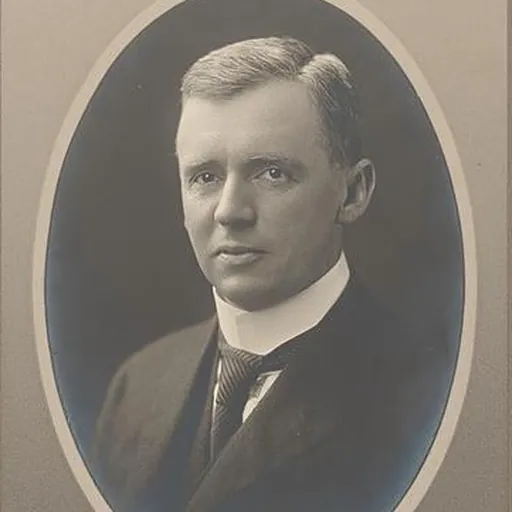
About Henry Barwell
Lived 1877 – 1959 (aged 82). Henry Barwell was an Australian politician.
Sir Henry Newman Barwell KCMG (26 February 187730 September 1959) was the 28th premier of South Australia.
Early life Born in Adelaide, South Australia, Barwell was educated at St Peter's College and the University of Adelaide, graduating in law. Admitted to the bar in 1899, Barwell built a successful legal practice where he specialised in defending murder suspects and became a prominent figure in the Adelaide Establishment. In 1902, he married Anne Webb in Clare, South Australia and together they had one son and three daughters.
Political career Barwell entered the South Australian House of Assembly in 1915 as the Liberal Union member for the seat of Stanley. In parliament he quickly became known both as an uncompromising conservative and as a likely future premier. He defended the restricted franchise of the South Australian Legislative Council, arguing that the Labor Party should not be allowed to gain control "over the capital that employs labor, and over the superior intellect that governs that labor".
In 1917, Barwell was made Attorney-General of South Australia and Minister for Industry in Archibald Peake's cabinet and was forced to deal with the deteriorating relationship between the urban and rural constituencies of the Liberal Union, which worsened with the creation of the Country Party in 1919, taking many of the Liberal Union's supporters with it. Peake died soon after and Barwell became Premier of South Australia on 8 April 1920. Despite voter antipathy against Barwell over his abrasive and sometimes tactless political style, the Liberal Union was nonetheless returned to office at the 1921 election, with Barwell retaining the Premiership.
Never one to shy away from controversy, Barwell publicly advocated the importation of coloured labour into tropical Australia, contrary to the White Australia Policy which at the time had almost unanimous support. Barwell argued that northern Australia had proven unsuitable for white settlement and only the large scale importation of "selected Asiatics working as coolie labour under indenture to white men" would help develop the region as they were the only race suited to such conditions. This was heresy for many Australians, particularly those in the opposition Labor Party, for which the White Australia Policy was historically a central plank in their policy platform. Labor politicians treated Barwell with undisguised contempt for the rest of his career, referring to him as "Black Barwell".
Barwell's decisiveness was evident during his premiership when he addressed the state of the South Australian Railways, which by 1922 had decayed to the point of imminent total collapse, endangering state finances. He forced the funding of a £5 million rehabilitation program through parliament and recruited a brilliant American railroad executive, William Alfred Webb, to lead it. He strongly supported Webb in applying business operating principles to the railways' operations. However, although the South Australian Railways was better prepared than most to meet the huge logistical demands of World War 2, the huge investment did not make the railways profitable – mainly because of the impacts of the Great Depression and the growth in ownership of motor cars. One long-remembered legacy of his premiership, however, was the nicknaming of a fleet of railcars, delivered during his reforms, as "Barwell's Bulls".
In 1922 Barwell announced the "South Australian Farm Apprenticeship Scheme", which undertook the ambitious target of arranging the immigration of 6000 young men and boys from England to cover the 6000 South Australian World War I casualties. He travelled to England to personally oversee the recruitment of what became known as the "Barwell Boys".
Barwell lost the 1924 election to the John Gunn led Labor Party
After the completion of his term as Agent General, Barwell remained in London, entering into various business interests, before eventually returning to Adelaide in 1940, where he unsuccessfully stood for pre-selection in his old seat of Stanley. Growing increasingly deaf, Barwell served as Deputy Chairman of the South Australian Housing Trust for fifteen years until his death in 1959 from cerebrovascular disease.
Don’t just read it —
keep it.
Full-length biographies made to live with: read them, listen on the way to work, watch them tonight.
- E-book
- Audio
- Video
Instant download · yours to keep · every purchase keeps this site free
Important facts
People in Henry Barwell's life
Named in this biography and alive at the same time





Related people
Same field, nearest in time




Contemporaries
People whose lives overlapped Henry Barwell's




Frequently asked questions
Who was Henry Barwell?
South Australian politician (1877–1959)
When was Henry Barwell born?
Henry Barwell was born on 26 February 1877 in Adelaide.
When did Henry Barwell die?
Henry Barwell died on 30 September 1959 in Unley Park.
What was Henry Barwell's occupation?
Henry Barwell was a politician.
What nationality was Henry Barwell?
Henry Barwell was Australian.
Sources & further reading
Cite this page
APA: Biography.guide. (2026). Henry Barwell. https://biography.guide/henry-barwell/
MLA: "Henry Barwell." Biography.guide, https://biography.guide/henry-barwell/.
Chicago: "Henry Barwell." Biography.guide. https://biography.guide/henry-barwell/.
Data last updated: 2026-09-23 · Spot an error? Report a correction.
Portrait: Wikimedia Commons · author & licence
Page generated 2026-09-27 05:07 UTC