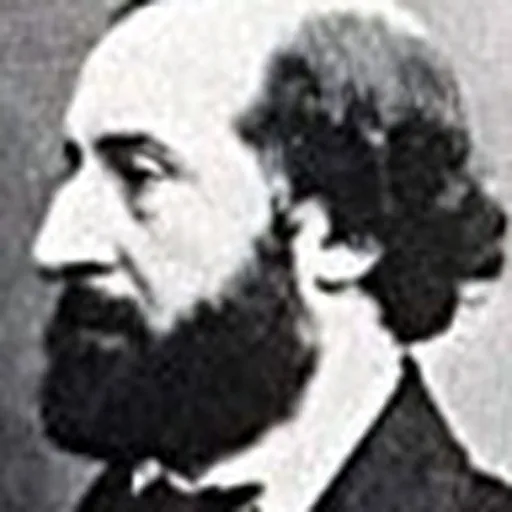
About Henri Labrouste
Lived 1801 – 1875 (aged 74). Henri Labrouste was a French architect.
Pierre-François-Henri Labrouste (11 May 1801 – 24 June 1875) was a French architect from the famous school of architecture. After a six-year stay in Rome, Labrouste established an architectural training workshop, which soon became known for rationalism. He became noted for his use of iron-frame construction and was one of the first to realize the importance of its use.
Biography Born in Paris, Labrouste was one of five children of , a lawyer and politician from Bordeaux and Anne-Dominique Gourg (1764–1851), daughter and granddaughter of cognac merchants. He entered the Collège Sainte-Barbe as a student in 1809. He was then admitted into the second class and the Lebas-Vaudoyer workshop in the École Royale des Beaux Arts in 1819. In 1820, he was promoted to the first class. Competing for the Grand Prix, Labrouste was awarded second place (the Palais de Justice scored first) by Guillaume-Abel Blouet in 1821.
In 1823, he won the departmental prize and worked as a lieutenant-inspector (sous-inspecteur) for the director Étienne-Hippolyte Godde during the construction of the Saint-Pierre-du-Gros-Caillou parish in Paris. In 1824 Labrouste won the competition with a design of a Court of Appeals (Cour de cassation). In November, he left Paris for Italy, visiting Turin, Milan, Lodi, Piacenza, Parma, Modena, Bologna, Florence and Arezzo.
In July 1835 in Paris he was present at the scene when Giuseppe Marco Fieschi attempted the assassination of King Louis-Philippe using a home-made, multi-barrel gun fired from an upstairs window. Although the King only received a minor injury, 18 people were killed, including Henri's father, Alexandre Labrouste.
Stay in Rome Receiving a pension or stipend from the French government for five years, he and the other Académie française laureates stayed in the Medici Villa in Rome. The directors of the Académie stated in correspondence in French about the laureates that, in their studies of antiquity, they "must research the laws of proportion and reduce them to formulas to be used by masters and students in Paris."
Work
His work was the subject of "Henri Labrouste: Structure Brought to Light," the first solo exhibition in the U.S. of his work, at The Museum of Modern Art in New York City.
His buildings include: Sainte-Geneviève Library, Paris, built between 1843 and 1850 The Salle Labrouste, a reading room in the in the Rue de Richelieu, Paris, and built between 1862 and 1868.
For the Société Centrale des Architectes, today called Académie d'Architecture, Labrouste designed several medals.
Don’t just read it —
keep it.
Full-length biographies made to live with: read them, listen on the way to work, watch them tonight.
- E-book
- Audio
- Video
Instant download · yours to keep · every purchase keeps this site free
Important facts
People in Henri Labrouste's life
Named in this biography and alive at the same time


Related people
Same field, nearest in time



Contemporaries
People whose lives overlapped Henri Labrouste's





Frequently asked questions
Who was Henri Labrouste?
French architect (1801–1875)
When was Henri Labrouste born?
Henri Labrouste was born on 11 May 1801 in Paris.
When did Henri Labrouste die?
Henri Labrouste died on 24 June 1875 in Fontainebleau.
What was Henri Labrouste's occupation?
Henri Labrouste was an architect.
What nationality was Henri Labrouste?
Henri Labrouste was French.
Sources & further reading
Cite this page
APA: Biography.guide. (2026). Henri Labrouste. https://biography.guide/henri-labrouste/
MLA: "Henri Labrouste." Biography.guide, https://biography.guide/henri-labrouste/.
Chicago: "Henri Labrouste." Biography.guide. https://biography.guide/henri-labrouste/.
Data last updated: 2026-09-21 · Spot an error? Report a correction.
Portrait: Wikimedia Commons · author & licence
Page generated 2026-09-27 04:59 UTC