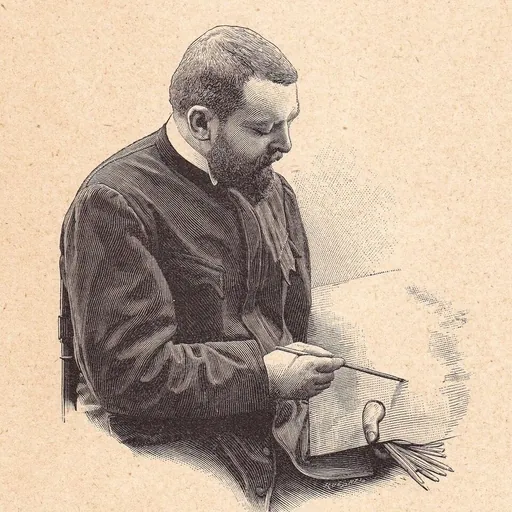
About Henri Gervex
Lived 1852 – 1929 (aged 76). Henri Gervex was a French painter, illustrator and pastellist.
Henri Gervex (10 December 1852 – 7 June 1929) was a French painter who studied painting under Alexandre Cabanel, Pierre-Nicolas Brisset, and Eugène Fromentin.
Biography Early years
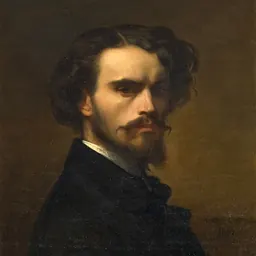
He was the son of Joséphine Peltier and Félix Nicolas Gervex, a piano maker. When he was 15, a friend of the family helped him get admitted to the atelier of Pierre-Nicolas Brisset. Three years later, he served in the 152nd Battalion of the National Guard. In 1871 he was accepted into the École des Beaux-Arts in the studio of Alexandre Cabanel, where he studied for five years along with Jean-Louis Forain, Fernand Cormon, and Eugène Damas, a landscape painter. He also apprenticed himself to the Orientalist painter Eugène Fromentin.
Debut His early work belonged almost exclusively to the mythological genre, which served as an excuse for the painting of the nude, but not always in the best of taste. His Rolla of 1878, based on a poem by Alfred de Musset, was rejected by the jury of the Salon de Paris for immorality, since it depicted a scene from the poem of a naked prostitute after having sex with her client. However, the censorship only made Gervex's painting even more famous, and launched the career of Gervex, then age 26. Although banned from the Salon, Rolla was exhibited in a nearby private gallery and became, according to the book Famous Pictures Reproduced from Renowned Paintings By the World's Greatest Artists, "probably the most successful private exhibition made in Paris." The book also called Rolla "a masterpiece, one of the few real great works on modern art."
Gervex was one of many lovers entertained by the famous courtesan Valtesse de La Bigne. Their relationship was long and deep, with Gervex including the golden haired beauty in his piece of art called The Civil Marriage of 1881; here Valtesse De la Bigne is dressed from head to toe in blue, her favourite colour, standing beside a dark haired man with a moustache. Another painting of La Bigne inspired Émile Zola in the creation of his heroine for the novel Nana, and Gervex himself was the model for the character of an opportunistic painter who appears in Zola's novel L'Œuvre (The Work [of Art], 1886).
Gervex afterwards devoted himself to representations of modern life and achieved signal success with his Dr Péan at the Salpétrière ("The Operation"), a modernized paraphrase, as it were, of Rembrandt's Anatomy Lesson.
Career
He was entrusted with several important official paintings and the decoration of public buildings. Among the first are The Distribution of Awards (1889) at the Palais de l'Industrie, The Coronation of Nicolas II, The Mayors' Banquet (1900), and the portrait group La République Française; and among the second, the ceiling for the Salle des Fêtes (ballroom) at the Hôtel de Ville, Paris, and the decorative panels painted in conjunction with Emile-Henri Blanchon for the mairie of the 19th arrondissement, Paris. For this work, Gervex received the Legion of Honour.
While traveling in Russia in 1893, he was commissioned by Czar Nicholas II to paint his coronation and individual portraits of the royal family.
In 1913 he was elected to the Académie des Beaux-Arts.
His house and studio at 68 rue de Chavreau in Paris, which he built in the 1890s to give him the space to create large-scale works including his commissions for Nicholas II, was later purchased by dancer Isadora Duncan.
Works La femme au Masque, 1885, which garnered world-wide attention in a 1902 court case because Camille du Gast had been falsely accused of being the subject.
Students Jacques-Émile Blanche (1861-1942) Georges Dubosc (1854-1927) Henry Gerbault (1863-1930)
Don’t just read it —
keep it.
Full-length biographies made to live with: read them, listen on the way to work, watch them tonight.
- E-book
- Audio
- Video
Instant download · yours to keep · every purchase keeps this site free
Important facts
People in Henri Gervex's life
Named in this biography and alive at the same time


Related people
Same field, nearest in time
Contemporaries
People whose lives overlapped Henri Gervex's

Frequently asked questions
Who was Henri Gervex?
French painter (1852-1929)
When was Henri Gervex born?
Henri Gervex was born on 10 September 1852 in Montmartre.
When did Henri Gervex die?
Henri Gervex died on 7 June 1929 in 17th arrondissement of Paris.
What was Henri Gervex's occupation?
Henri Gervex was a painter, illustrator and pastellist.
What nationality was Henri Gervex?
Henri Gervex was French.
Sources & further reading
Cite this page
APA: Biography.guide. (2026). Henri Gervex. https://biography.guide/henri-gervex/
MLA: "Henri Gervex." Biography.guide, https://biography.guide/henri-gervex/.
Chicago: "Henri Gervex." Biography.guide. https://biography.guide/henri-gervex/.
Data last updated: 2026-09-20 · Spot an error? Report a correction.
Page generated 2026-09-27 05:09 UTC