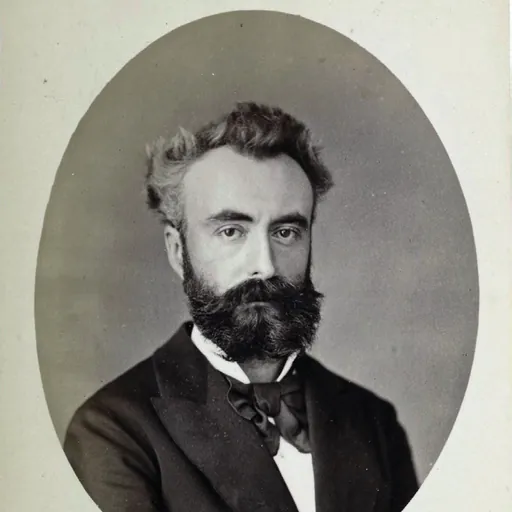
Henri Émile Sauvage
French paleontologist, ichthyologist, and herpetologist
About Henri Émile Sauvage
Lived 1842 – 1917 (aged 74). Henri Émile Sauvage was a French herpetologist, paleontologist and ichthyologist.
Henri Émile Sauvage (22 September 1842 in Boulogne-sur-Mer – 3 January 1917 in Boulogne-sur-Mer) was a French paleontologist, ichthyologist, and herpetologist. He was a leading expert on Mesozoic fish and reptiles.
He worked as a curator at the Muséum d'Histoire Naturelle in Boulogne-sur-Mer, and published extensively on Late Jurassic dinosaurs and other vertebrates from the Boulonnais region of northern France. He is mainly known for having first described in 1873 the famous pliosaurid Liopleurodon. He made important contributions involving vertebrate palaeontology in Portugal, describing in 1897, Suchosaurus girardi from jaw fragments found in that country. In 1893 Philippe Thomas published the palaeontological results of the Tunisian Scientific Exploration Mission (1885–1886) in six installments plus an atlas, including the work of Victor-Auguste Gauthier (sea urchins), Arnould Locard (Mollusca), Auguste Péron (Brachiopods, Bryozoa and Pentacrinitess) and Henri Émile Sauvage (fish).
The plesiosaurid species Lusonectes sauvagei commemorates his name, as do the crustacean species Pseudanthessius sauvagei and the gecko species Bavayia sauvagii.
Works Note sur les geckotiens de la Nouvelle-Calédonie, 1878. Histoire naturelle des poissons, (1891); in Alfred Grandidier's Histoire physique, naturelle et politique de Madagascar. Vertébrés fossiles du Portugal: Contributions à l'étude des poissons et des reptiles du jurassique et du crétacique, (1897). Musées municipaux de Boulogne-sur-Mer, 1898. Biography: La Vie et l'oeuvre d'Emile Sauvage; Author: Casimir Cépède. Publisher: Boulogne-sur-Mer :Imprimerie G. Hamain, 1923.
Taxon described by him See :Category:Taxa named by Henri Émile Sauvage
Taxon named in his honor The Sauvage's mormyrid, Petrocephalus sauvagii, is a species of electric fish in the family Mormyridae, found in the Congo River basin and Niger Delta in Africa.
Don’t just read it —
keep it.
Full-length biographies made to live with: read them, listen on the way to work, watch them tonight.
- E-book
- Audio
- Video
Instant download · yours to keep · every purchase keeps this site free
Important facts
People in Henri Émile Sauvage's life
Named in this biography and alive at the same time


Related people
Same field, nearest in time


Contemporaries
People whose lives overlapped Henri Émile Sauvage's

Frequently asked questions
Who was Henri Émile Sauvage?
French paleontologist, ichthyologist, and herpetologist (1842-1917)
When was Henri Émile Sauvage born?
Henri Émile Sauvage was born on 22 September 1842 in Boulogne-sur-Mer.
When did Henri Émile Sauvage die?
Henri Émile Sauvage died on 3 January 1917 in Boulogne-sur-Mer.
What was Henri Émile Sauvage's occupation?
Henri Émile Sauvage was a herpetologist, paleontologist and ichthyologist.
What nationality was Henri Émile Sauvage?
Henri Émile Sauvage was French.
Sources & further reading
· Wikipedia: Henri Émile Sauvage
· DBpedia: Henri Émile Sauvage
Cite this page
APA: Biography.guide. (2026). Henri Émile Sauvage. https://biography.guide/henri-emile-sauvage/
MLA: "Henri Émile Sauvage." Biography.guide, https://biography.guide/henri-emile-sauvage/.
Chicago: "Henri Émile Sauvage." Biography.guide. https://biography.guide/henri-emile-sauvage/.
Data last updated: 2026-09-21 · Spot an error? Report a correction.
Portrait: Wikimedia Commons · author & licence
Page generated 2026-09-27 05:00 UTC