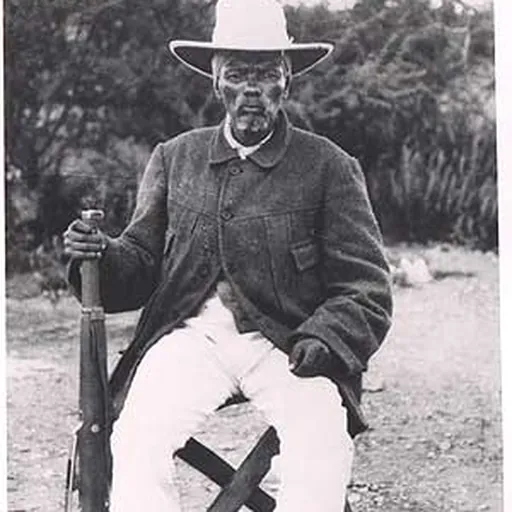
Hendrik Witbooi
National hero of Namibia
About Hendrik Witbooi
Lived 1830 – 1905 (aged 74–75). Hendrik Witbooi was a kaptein.
Hendrik Witbooi ( – 29 October 1905) was a chief of the ǀKhowesin people, a subgroup of the Nama people in present-day Namibia. He led the Nama people during their revolts against the German colonial empire. Witbooi is regarded as one of the national heroes of Namibia, and his face is portrayed on the obverse of all N$50, N$100, and N$200 Namibian dollar banknotes.
Becoming chief of the ǀKhowesin in 1888 following a power struggle, he united other Nama groups and led them during the first uprising against German colonial authorities from 1893 to 1894. This ended in a conditional surrender, and Witbooi began supporting the Germans in conflicts with other tribes. Following the outbreak of the Herero uprising in 1904, Witbooi and the Nama initially fought alongside the Germans against the Herero, including at the decisive battle of Waterberg in August 1904.
However in September that year Witbooi led another Nama revolt against the Germans. It ended in defeat and the Nama genocide, with an estimated 10,000 killed, around half of their prewar population. Witbooi was killed in action on 29 October 1905.
Names Kaptein Hendrik Witbooi (also spelled Witboi) was also known by the Nama name and the nickname Kort (from Dutch kort = short), in Herero Korota or pejorative Otjikorota.
Family and early life Hendrik Witbooi was born into a prominent family among the Nama tribes, also known as the Khoekhoe. His grandfather, David Witbooi, was chief of the tribe, and led the people across the Orange River into Namaland. His father, Moses Witbooi, was also a chief of the tribe.
His uncle, Jonker Afrikaner, was another notable Nama chief, and became an opponent of Hendrik Witbooi. Jonker Afrikaner was the son of the famous Jager Afrikaner.
Witbooi was born circa 1830 in Pella, Northern Cape, in Cape Colony, which is today part of South Africa. He was educated as a Lutheran by German missionary Johannes Olp and was well-versed in many languages, including his native Nama. He married and had five daughters and seven sons, including Isaak Witbooi.
The ǀKhowesin Nama and other Nama tribes often fought amongst each other and with Herero tribes. After almost being killed in a conflict with the Herero, Witbooi had a vision that he had been chosen by God to lead his people north.
Witbooi was educated at Rhenish Missionary and Wesleyan Methodist schools in Namibia. He also studied at the Wilberforce Institute in Evaton, South Africa.
He initially began working as a teacher in 1856 at Keetmanshoop. He transferred in 1859 to Maltahöhe. He returned in 1865 to Gibeon at the request of the community and the Church to build on the foundations laid by his aging father.
Rise to influence Witbooi moved north on 16 May 1884, with a faction of the ǀKhowesin tribe. This was against the wishes of his father, Moses, who remained opposed to Hendrik's plans. As evidenced by his diaries (which make up a large portion of his surviving documents), Hendrik still admired his father greatly, despite their political differences. In late 1887, Moses' chief rival, his subchief Paul Visser, deposed Moses; he arranged to kill the chief on 22 February 1888.
Hendrik Witbooi advanced to leadership at Gibeon in 1888, achieved after numerous struggles. These contests took place long after the death of Jonker Afrikaner in 1861, which had opened the way for a power struggle among the various groups for paramount leadership. Hendrik finally defeated his last chief rival, Paul Visser, shooting him on 12 July 1888 and taking over leadership at Gibeon.
With this, Hendrik became chief of the ǀKhowesin people. He began to unite other Nama tribes under his control as well. By 1890, Hendrik Witbooi was signing all his letters, 'Chief of Great Namaqualand'.
German conflicts In the early morning of 12 April 1893, the ǀKhowesin were attacked by the Germans at Hornkranz. Many were killed, although Hendrik managed to escape with most of his fighting men. He campaigned against the Germans for two years, until the treaty of Gurus on 15 September 1894 where he agreed to a conditional surrender. Witbooi also decided to render military support for the Germans against other smaller tribes, such as the eastern Mbanderu Herero, Afrikaners, and Swartbooi.
After serving as a branch of the German army fighting against the Herero for the previous three years, Witbooi and the Nama again revolted against German rule in Namibia on 3 October 1904. During the ensuing war with the Germans in 1904–1905, Witbooi rallied his people with the conviction God had guided them to fight for their freedom from the imperialists. Witbooi was killed in action on 29 October 1905, near Vaalgras, near Koichas. His dying request was: "It is enough. The children should now have rest". He was replaced by Fransman Nama until the Nama surrendered in 1908.
Recognition Kaptein Hendrik Witbooi is one of nine national heroes of Namibia who were identified at the inauguration of the country's Heroes' Acre near Windhoek. Founding president Sam Nujoma remarked in his inauguration speech on 26 August 2002 that:
Witbooi is honored in the form of a granite tombstone with his name engraved and his portrait plastered onto the slab.
Witbooi's diary and complete correspondence have survived and became known as the Hendrik Witbooi Papers. It is stored in the National Archives of Namibia in Windhoek. In 2005, UNESCO inscribed the archive in its Memory of the World International Register, recognising Witbooi's journals as documentary heritage of global importance.
Cultural depictions Witbooi is the subject of Conny Braam's 2016 Dutch-language novel Ik ben Hendrik Witbooi depicting his struggle against German colonialism. Witbooi is depicted in the 1989 South African Boer War miniseries Arende, where he is the leader of a group that ambushes the protagonist, Sloet Steenkamp, party of Boer exiles in the final episode of the last season.
Don’t just read it —
keep it.
Full-length biographies made to live with: read them, listen on the way to work, watch them tonight.
- E-book
- Audio
- Video
Instant download · yours to keep · every purchase keeps this site free
Important facts
People in Hendrik Witbooi's life
Named in this biography and alive at the same time


Contemporaries
People whose lives overlapped Hendrik Witbooi's




Frequently asked questions
Who was Hendrik Witbooi?
National hero of Namibia
When was Hendrik Witbooi born?
Hendrik Witbooi was born in 1830 in South Africa.
When did Hendrik Witbooi die?
Hendrik Witbooi died on 19 November 1905 in Karas Mountains.
What was Hendrik Witbooi's occupation?
Hendrik Witbooi was a kaptein.
Sources & further reading
· DBpedia: Hendrik Witbooi (Nama chief)
Cite this page
APA: Biography.guide. (2026). Hendrik Witbooi. https://biography.guide/hendrik-witbooi/
MLA: "Hendrik Witbooi." Biography.guide, https://biography.guide/hendrik-witbooi/.
Chicago: "Hendrik Witbooi." Biography.guide. https://biography.guide/hendrik-witbooi/.
Data last updated: 2026-09-23 · Spot an error? Report a correction.
Portrait: Wikimedia Commons · author & licence
Page generated 2026-09-27 05:06 UTC