
About Helmut Bennemann
Lived 1915 – 2007 (aged 92). Helmut Bennemann was a German aircraft pilot.
Helmut Bennemann (16 March 1915 – 17 November 2007) was an Oberstleutnant of Nazi Germany's Luftwaffe in World War II. Bennemann claimed 93 aerial victories in over 400 combat missions. The majority of his victories were claimed over the Eastern Front. His commands included Geschwaderkommodore (wing commander) of the Jagdgeschwader 53. Following World War II, Bennemann became a dentist He died on 17 November 2007 at the age of 92 in Bad Sassendorf.
Career Bennemann was born on 16 March 1915 in Wanne-Eickel in the Ruhrgebiet of Province of Westphalia within the German Empire. He joined the military service of the Luftwaffe in 1936 and was trained as an aerial reconnaissance pilot. When Germany invaded Poland on 1 September 1939 starting World War II, Bennemann flew reconnaissance missions.
In June 1940, Bennemann was posted to I. Gruppe (1st group) of Jagdgeschwader 52 (JG 52—52nd Fighter Wing) where he served as an adjutant. At the time, I. Gruppe was based at Zerbst and subordinated to Jagdgeschwader 77 (JG 77—77th Fighter Wing) and tasked with protecting Dessau and the Leuna works from aerial attacks. On 18 July, I. Gruppe was ordered to Neuruppin, augmenting the aerial defenses of Berlin during the session of the Reichstag following the Battle of France. The Gruppe then relocated to Bayreuth-Bindlach Airfield where it was tasked with protecting the Bayreuth Festival before returning to Zerbst on 24 July. Five days later, I. Gruppe moved to Bönninghardt located west of Wesel.
Battle of Britain In preparation for Operation Sea Lion, the planned invasion of the United Kingdom, and the Battle of Britain, I. Gruppe was ordered to Coquelles located approximately southwest of Calais. Here Bennemann claimed his first aerial victory on 26 August, when he shot down a Royal Air Force (RAF) Supermarine Spitfire fighter near Dover on a mission escorting bombers to RAF Lympne. On 31 August, Bennemann claimed his second aerial victory, a Hawker Hurricane fighter shot down near London on a mission escorting Messerschmitt Bf 110 heavy fighters from Erprobungsgruppe 210 (ErpGr. 210—210th Testing Group) attacking RAF Kenley. The following day, I. Gruppe escorted Heinkel He 111 bombers attacking the Port of Tilbury on the River Thames. On this mission, Bennemann claimed a Spitfire shot down near Sittingbourne.
On 2 September, I. Gruppe again escorted Bf 110 heavy fighters from ErpGr. 210, this time attacking RAF Eastchurch. That day, Bennemann claimed a Spitfire fighter shot down near Canterbury. Five days later, the Luftwaffe targeted the Beckton Gas Works in London. Escorting He 111 bombers to the target area, Bennemann claimed a Hurricane fighter shot down. On 15 September, Bennemann claimed three Hurricane fighters shot down over the Thames Estuary, recording aerial victories six to eight. That day, I. Gruppe had escorted Junkers Ju 88 bombers to London. On 24 September, I. Gruppe flew a combat air patrol over the English Channel, claiming seven aerial victories, two of which by Bennemann against two Spitfire fighters off of Dover. Bennemann was awarded the Honor Goblet of the Luftwaffe on 5 October 1940. The Gruppe was withdrawn from the English Channel on 31 October and relocated to Krefeld Airfield for a period of rest and replenishment. With eleven aerial victories to his credit, at the time Bennemann was the second most successful fighter pilot of the Gruppe.
On 27 December, the Gruppe moved to Katwijk aan Zee in the Netherlands. In early 1941, the Gruppe received new orders and began preparations for relocation to Sicily which were later revoked. Consequently, the entire I. Gruppe remained at Katwijk aan Zee where it was tasked with patrolling the Dutch coast area and German Bight, the three Staffeln were then deployed at various airfields on the Dutch, German and Danish North Sea coast. On 27 April, Bennemann was appointed Staffelkapitän (Squadron Leader) of 3. Staffel of JG 52. He replaced Oberleutnant Helmut Kühle who was transferred.
War against the Soviet Union On 22 June, German forces had launched Operation Barbarossa, the invasion of the Soviet Union. On 21 September 1941, I. Gruppe of JG 52 was ordered to relocate to the Eastern Front. With stopovers at Dortmund, Magdeburg, and Warsaw, the Gruppe arrived in Orsha on 29 September. In support for Operation Typhoon, also known as the Battle of Moscow, the Gruppe moved to an airfield named Ponyatovka, located approximately southwest of Roslavl, on 2 October. The following day, Bennemann claimed his first aerial victory on the Eastern Front when he shot down a Polikarpov I-16 fighter.
On 1 February 1942, I. Gruppe was withdrawn from combat operations and was moved to Smolensk and then further west to Orsha. From 8 to 12 February the Gruppe took a train to Jesau near Königsberg, present-day Kaliningrad in Russia, for a period of recuperation and replenishment where they received new Bf 109 F-4 aircraft. The Gruppe was ordered to Olmütz, present-day Olomouc in Czech Republic, on 11 April. On 17 May, I. Gruppe relocated to Artyomovsk, present-day Bakhmut. On 14 June, Bennemann was appointed Gruppenkommandeur (group commander) of I. Gruppe of JG 52. He succeeded Hauptmann Karl-Heinz Leesmann who was transferred. On 26 June, the Gruppe moved to Bilyi Kolodyaz, approximately southeast of Vovchansk, and was fighting in support of Case Blue, the strategic summer offensive in southern Russia with the objective to capture the oil fields of Baku, Grozny and Maykop.
To support German forces fighting in the Battle of the Caucasus, I. Gruppe relocated to an airfield at Kerch, in the east of Crimea, on 2 August. At the time, the Gruppe was moved around as a kind of fire brigade, deployed in areas where the Soviet Air Forces was particular active. The Gruppe then moved to Oryol on 15 August. A Petlyakov Pe-2 bomber shot down by Bennemann on 23 August was I. Gruppes 600 aerial victory to date. Bennemann was awarded the Knight's Cross of the Iron Cross on 2 October 1942. His 62nd aerial victory claimed over a Mikoyan-Gurevich MiG-3 fighter on 2 November was the 800th aerial victory of I. Gruppe. By the End of 1942, Bennemann had claimed 72 aerial victories, making him the leading active fighter pilot of I. Gruppe at the time.
On 10 May 1943, Benemann was severely wounded by the explosion of an incendiary bomb at Charkow-Woitschenko Airfield. During his convalescence, he was replaced by Hauptmann Johannes Wiese and Hauptmann Gerhard Barkhorn as commander of I. Gruppe. Command of the Gruppe officially passed to Wiese on 5 October.
Wing commander Bennemann was appointed Geschwaderkommodore (wing commander) of Jagdgeschwader 53 (JG 53—53rd Fighter Wing) on 9 November 1943. He took over command from Oberst Günther Freiherr von Maltzahn who had been transferred on 4 October. Intermittently, the Geschwader had been led by both Major Friedrich-Karl Müller and Major Kurt Ubben. On 25 April 1944, he shot down a USAAF B-24 over Bologna to claim his 90th victory. However, his Bf 109G-6 (Werknummer 163 314—factory number) "Black < 3" was hit by defensive fire and Bennemann was again wounded, baling out successfully.
On 22 June 1944, Soviet forces launched Operation Bagration which led to the annihilation of Army Group Centre during the following weeks. In support of the 3rd Panzer Army, the Geschwaderstab of JG 53 relocated to Vilna. Here, Bennemann was tasked with organizing the supply missions for Vilna. On 8 July, the encirclement of Vilna by Soviet forces was imminent, and the Geschwaderstab was ordered to relocate to Germany. On 18 July, Bennnemann was promoted to Oberstleutnant (lieutenant colonel). Following the brief interlude on the Eastern Front, the Geschwaderstab was based at Wunstorf near Hannover in Germany. On 20 August, Bennemann led the Stabsschwarm to Attichy in France That evening, Bennenmann flew to Reims where he met with Major Heinrich Bär, the Geschwaderkommodore of Jagdgeschwader 3 "Udet" (JG 3—3rd Fighter Wing), to discuss operational conditions in France. On 29 October, Bennemann claimed his 93rd and last aerial victory. That day, he led the Geschwaderstab, II., III. and IV. Gruppe on a Defense of the Reich mission against the United States Army Air Forces (USAAF). At 11:45, the Luftwaffe fighters encountered a formation of approximately 35 North American P-51 Mustang fighters of the 354th Fighter Group in the area between Bruchsal and Böckingen. Shortly after, the USAAF fighters were joined by Republic P-47 Thunderbolt fighters. In this encounter, Luftwaffe pilots claimed five P-51s shot down, including one by Bennemann. USAAF records show that four P-51s were lost in this engagement. The 354th Fighter Group claimed 24 aerial victories, and damaging ten further Bf 109s while JG 53 reported the loss of 15 aircraft shot down, including ten pilots killed in action.
In early 1945, Bennemann joined other high-ranking pilots in the "Fighter Pilots' Revolt incident" which escalated in a meeting with Hermann Göring on 22 January 1945. This was an attempt to reinstate Adolf Galland who had been dismissed for outspokenness regarding the Oberkommando der Luftwaffe (Luftwaffe high command), and had been replaced by Gordon Gollob as General der Jagdflieger. The meeting was held at the Haus der Flieger in Berlin and was attended by a number of high-ranking fighter pilot leaders which included Bennemann, Lützow, Hermann Graf, Gerhard Michalski, Hannes Trautloft, Kurt Bühligen, Erich Leie and Herbert Ihlefeld, and their antagonist Göring supported by his staff Bernd von Brauchitsch and Karl Koller. The fighter pilots, with Lützow taking the lead as spokesman, criticized Göring and made him personally responsible for the decisions taken which contributed to the lost air war over Europe.
Later life Following World War II, Bennemann attended university attaining a Doctor of Medical Dentistry, abbreviated as Dr. med. dent. (Doctor medicinae dentariae). He then worked as a dentist in his own practice. Bennemann died on 17 November 2007 at the age of in Bad Sassendorf.
Summary of career Aerial victory claims According to US historian David T. Zabecki, Bennemann was credited with 93 aerial victories. Obermaier also list Bennemann with 93 aerial victories claimed in over 400 combat missions. This figure includes 77 claims on the Eastern Front and 16 over the Western Allies, including one four-engine bomber. Spick lists him with 92 aerial victories with 70 on the Eastern Front and 22 on the Western Front. Mathews and Foreman, authors of Luftwaffe Aces — Biographies and Victory Claims, researched the German Federal Archives and found records for 89 aerial victory claims, plus four further unconfirmed claims. This figure of confirmed claims includes 76 aerial victories on the Eastern Front and 14 on the Western Front, including one four-engined bomber.
Victory claims were logged to a map-reference (PQ = Planquadrat), for example "PQ 6083". The Luftwaffe grid map covered all of Europe, western Russia and North Africa and was composed of rectangles measuring 15 minutes of latitude by 30 minutes of longitude, an area of about . These sectors were then subdivided into 36 smaller units to give a location area in size.
Chronicle of aerial victories Claim Date Time Type Location Claim Date Time Type Location – 2. Staffel of Jagdgeschwader 52 –Battle of Britain and on the English Channel — 3 August – 30 October 1940 1 26 August 1940 12:50 Spitfire Dover 8 15 September 1940 15:40 Hurricane Thames Estuary 2 31 August 1940 13:50 Hurricane southern edge of London 9 24 September 1940 14:35 Spitfire off Dover 3 1 September 1940 11:45 Spitfire Sittingbourne 10 24 September 1940 14:40 Spitfire off Dover 4 2 September 1940 14:00 Spitfire Canterbury ? 27 September 1940 Spitfire 5 7 September 1940 17:55 Hurricane London 11 12 October 1940 17:25 Spitfire southeast of London 6 15 September 1940 15:30 Hurricane Thames Estuary ? 28 October 1940 Hurricane 7? 15 September 1940 15:30 Hurricane Thames Estuary – 2. Staffel of Jagdgeschwader 52 –On the Western Front — 27 December 1940 – 23 September 1941 ? 14 April 1941 12:27 Blenheim vicinity of Breskens – 3. Staffel of Jagdgeschwader 52 –Operation Barbarossa — 2 October – 5 December 1941 12 3 October 1941 15:10 I-16 16 27 November 1941 09:55 DB-3 13 28 October 1941 14:15 I-153 17 16 November 1941 09:53 Pe-2 14 28 October 1941 14:25 Il-2 18 2 December 1941 14:20 I-61 (MiG-3) 15 29 October 1941 08:17 I-18 (MiG-1) – 3. Staffel of Jagdgeschwader 52 –On the Eastern Front — 19 May – 13 June 1942 19 24 May 1942 18:50 Yak-1 24 1 June 1942 06:52 Il-2 20 26 May 1942 15:43 Pe-2 25 1 June 1942 18:44 Yak-1 21 27 May 1942 16:05 Il-2 PQ 6083 26 2 June 1942 05:30 Pe-2 22 27 May 1942 19:20 Il-2 PQ 7071 27 12 June 1942 17:20 LaGG-3 PQ 70221 23 31 May 1942 16:45 I-153 PQ 60864 south of Petrovskaja – Stab I. Gruppe of Jagdgeschwader 52 –On the Eastern Front — 14 June 1942 – 3 February 1943 28 22 June 1942 07:35 LaGG-3 46 23 August 1942 06:42 Pe-2 PQ 54452west of Zubkovo 29 22 June 1942 07:55 LaGG-3 47 23 August 1942 06:43? Il-2 PQ 54452west of Zubkovo 30 24 June 1942 08:25 LaGG-3 48 27 August 1942 14:24? Il-2 PQ 46362 31 24 June 1942 11:10 LaGG-3 49 3 September 1942 06:40 LaGG-3 PQ 57752Sea of Azov 32 25 June 1942 14:20 Hurricane 50 3 September 1942 14:35 Il-2 PQ 46253 33 26 June 1942 10:19 LaGG-3 51 4 September 1942 05:52? Pe-2 PQ 46412 34 26 June 1942 10:35 Hurricane 52 23 September 1942 11:50 LaGG-3 PQ 40843 north-northeast of Grebenka 35 4 July 1942 08:55 LaGG-3 53 24 September 1942 16:35? LaGG-3 PQ 4915 36 31 July 1942 10:00? Yak-1 PQ 07181 54 16 October 1942 09:55 MiG-3 PQ 49432vicinity of Srednyaya Akhtuba 37 1 August 1942 14:45 Yak-1 PQ 07853 55 17 October 1942 10:10 MiG-3 PQ 49273 east of Stalingrad 38 4 August 1942 05:13 Il-2 PQ 66453Sea of Asov, north-northeast of Kerch 56 24 October 1942 11:45? Yak-1 PQ 49131 north of Grebenka 39 5 August 1942 10:12 I-153 PQ 6523 57 24 October 1942 14:20 La-5 PQ 49272 east of Stalingrad 40 5 August 1942 10:13 I-153 PQ 6523 58 24 October 1942 14:31? Pe-2 PQ 49471 south-southeast of Stalingrad 41 10 August 1942 15:50 MBR-2 PQ 8552 east of Novocherkassk 59 25 October 1942 16:05 Yak-1 PQ 49462 east-southeast of Stalingrad 42 13 August 1942 08:18 LaGG-3 PQ 06771vicinity of Bondarenka 60 29 October 1942 15:30 MiG-3 PQ 49294 east of Stalingrad 43 21 August 1942 08:40 U-2 PQ 55763Black Sea 61 1 November 1942 11:45 MiG-3 PQ 49452 southeast of Stalingrad 44 22 August 1942 08:15? LaGG-3 PQ 54433northwest of Bolkhov 62 2 November 1942 09:50 MiG-3 PQ 59143 45 22 August 1942 13:15 LaGG-3 PQ 64173 According to Prien, Stemmer, Rodeike and Bock, Bennemann claimed his 63rd aerial victory between 6 November and 31 December 1942. This claim is not listed by Mathews and Foreman. 64 26 December 1942 10:30 La-5 PQ 01762 69♠ 28 December 1942 07:25? Il-2 PQ 01863 65 26 December 1942 10:50 MiG-1 PQ 01572 70♠ 28 December 1942 07:33? Il-2 PQ 01763 66 27 December 1942 11:29 Pe-2 PQ 01731 71♠ 28 December 1942 10:00 Pe-2 PQ 01783 67♠ 28 December 1942 07:20? Il-2 PQ 01864 72♠ 28 December 1942 10:03 Pe-2 PQ 01763 68♠ 28 December 1942 07:23? Il-2 PQ 01843 – Stab I. Gruppe of Jagdgeschwader 52 –On the Eastern Front — 4 February – 10 May 1943 73 17 March 1943 12:45 La-5 PQ 35 Ost 61664 north of Volchansk 81 17 April 1943 11:16 LaGG-3 PQ 34 Ost 75492, vicinity of NovorossiyskBlack Sea, west of Gelendzhik 74 18 March 1943 16:10 LaGG-3 PQ 35 Ost 61891 south-southwest of Bely Kolodez 82 17 April 1943 11:23 LaGG-3 PQ 34 Ost 75424, south of Novorossiysk east of Novorossiysk 75 19 March 1943 10:13 La-5 PQ 35 Ost 60211 east of Kharkiv 83 17 April 1943 15:07 P-39 PQ 34 Ost 75431, vicinity of Novorossiysk southeast of Novorossiysk 76 19 March 1943 10:18 La-5 PQ 35 Ost 60212 84 17 April 1943 15:09 P-39 PQ 34 Ost 75433, vicinity of Novorossiysksoutheast of Novorossiysk 77 19 March 1943 13:47 Pe-2 PQ 35 Ost 61851 west-southwest of Bely Kolodez 85 21 April 1943 09:25 LaGG-3 PQ 34 Ost 75432northeast of Novorossiysk 78 19 March 1943 13:48 Pe-2 PQ 35 Ost 61851 west-southwest of Bely Kolodez 86 27 April 1943 14:02? Il-2 PQ 34 Ost 85133east of Chablj 79 26 March 1943 09:15 MiG-3 PQ 35 Ost 71794 southeast of Bely Kolodez 87 9 May 1943 10:03 I-16 PQ 34 Ost 9884 80 29 March 1943 12:23 Il-2 m.H. PQ 35 Ost 61451 northeast of Belograd 88 9 May 1943 10:06 I-16 PQ 34 Ost 9874 – Stab of Jagdgeschwader 53 –On the Italian Front — 9 November 1943 – June 1944 89 15 December 1943 11:15 B-26 southwest of Ceccano 90 25 April 1944 11:33 B-24 southwest of Forlì – Stab of Jagdgeschwader 53 –In Defense of the Reich — September – December 1944 91? 8 October 1944 P-47 93 29 October 1944 11:45 P-51 vicinity of Jöhlingen 92? October 1944 P-47
Awards Iron Cross (1939) 2nd and 1st Class Honor Goblet of the Luftwaffe (5 October 1940) German Cross in Gold on 27 July 1942 as Hauptmann in the I./Jagdgeschwader 52 Knight's Cross of the Iron Cross on 2 October 1942 as Hauptmann and Gruppenkommandeur of the I./Jagdgeschwader 52
Don’t just read it —
keep it.
Full-length biographies made to live with: read them, listen on the way to work, watch them tonight.
- E-book
- Audio
- Video
Instant download · yours to keep · every purchase keeps this site free
Important facts
People in Helmut Bennemann's life
Named in this biography and alive at the same time


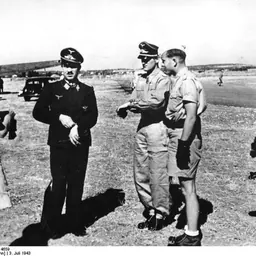
Related people
Same field, nearest in time


Contemporaries
People whose lives overlapped Helmut Bennemann's





Frequently asked questions
Who was Helmut Bennemann?
German World War II fighter pilot
When was Helmut Bennemann born?
Helmut Bennemann was born on 16 March 1915 in Herne.
When did Helmut Bennemann die?
Helmut Bennemann died on 17 November 2007 in Bad Sassendorf.
What was Helmut Bennemann's occupation?
Helmut Bennemann was an aircraft pilot.
What nationality was Helmut Bennemann?
Helmut Bennemann was German.
Sources & further reading
Cite this page
APA: Biography.guide. (2026). Helmut Bennemann. https://biography.guide/helmut-bennemann/
MLA: "Helmut Bennemann." Biography.guide, https://biography.guide/helmut-bennemann/.
Chicago: "Helmut Bennemann." Biography.guide. https://biography.guide/helmut-bennemann/.
Data last updated: 2026-09-20 · Spot an error? Report a correction.
Page generated 2026-09-27 05:20 UTC