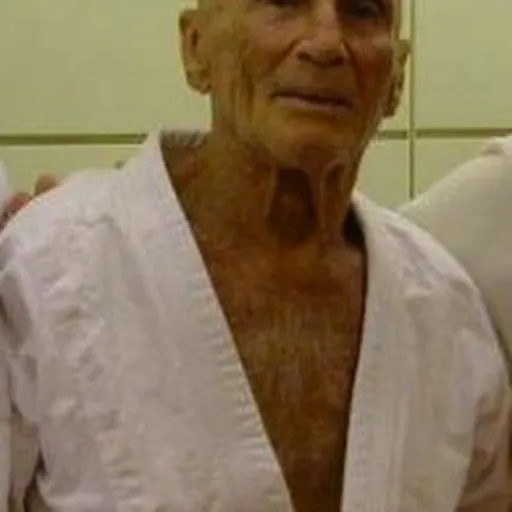
About Hélio Gracie
Lived 1913 – 2009 (aged 95). Hélio Gracie was a Brazilian judoka and writer.
Early life Gracie was born on October 1, 1913, in Belém, Brazil. Contrary to popular belief, he was a talented athlete, and trained and competed in rowing and swimming since his childhood. He had his first contact in martial arts at 16, when he started training judo (at that time commonly referred to as "Kano jiu-jitsu" or simply "jiu-jitsu"), with his brothers Carlos and George. He also learned catch wrestling under the renowned Orlando Americo "Dudú" da Silva, who taught his brothers for a time.
When he was 16 years old, he had the opportunity to teach a judo class, which helped him develop his family style, "Gracie jiu-jitsu". When the director of the Bank of Brazil, Mario Brandt, arrived for a private class at the original Gracie Academy in Rio de Janeiro as scheduled Carlos Gracie, the instructor, was running late. Hélio offered to teach the class in Carlos's stead. When Carlos arrived with apologies, Brandt assured him it was no problem, and even requested that he be allowed to continue learning with Hélio.
Gracie realized, however, that even though he knew the techniques theoretically, the moves were much harder for him to execute. Consequently, he began adapting Mitsuyo Maeda's brand of judo, already heavily based around newaza ground fighting techniques. From these experiments, Gracie jiu-jitsu was created. "Carlos and Helio Gracie ... brought a fresh eye to jujitsu just as their fellow countryman brought a special new approach to football."
Aside from training with his brothers, Gracie learned further judo under Sumiyuki Kotani and Argentinian judo pioneer Chugo Sato. He might have also got training under a practitioner named Hiraichi Tada. while according to Robert Hill, Kodokan records show Gracie at the rank of 3rd dan at the time, though Hill also noted that it was not unusual for Kodokan records to show a lower rank than that actually held by non-Japanese judo practitioners.
Fighting career First challenges Gracie began his professional fighting career at 18 years old against boxer Antonio Portugal. The fight took place in the undercard of a "jiu-jitsu vs. boxing" event on January 16, 1932, which saw judoka Geo Omori defeating boxer Tavares Crespo. Gracie won his fight by submission in a short time, Portugal is sometimes incorrectly billed as a boxing champion.
His second match would be the same year in a jiu-jitsu exhibition against Takashi Namiki in September. As Namiki had a 7 kg (15 lb) weight advantage and was a native of Japan just like the art of jiu-jitsu, he was expected to defeat Gracie. Namiki dominated the match, but Gracie wasn't defeated, leading it to a draw after several rounds.
Matches against wrestlers
Also in 1932, Gracie faced professional wrestler Fred Ebert on November 6. It was his biggest challenge up to the point, as Ebert outweighed him by 29 kg (64 lb) and was a decorated freestyle wrestler, and their match would have no time limit. Gracie was positive, claiming he would submit Ebert in a short time. In an interview, Gracie claimed that he had to undergo an urgent surgery the next day and that the stop was demanded by the doctor due to Gracie having a high fever caused by a swelling.
In 1934, Gracie faced another jiu-jitsu practitioner named Miyaki. The latter (whose first name is unknown) was billed as a judo black belt, although he had fought only one professional fight, a loss against professional wrestler Robert Ruhmann. During the match, the two fighters exchanged punches before Dudú, heavier by 20 kg, took Gracie down. Gracie defended from the guard, but Dudú landed heavy punishment in form of ground and pound, breaking Gracie's nose with a headbutt and making him bleed profusely. However, the wrestler ended up spending all his energy in the assault, and it allowed Gracie to counterattack gradually with short punches from the bottom. When they returned to standing by the referee, Gracie landed two side kicks of the kind called pisão in capoeira, and the tired Dudú submitted verbally shortly after. To fight him, Gracie faced before a lesser member of Kimura's troupe, Yukio Kato. Gracie and Kato went to a draw on September 6, 1951, with Kato immediately asking for a rematch. It took place on September 29, and it saw Gracie winning by choking out his opponent. Although the win was controversial, the match against Kimura was realized, and it happened on October 22. Kimura defeated Gracie by gyaku-ude-garami at the second round in a convincing fashion. Gyaku-ude-garami then went on to be known as the Kimura lock.
Academia Gracie vs Academia Fadda Oswaldo Fadda represents a non-Gracie line of Brazilian jiu-jitsu. He was trained by Luiz França who was a student of Mitsuyo Maeda around the same time as Carlos and Hélio Gracie. Fadda was known for training the poor in Rio de Janeiro, and for the use of leg locks, which the Gracies considered low class. He trained a number of students and challenged Gracie's academy in 1953. Fadda's academy won the majority of the matches.
Gracie vs. Santana In 1955, Gracie was challenged by Valdemar Santana, a former student of his academy who now trained and fought under the management of Carlos Renato and Haroldo Brito. Reasons why Santana left the Gracie team are diffuse; one of them is that he was expelled for taking a professional wrestling bout, something that their fighters had forbidden, while another tells how Santana accidentally flooded Gracie's gym while doing cleaning chores. Gracie accepted the challenge of a vale tudo match, even though Santana was 16 years younger and 60 lb heavier. possibly three hours and 40 minutes. Gracie defended from his guard for most of the fight, hitting elbows to the head and heel kicks to the back, while his opponent threw punches through the guard. After a long time of fighting, Gracie got eventually tired, and Santana took over with headbutts and more strikes.
Assault and Rufino Dos Santos
A dispute between Gracie's brother Carlos and Manoel Rufino dos Santos worsened after Dos Santos won a public bout against Carlos in August 1932. Subsequently, the conflict then moved to the newspapers, where Rufino criticized Carlos's skill and dismissed his jiu-jitsu credentials, leading Carlos, George and Hélio Gracie to assault him in front of his teaching place at the Tijuca Tênis Clube on October 18. They hit him repeatedly with a steel box and immobilized him for Carlos to apply an armlock, dislocating Rufino's shoulder so badly that it needed surgery. The cause of death, reported by the family, was natural causes. He was 95 years old, and was teaching/training on the mat until 10 days before his death, when he became ill.
Personal life Gracie had been married to Margarida for 50 years. Because Margarida was unable to bear children, during their marriage, Gracie became the father of three sons (Rickson, Rorion, and Relson) with a nanny Isabel 'Belinha' Soares and four sons (Royler, Rolker, Royce, Robin), two daughters (Rerika and Ricci) with Vera. After Margarida's death, he married Vera who was 32 years his junior.
Gracie was a member of the Brazilian movement Brazilian Integralism, which first appeared in Brazil in 1932. Today, many members of the Gracie family are also close to the former Brazilian President Jair Bolsonaro, who received an honorary black belt from Robson Gracie in 2018, although some family members were associated with the left under the Brazilian Dictatorship period.
Documentary
On July 6, 2023, it was announced that ESPN Films is producing a documentary series on the Gracie family directed by Chris Fuller and produced by Greg O'Connor and Guy Ritchie.
Awards and accolades Black Belt Magazine 1997 Man of the Year
Fight record
Don’t just read it —
keep it.
Full-length biographies made to live with: read them, listen on the way to work, watch them tonight.
- E-book
- Audio
- Video
Instant download · yours to keep · every purchase keeps this site free
Important facts
People in Hélio Gracie's life
Named in this biography and alive at the same time







Related people
Same field, nearest in time

Contemporaries
People whose lives overlapped Hélio Gracie's





Frequently asked questions
Who was Hélio Gracie?
Brazilian practitioner of Brazilian jiu-jitsu
When was Hélio Gracie born?
Hélio Gracie was born on 1 October 1913 in Belém.
When did Hélio Gracie die?
Hélio Gracie died on 29 January 2009 in Petrópolis.
What was Hélio Gracie's occupation?
Hélio Gracie was a judoka and writer.
What nationality was Hélio Gracie?
Hélio Gracie was Brazilian.
Sources & further reading
Cite this page
APA: Biography.guide. (2026). Hélio Gracie. https://biography.guide/helio-gracie/
MLA: "Hélio Gracie." Biography.guide, https://biography.guide/helio-gracie/.
Chicago: "Hélio Gracie." Biography.guide. https://biography.guide/helio-gracie/.
Data last updated: 2026-09-22 · Spot an error? Report a correction.
Portrait: Wikimedia Commons · author & licence
Page generated 2026-09-27 05:01 UTC