
About Helena Swanwick
Lived 1864 – 1939 (aged 75). Helena Swanwick was a British journalist, peace activist, suffragist, editor, suffragette and feminist, known for Pacifist.
Helena Maria Lucy Swanwick CH (; 30 January 1864 – 16 November 1939) was a Bavarian-born British suffragist, pacifist, internationalist and writer. Her autobiography, I Have Been Young, gives an account of the non-militant women's suffrage campaign in the UK and of anti-war campaigning during the First World War, together with philosophical discussions of non-violence.
Swanwick's name and picture, along with 58 other women's suffrage supporters, are on the plinth of the statue of Millicent Fawcett in Parliament Square, London, unveiled in April 2018.
Family Born in Munich, Swanwick had five brothers including the painter Walter Sickert. Her maternal grandmother was an Irish dancer who became pregnant by the astronomer Richard Sheepshanks, a Fellow of Trinity College, Cambridge.
Education and early career She was educated at the Notting Hill High School, She studied at Girton College, Cambridge, which was financed by a partial scholarship from her sympathetic godmother, as her parents did not see the point in a girl gaining a higher education and did not contribute to the cost. She was furious when her mother would not allow her to go out unchaperoned and how she was treated differently to her brothers. She married the Manchester University lecturer and mathematician Frederick Swanwick in 1888. She covered topics including book reviews and domestic matters,
Suffrage After reading about Christabel Pankhurst and Annie Kenney's protest and unfurling a banner declaring "Votes for Women" at the Manchester Free Trade Hall in October 1905, Swanwick joined the Women's Social and Political Union (WSPU) and later wrote that her "heart rose up in support of their revolt." In 1906, Swanwick left the WSPU and joined the National Union of Women's Suffrage Societies (NUWSS), because of her belief in non-violence and as she found that she could not work with the Pankhurts. She served as the first editor and manager of the NUWSS weekly journal, The Common Cause, from 1909 to 1912. She was paid a salary of £200, and after her husband retired from teaching they moved to London so that the paper could be produced in the capital. She wrote to Scott on 19 July 1912 that "I have much sympathy for feminine rebellion. For their claptrap and dishonesty, for their persecution and terrorism, I have loathing." and argued that militarism directly involved the subjection of women. From 1914, she was one of the founding members of the Union of Democratic Control (UDC) and their first female member.
G. K. Chesterton criticised Swanwick's pacifism in the 2 September 1916 issue of Illustrated London News, writing that: "Mrs. Swanwick... has recently declared that there must be no punishment for the responsible Prussian. She puts it specifically on the ground that they were promised, or promised themselves, the conquest of the whole world; and they have not got it. This, she says, will be punishment enough. If I were to propose, to the group which is supposed to inspire the Pacifist propaganda, that a man who burgled their strong boxes or pilfered their petty cash should suffer no punishment beyond failing to get the money, they would very logically ask me if I was an Anarchist."
Post-war work and death After the war she maintained her internationalist views, opposing the "unjust and unsustainable" terms of the Treaty of Versailles.
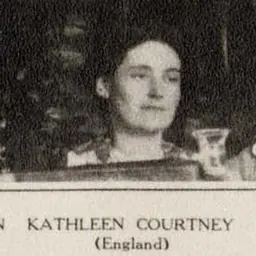
In April 1915, Aletta Jacobs, a suffragist in the Netherlands, invited suffrage members from around the world to an International Congress of Women in The Hague. At the conference, the Women's International League for Peace and Freedom (WILPF) was formed and Swanswick was a founding member and chairwoman. Other notable leading members of WILPF in Britain included Kathleen Courtney, Isabella Ford, Margaret Hills, Catherine Marshall, Emmeline Pethick-Lawrence, Maude Royden and Ethel Snowdon. She also argued that the WILPF should become popularised through education and public debate and wrote in a 1919 essay that she hoped that the organisation would "rouse the great mass of people in every country to take an interest in these great matters." in recognition of her work for peace and the enfranchisement of women. She was also a member of the Labour Party.
Swanwick retired from public life in 1931, but continued to write. She became increasingly depressed throughout the 1930s by the growing attitude of preparedness towards fascist violence, a depression that deepened after the death of her husband in 1934. In November 1939, following the outbreak of the Second World War, she died by suicide with an overdose of veronal at her home in Maidenhead, Berkshire.
Selected works The Small Town Garden (1907) The Future of the Women's Movement (1913) The War in its Effect upon Women (1916) Women in the Socialist State (1921) Builders of Peace, Being Ten Years History of the Union of Democratic Control (1924) Labour's foreign policy: what has been and what might be (1929) Frankenstein and His Monster: Aviation for World War Service (1934) I Have Been Young, autobiography, (1935). Collective Insecurity (1937) The Roots of Peace: A Sequel to Collective Insecurity, Being an Essay on Some of the Uses, Condition (1938)
Don’t just read it —
keep it.
Full-length biographies made to live with: read them, listen on the way to work, watch them tonight.
- E-book
- Audio
- Video
Instant download · yours to keep · every purchase keeps this site free
Important facts
more
Helena Sickert, H.M.S.People in Helena Swanwick's life
Named in this biography and alive at the same time


Related people
Same field, nearest in time


Contemporaries
People whose lives overlapped Helena Swanwick's



Frequently asked questions
Who was Helena Swanwick?
British suffragist, editor (1864–1939)
When was Helena Swanwick born?
Helena Swanwick was born on 30 January 1864 in Munich.
When did Helena Swanwick die?
Helena Swanwick died on 16 November 1939 in Maidenhead.
What was Helena Swanwick's occupation?
Helena Swanwick was a journalist, peace activist, suffragist, editor, suffragette and feminist.
What was Helena Swanwick known for?
Helena Swanwick was known for Pacifist.
What nationality was Helena Swanwick?
Helena Swanwick was British.
Sources & further reading
Cite this page
APA: Biography.guide. (2026). Helena Swanwick. https://biography.guide/helena-swanwick/
MLA: "Helena Swanwick." Biography.guide, https://biography.guide/helena-swanwick/.
Chicago: "Helena Swanwick." Biography.guide. https://biography.guide/helena-swanwick/.
Data last updated: 2026-09-20 · Spot an error? Report a correction.
Page generated 2026-09-27 05:24 UTC