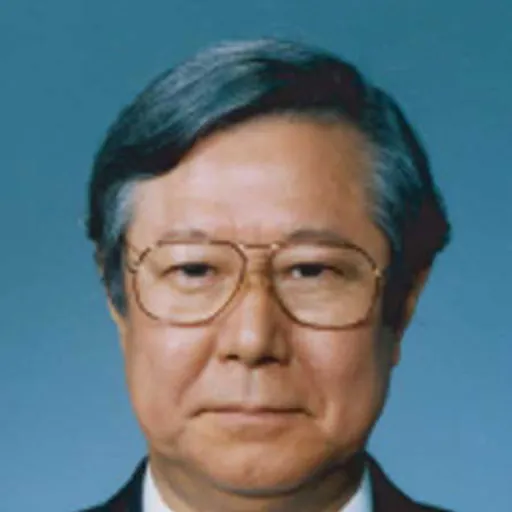
About Heisuke Hironaka
Lived 1931 – 2026 (aged 94). Heisuke Hironaka was a Japanese mathematician and university teacher.
was a Japanese mathematician who was awarded the Fields Medal in 1970 for his contributions to algebraic geometry.
Early life and education Hironaka was born in Yamaguchi, Japan on April 9, 1931. He was inspired to study mathematics after a visiting Hiroshima University mathematics professor gave a lecture at his junior high school. Hironaka applied to the undergraduate program at Hiroshima University, but was unsuccessful. However, the following year, he was accepted into Kyoto University to study physics, entering in 1949 and receiving his Bachelor of Science and Master of Science from the university in 1954 and 1956. Hironaka initially studied physics, chemistry, and biology, but during his third year as an undergraduate, he chose to move to taking courses in mathematics.
The same year, Hironaka was invited to a seminar group led by Yasuo Akizuki, who would have a major influence on Hironaka's mathematical development. The group, informally known as the Akizuki School, discussed cutting-edge research developments including the resolution of singularities problem for which Hironaka later received the Fields Medal. Hironaka has described his interest in this problem as having the logic and mystery of "a boy falling in love with a girl." In 1956, Akizuki invited then Harvard professor Oscar Zariski to Kyoto University. Hironaka took the opportunity to present his own research to Zariski, who suggested that Hironaka move to Harvard University to continue his studies. Hironaka's algebra background, developed under Akizuki, allowed him to bring fresh insights into mathematics discussions in Harvard, which placed a greater emphasis on geometric perspectives. From 1958 to 1959, Alexander Grothendieck visited Harvard University and was another important influence on Hironaka, inviting him to the Institut des Hautes Études Scientifique (IHES) in Paris.
Career Hironaka was an Associate Professor of Mathematics at Brandeis University from 1960 to 1963. He taught at Columbia University from 1964 to 1968 and became a professor of mathematics at Harvard University from 1968 until becoming emeritus in 1992.
He returned to Japan for a joint professorship at the Research Institute for Mathematical Sciences and Kyoto University from 1975 to 1983 and was the Institute Director from 1983 to 1985.
Hironaka was the president of Yamaguchi University from 1996 to 2002.
Research In 1960, Hironaka introduced Hironaka's example, showing that a deformation of Kähler manifolds need not be Kähler. The example is a 1-parameter family of smooth compact complex 3-manifolds such that most fibers are Kähler (and even projective), but one fiber is not Kähler. This can be used to show that several other plausible statements holding for smooth varieties of dimension at most 2 fail for smooth varieties of dimension at least 3.
In 1964, Hironaka proved that singularities of algebraic varieties admit resolutions in characteristic zero. Hironaka was able to give a general solution to this problem, proving that any algebraic variety can be replaced by (more precisely is birationally equivalent to) a similar variety that has no singularities.
Influence on Asian mathematics Hironaka has been active in promoting mathematical education, particularly in Japan and South Korea. Hironaka wrote or co-authored 26 books on mathematics and other topics.
Personal life and death Hironaka married Wakako Kimoto in 1960, a Brandeis Wien International Scholar who entered Japanese politics through her election to the House of Councillors in 1986. They had a son Jo, and daughter Eriko, who is also a mathematician.
On his love for mathematics, Hironaka said "I accumulate anything to do with numbers. For instance, I have more than 10,000 photos of flowers and leaves. I like to just count the numbers and compare them. I am so pleased to be a mathematician, because I can see the mathematical interest in things."
Awards Hironaka received a Fields Medal, the highest honor in mathematics, at the International Congress of Mathematicians at Nice in 1970 at 39, just under the 40 year age limit.
List of awards: Asahi Prize (1967) Fields Medal (1970) Guggenheim Fellowship (1971) Order of Culture (1975) Person of Cultural Merit (1975) Honorary doctor of the Complutense University of Madrid (1981) Legion of Honour (2004) Harvard Centennial Medal (2011)
Selected publications Hironaka, H. (1957). "On the arithmetic genera and the effective genera of algebraic curves," Mem. College Sci. Univ. Kyoto Ser. A Math., 30(2): 177–195. DOI: 10.1215/kjm/1250777055 Hironaka, H. (1960). "On the theory of birational blowing-up," Hironaka, H. (1964), "The Resolution of Singularities of an Algebraic Variety over a Field of Characteristic Zero." Annals of Mathematics., 79(1):109–203. https://doi.org/10.2307/1970486 Hironaka, H.; Matsumura, Hideyuki. (1967), “Formal functions and formal embeddings” J. Math. Soc. Japan, 20(1-2): 52-82. DOI: 10.2969/jmsj/02010052 Hironaka, H. (1967), “On the characters ν \nu* and τ \tau* of singularities" J. Math. Kyoto Univ., 7(1): 325–327. DOI: 10.1215/kjm/1250524306 Hironaka, H. (1974), “The theory of infinitely near singular points” J. Korean Math. Soc. 40(5): 901–920. https://doi.org/10.4134/JKMS.2003.40.5.901 Aroca, J. M.; Hironaka, Heisuke; Vicente, J. L. (1977). “Desingularization theorems" Memorias de Matematica del Instituto. Hironaka, H. (1991), "Fame, sweet and bitter." In P. Hilton, F. Hirzebruch, and R. Remmert (Eds.), Miscellanea mathematica (pp. 155–176) Hironaka, H.; Janeczko, S. (Eds.). (2004). “Geometric singularity theory" Aroca, J. M.; Hironaka, H; Vicente, J. L. (2018), "Complex Analytic Desingularization" ISBN 978-4-431-70218-4
Don’t just read it —
keep it.
Full-length biographies made to live with: read them, listen on the way to work, watch them tonight.
- E-book
- Audio
- Video
Instant download · yours to keep · every purchase keeps this site free
Important facts
People in Heisuke Hironaka's life
Named in this biography and alive at the same time




Related people
Same field, nearest in time

Contemporaries
People whose lives overlapped Heisuke Hironaka's

Frequently asked questions
Who was Heisuke Hironaka?
Japanese mathematician
When was Heisuke Hironaka born?
Heisuke Hironaka was born on 9 April 1931 in Yamaguchi.
When did Heisuke Hironaka die?
Heisuke Hironaka died on 18 March 2026 in Tokyo.
What was Heisuke Hironaka's occupation?
Heisuke Hironaka was a mathematician and university teacher.
What nationality was Heisuke Hironaka?
Heisuke Hironaka was Japanese.
Sources & further reading
Cite this page
APA: Biography.guide. (2026). Heisuke Hironaka. https://biography.guide/heisuke-hironaka/
MLA: "Heisuke Hironaka." Biography.guide, https://biography.guide/heisuke-hironaka/.
Chicago: "Heisuke Hironaka." Biography.guide. https://biography.guide/heisuke-hironaka/.
Data last updated: 2026-09-20 · Spot an error? Report a correction.
Portrait: Wikimedia Commons · author & licence
Page generated 2026-09-27 04:58 UTC