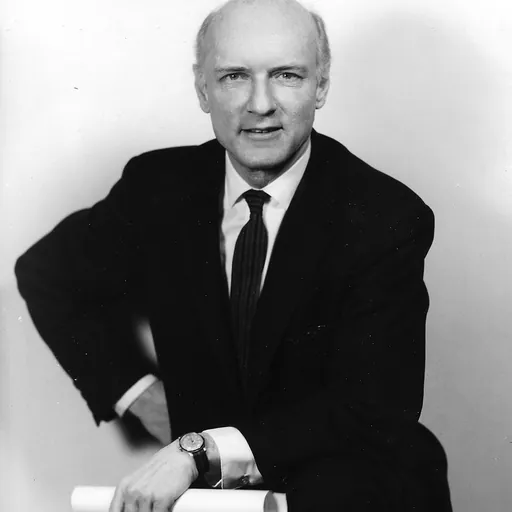
Heinz von Foerster
Austrian-American scientist and cybernetician
About Heinz von Foerster
Lived 1911 – 2002 (aged 90). Heinz von Foerster was an Austrian mathematician, physicist, university teacher, computer scientist and philosopher, known for Artificial intelligence, Biophysics and Computer science.
Heinz von Foerster (; November 13, 1911 – October 2, 2002) was an Austrian-American scientist combining physics and philosophy, and widely attributed as the originator of second-order cybernetics. He was twice a Guggenheim fellow (1956–57 and 1963–64) and also was a fellow of the American Association for the Advancement of Science, 1980. He is well known for his 1960 Doomsday equation formula published in Science predicting future population growth.
As a polymath, he wrote nearly two hundred professional papers, gaining renown in fields ranging from computer science and artificial intelligence to epistemology, and researched high-speed electronics and electro-optics switching devices as a physicist, and in biophysics, the study of memory and knowledge. He worked on cognition based on neurophysiology, mathematics, and philosophy and was called "one of the most consequential thinkers in the history of cybernetics". He came to the United States, and stayed after meeting with Warren Sturgis McCulloch, where he received funding from The Pentagon to establish the Biological Computer Laboratory, which built the first parallel computer, the Numa-Rete. Working with William Ross Ashby, one of the original Ratio Club members, and together with Warren McCulloch, Norbert Wiener, John von Neumann and Lawrence J. Fogel, Heinz von Foerster was an architect of cybernetics and one of the members of the Macy conferences, eventually becoming editor of its early proceedings alongside Hans-Lukas Teuber and Margaret Mead.
Biography Von Foerster was born in 1911 in Vienna, Austria-Hungary , as Heinz von Förster. His paternal grandfather was the Austrian architect . His maternal grandmother was Marie Lang, an Austrian feminist, theosophist, and publisher. He studied physics at the Technical University of Vienna and at the University of Breslau, where in 1944 he received a PhD in physics. His younger brother was the Jazz musician and his relatives included Ludwig Wittgenstein, Erwin Lang and Hugo von Hofmannsthal. Ludwig Förster was his great-grandfather. His Jewish roots did not cause him much trouble while he worked in radar laboratories during the Nazi era, as "he hid his ancestry with the help of an employer who chose not to press him for documents on his family."
He moved to the US in 1949 and worked at the University of Illinois at Urbana–Champaign, where he was a professor of electrical engineering from 1951 to 1975. He was also professor of biophysics (1962–1975) and director of the Biological Computer Laboratory (1958–1975). Additionally, in 1956–57 and 1963–64, he was a Guggenheim Fellow and also President of the Wenner-Gren-Foundation for anthropological research from 1963 to 1965. He is also known for his interest in computer music and magic.
The electron tube laboratory In 1949, von Foerster started work at the University of Illinois at Urbana–Champaign at the electron tube laboratory of the Electrical Engineering Department, where he succeeded Joseph Tykociński-Tykociner. With his students he developed many innovative devices, including ultra-high-frequency electronics
He also worked on mathematical models of population dynamics and in 1959 published a model now called the "von Foerster equation", which is derivable from the principles of constant aging and conservation of mass.
where: n = n(t,a), t stands for time and a for age. m(a) is the death in function of the population age; n(t,a) is the population density in function of age.
When m(a) = 0, we have:
It relates that a population ages, and that fact is the only one that influences change in population density.
It is therefore a continuity equation; it can be solved using the method of characteristics.
Macy conferences He was the youngest member of the core group of the Macy conferences on Cybernetics and editor of the five volumes of Cybernetics (1949–1953), a series of conference transcripts that represent important foundational conversations in the field. It was von Foerster who suggested that Wiener's coinage "Cybernetics" be applied to this conference series, which had previously been called "Circular Causal and Feedback Mechanisms in Biological and Social Systems".
Doomsday equation
A 1960 issue of Science magazine included an article by von Foerster and his colleagues P. M. Mora and L. W. Amiot proposing a formula representing a best fit to available historical data on world population; the authors then predicted future population growth on the basis of this formula. The formula gave 2.7 billion as the 1960 world population and predicted that population growth would become infinite by Friday, November 13, 2026 – von Foerster's 115th birthday anniversary – a prediction that earned it the name "the Doomsday Equation."
Based on population data obtained from various sources, von Foerster and his students concluded that world population growth over the centuries was faster than an exponential. In such a situation, doubling-time decreases over time. Von Foerster's tongue-in-cheek prediction of Doomsday on November 13, 2026, was based on an extrapolation into the future of doubling-time, with the finding that doubling-time would decrease to zero on that date.
Responders to his Doomsday prediction objected on the grounds of the finite human gestation time of 9 months, and the transparent fact that biological systems rarely persist in exponential growth for any substantial length of time. Those who knew von Foerster could see in his rejoinders an evident sense of humor.
Don’t just read it —
keep it.
Full-length biographies made to live with: read them, listen on the way to work, watch them tonight.
- E-book
- Audio
- Video
Instant download · yours to keep · every purchase keeps this site free
Important facts
People in Heinz von Foerster's life
Named in this biography and alive at the same time



Related people
Same field, nearest in time

Contemporaries
People whose lives overlapped Heinz von Foerster's






Frequently asked questions
Who was Heinz von Foerster?
Austrian-American scientist and cybernetician (1911-2002)
When was Heinz von Foerster born?
Heinz von Foerster was born on 13 November 1911 in Vienna.
When did Heinz von Foerster die?
Heinz von Foerster died on 2 October 2002 in Pescadero.
What was Heinz von Foerster's occupation?
Heinz von Foerster was a mathematician, physicist, university teacher, computer scientist and philosopher.
What was Heinz von Foerster known for?
Heinz von Foerster was known for Artificial intelligence, Biophysics, Computer science, Epistemology, Second-order cybernetics and Von Foerster equation.
What nationality was Heinz von Foerster?
Heinz von Foerster was Austrian.
Sources & further reading
· Wikipedia: Heinz von Foerster
Cite this page
APA: Biography.guide. (2026). Heinz von Foerster. https://biography.guide/heinz-von-foerster/
MLA: "Heinz von Foerster." Biography.guide, https://biography.guide/heinz-von-foerster/.
Chicago: "Heinz von Foerster." Biography.guide. https://biography.guide/heinz-von-foerster/.
Data last updated: 2026-09-21 · Spot an error? Report a correction.
Portrait: Wikimedia Commons · author & licence
Page generated 2026-09-27 04:58 UTC