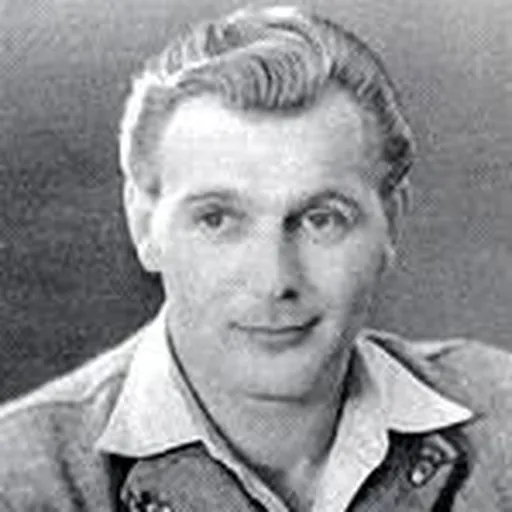
Heinz Heger
Austrian gay concentration camp survivor
About Heinz Heger
Lived 1915 – 1994 (aged 79). Heinz Heger was an Austrian contemporary witness.
Josef Kohout (24 January 1915 – 15 March 1994) was an Austrian Nazi concentration camp survivor, imprisoned for his homosexuality. He is best known for the 1972 book Die Männer mit dem rosa Winkel (The Men With the Pink Triangle), which was written by his acquaintance Hans Neumann using the pen name Heinz Heger, which is often falsely attributed to Kohout. The book is one of very few first-hand accounts of the treatment of homosexuals in Nazi imprisonment. It has been translated into several languages, and a second edition published in 1994. and is regarded as the best known. which was made into the movie Bent, directed by Sean Mathias, in 1997.
Biography Kohout was born and grew up in Vienna. His mother and father were wealthy Catholics, and his father had a high-ranking job in the civil service. Kohout was arrested in March 1939, at age 24, when a Christmas card he had sent to his male lover, Fred, was intercepted. including his own account, mention that the German penal code's Paragraph 175 was the basis of Kohout's incarceration. However, since he was convicted by an Austrian court and Paragraph 175 did not apply for Austrian citizens, he was convicted on basis of the Austrian penal code. and theorized in his writings that the sadism of some of the SS officers reflected repressed homosexual desires of their own. Kohout's journal entry for his final day in the camp reads "Amerikaner gekommen" ("Americans came").
In 1946 he met his partner, with whom he stayed until his death in 1994. After the camp's liberation, Kohout – like other homosexual prisoners – was still regarded as a criminal, since homosexuality remained illegal after the demise of the Nazi regime. He was not eligible for compensation and, despite attempts on his part, he received none from the West German government. Many other gay men who had survived concentration camps were returned to prison, and the time they had spent interned in the camps was not deducted from their sentences. It is taught and read in college courses internationally, including at universities and Jewish seminaries.
Erik Jensen, writing in the Journal of the History of Sexuality, identifies the publication of Kohout's memoir as a turning point in the history of the gay community, when the activists of the 1960s and 1970s began to take account of the perspectives of the preceding generation and to embrace the pink triangle as a symbol of gay identity.
Legacy
Kohout died in Vienna, and certain items of his possessions were donated by his partner to the United States Holocaust Memorial Museum. He included Kohout's journals from the camp, a number of letters sent by his parents that never reached him while he was imprisoned, and the cloth strip with the pink triangle and his prisoner number that he had been forced to wear. It was the first pink triangle belonging to an identifiable individual that was collected by a museum.
Don’t just read it —
keep it.
Full-length biographies made to live with: read them, listen on the way to work, watch them tonight.
- E-book
- Audio
- Video
Instant download · yours to keep · every purchase keeps this site free
Important facts
People in Heinz Heger's life
Named in this biography and alive at the same time




Related people
Same field, nearest in time
Contemporaries
People whose lives overlapped Heinz Heger's




Frequently asked questions
Who was Heinz Heger?
Austrian gay concentration camp survivor (1915-1994)
When was Heinz Heger born?
Heinz Heger was born on 25 January 1915 in Vienna.
When did Heinz Heger die?
Heinz Heger died on 15 March 1994 in Vienna.
What was Heinz Heger's occupation?
Heinz Heger was a contemporary witness.
What nationality was Heinz Heger?
Heinz Heger was Austrian.
Sources & further reading
Cite this page
APA: Biography.guide. (2026). Heinz Heger. https://biography.guide/heinz-heger/
MLA: "Heinz Heger." Biography.guide, https://biography.guide/heinz-heger/.
Chicago: "Heinz Heger." Biography.guide. https://biography.guide/heinz-heger/.
Data last updated: 2026-09-23 · Spot an error? Report a correction.
Portrait: Wikimedia Commons · author & licence
Page generated 2026-09-27 05:05 UTC