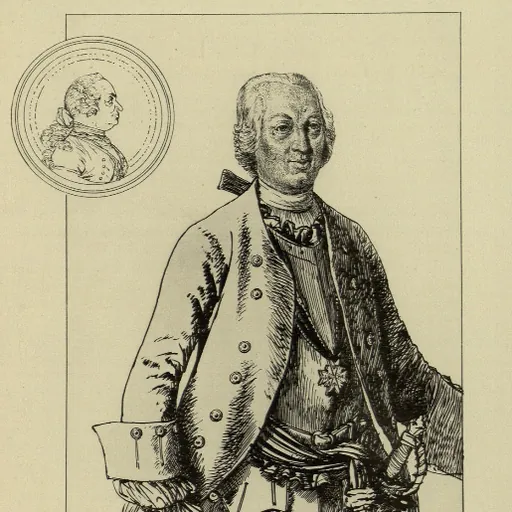
About Heinrich Sigismund Heyde
Lived 1703 – 1765 (aged 61–62). Heinrich Sigismund Heyde was a German military officer.
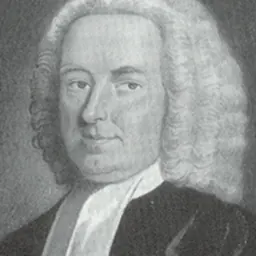
Heinrich Sigismund von der Heyde was a Prussian officer and commander-in-chief of Kolberg (born 1703 in the Lower Lusatia region of Brandenburg – 4 May 1765 in Kolberg). He is best known for his tenacious defense of Kolberg during its three sieges of the Seven Years' War. He received the Pour le Merite and he is immortalized on the Equestrian statue of Frederick the Great.
Family Heyde was born 1 January 1703 in Schacksdorf, a village in the Lower Lusatia region of Brandenburg. He was the son of Heinrich Siegmund von der Heyde, heir to Schacksdorf, and Magdalene Sophie von Stutterheim from Sellendorf.
Military career Heyde entered the Prussian military in Infantry Regiment Nr. 3 (Alt-Anhalt) in 1718. Between 1726 and 1740, he received a series of promotions. In 1740, he was a staff officer for Leopold of Anhalt-Dessau. In 1741, he also received his first command, a grenadier company, as a captain, with which he also fought in the First Silesian War. In 1744 and 1745 he fought in Bohemia and Moravia. He was injured in the Battle of Hohenfriedberg. Based on differences between him and Leopold, in 1747, the King ordered his transfer to Regiment Nr. 2 (Röder) garrisoned in Königsberg. For this stubborn defense, he was promoted to colonel, and Frederick the Great awarded him the Pour le Mérite. On 29 August, they were joined by six ships of line and three frigates of their Swedish allies. Heyde deployed his 700 troops to construct siege works on 6 September; cavalry units covered the construction. He defended Kolberg with his limited number of troops until 18 September, when General Paul von Werner arrived with 3,800 men after a 13-day, forced march from Silesia. Werner deployed his troops and attacked immediately with such force that the Russians believed they were facing an army of about 20,000; the Russians retreated. Two coins commemorate this act: one with the image of Werner, one with the image of Heyde. The King sent a gold and twenty silver coins with a personal thank you to Heyde. After the second siege of Kolberg, Frederick reevaluated his previously lukewarm opinion of Heyde: I am not infallible; in this man I have been greatly wrong.
Prussian relief troops—several thousand of them commanded by General Dubislav von Platen—managed to break through to Kolberg later in the month, but a comprehensive break out through Russian lines on 17 October failed. Kolberg, although secured by some 20,000 troops, was consuming supplies at a fast rate. The Russian navy had also reappeared and resumed bombardment of the fortress. Platen extricated himself and his troops to safety, but the garrison itself remained trapped inside the city, with depleting supplies, and the Duke's troops remained in their defensive positions. In November, Württemberg abandoned Kolberg, broke through the Russian lines to reunite with Platen; their joint forces assaulted Rumyantsev unsuccessfully from the rear. After this last effort, Platen departed as ordered by Friedrich; Württemberg tried several more times to force his way back into the fortress. On 12 December, the Russian forces halted his attempt at Spie, southwest of Kolberg, inflicting 1,000 casualties on the Duke's force. Württemberg's remaining 8,000 troops retreated to Stettin, leaving Kolberg to its fate.
After the death of Czarina Elizabeth of Russia on 5 January 1762, the Prussophile Peter III came to power and ended the Russia's participation in the war. The prisoners-of-war turned around and marched back to Prussia.
Rank Promotions Fahnrich: 16 August 1718 (Regiment Nr. 3) Ensign: 1726 Second Lieutenant: 1731 First (Premier) Lieutenant: 1736 Regimental chief of staff: 1740 Captain: 1741 Major: 1753 Colonel: 1758 Lt. General: 1760
Don’t just read it —
keep it.
Full-length biographies made to live with: read them, listen on the way to work, watch them tonight.
- E-book
- Audio
- Video
Instant download · yours to keep · every purchase keeps this site free
Important facts
Related people
Same field, nearest in time


Contemporaries
People whose lives overlapped Heinrich Sigismund Heyde's




Frequently asked questions
Who was Heinrich Sigismund Heyde?
German officer
When was Heinrich Sigismund Heyde born?
Heinrich Sigismund Heyde was born in 1703 in Groß Schacksdorf.
When did Heinrich Sigismund Heyde die?
Heinrich Sigismund Heyde died on 4 May 1765 in Kołobrzeg.
What was Heinrich Sigismund Heyde's occupation?
Heinrich Sigismund Heyde was a military officer.
What nationality was Heinrich Sigismund Heyde?
Heinrich Sigismund Heyde was German.
Sources & further reading
· Wikipedia: Heinrich Sigismund Heyde
· DBpedia: Heinrich Sigismund von der Heyde
Cite this page
APA: Biography.guide. (2026). Heinrich Sigismund Heyde. https://biography.guide/heinrich-sigismund-heyde/
MLA: "Heinrich Sigismund Heyde." Biography.guide, https://biography.guide/heinrich-sigismund-heyde/.
Chicago: "Heinrich Sigismund Heyde." Biography.guide. https://biography.guide/heinrich-sigismund-heyde/.
Data last updated: 2026-09-23 · Spot an error? Report a correction.
Portrait: Wikimedia Commons · author & licence
Page generated 2026-09-27 05:07 UTC