
About Heinrich Scheidemann
Lived 1596 – 1663 (aged 66–67). Heinrich Scheidemann was an organist and composer.
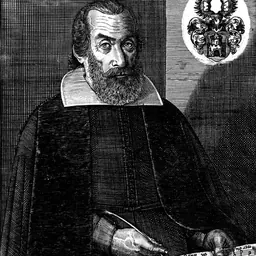
Heinrich Scheidemann (ca. 1595 – 1663) was a German organist and composer. He was the best-known composer for the organ in north Germany in the early to mid-17th century, and was an important forerunner of Dieterich Buxtehude and J.S. Bach.
Life He was born in Wöhrden in Holstein. His father was an organist in both Wöhrden and Hamburg, and probably Scheidemann received some early instruction from him. Scheidemann studied with Sweelinck in Amsterdam from 1611 to 1614, and evidently was one of his favorite pupils, since Sweelinck dedicated a canon to him, prior to Scheidemann's return to Germany. By 1629, and possibly earlier, Scheidemann was in Hamburg as organist at the Catharinenkirche, a position which he held for more than thirty years, until his death in Hamburg in early 1663 during an outbreak of the plague.
Music and influence
Scheidemann was renowned as an organist and composer, as evidenced by the wide distribution of his works; more organ music by Scheidemann survives than by any other composer of the time. Unlike the other early Baroque German composers, such as Praetorius, Schütz, Scheidt, and Schein, each of whom wrote in most of the current genres and styles, Scheidemann wrote almost entirely organ music. A few songs survive, as well as some harpsichord pieces, but they are dwarfed by the dozens of organ pieces, many in multiple movements.
Scheidemann's lasting contribution to the organ literature, and to Baroque music in general, was in his settings of Lutheran chorales, which were of three general types: cantus firmus chorale arrangements, which were an early type of chorale prelude; "monodic" chorale arrangements, which imitated the current style of monody—a vocal solo over basso continuo—but for solo organ; and elaborate chorale fantasias, which were a new invention, founded on the keyboard style of Sweelinck but using the full resources of the developing German Baroque organ. In addition to his chorale arrangements, he also wrote important arrangements of the Magnificat, which are not only in multiple parts but are in cyclic form towards liturgical use in alternation with the choir during the so-called Vespers, a technique in multiple-movement musical construction which was not to return with vigor until the 19th century. Among his students were Johann Adam Reincken, his successor at the St. Catharine Church in Hamburg, and (possibly) Dieterich Buxtehude.
Discography The Organ Works of Heinrich Scheidemann. Vol. 1. Calcante Recordings. CAL-023. 1999. 2 CD (Cleveland Johnson and Claudia Heberlein Johnson in Stade/St. Cosmae, Tangermünde, and Wellesley) The Organ Works of Heinrich Scheidemann. Vol. 2. Calcante Recordings. CAL-024. 1999. 2 CD (Cleveland Johnson and Claudia Heberlein Johnson in Stade/St. Cosmae, Tangermünde, and Wellesley) The Organ Works of Heinrich Scheidemann. Vol. 3. Calcante Recordings. CAL-025. 2003. 2 CD (Cleveland Johnson and Claudia Heberlein Johnson in Stade/St. Cosmae, Tangermünde, and Wellesley)
References and further reading Article "Heinrich Scheidemann, in The New Grove Dictionary of Music and Musicians, ed. Stanley Sadie. 20 vol. London, Macmillan Publishers Ltd., 1980. Manfred Bukofzer, Music in the Baroque Era. New York, W.W. Norton & Co., 1947. Pieter Dirksen, Heinrich Scheidemann's Keyboard Music. Its Transmission, Style and Chronology, Ashgate, Aldershot, 2007.
Don’t just read it —
keep it.
Full-length biographies made to live with: read them, listen on the way to work, watch them tonight.
- E-book
- Audio
- Video
Instant download · yours to keep · every purchase keeps this site free
Important facts
People in Heinrich Scheidemann's life
Named in this biography and alive at the same time
Related people
Same field, nearest in time


Contemporaries
People whose lives overlapped Heinrich Scheidemann's






Frequently asked questions
Who was Heinrich Scheidemann?
German composer
When was Heinrich Scheidemann born?
Heinrich Scheidemann was born in 1596 in Wöhrden.
When did Heinrich Scheidemann die?
Heinrich Scheidemann died in 1663 in Hamburg.
What was Heinrich Scheidemann's occupation?
Heinrich Scheidemann was an organist and composer.
What nationality was Heinrich Scheidemann?
Heinrich Scheidemann's recorded nationality: Duchy of Holstein.
Sources & further reading
· Wikipedia: Heinrich Scheidemann
· DBpedia: Heinrich Scheidemann
Cite this page
APA: Biography.guide. (2026). Heinrich Scheidemann. https://biography.guide/heinrich-scheidemann/
MLA: "Heinrich Scheidemann." Biography.guide, https://biography.guide/heinrich-scheidemann/.
Chicago: "Heinrich Scheidemann." Biography.guide. https://biography.guide/heinrich-scheidemann/.
Data last updated: 2026-09-26 · Spot an error? Report a correction.
Page generated 2026-09-27 05:15 UTC