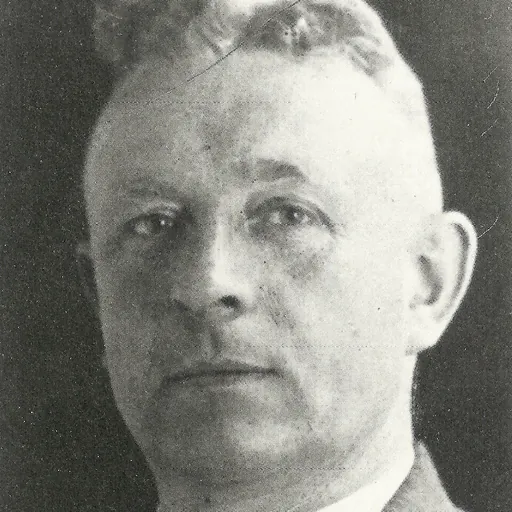
About Heinrich Körner
Lived 1892 – 1945 (aged 52). Heinrich Körner was a German trade unionist, resistance fighter, tools maker and union member.
Heinrich Körner (30 April 1892 in Essen – 25 or 26 April 1945 in Berlin) was a German Catholic trade unionist and resistance fighter against Adolf Hitler's Nazi regime. Convicted for his involvement in the July Plot, Körner died during the Soviet liberation of Plötzensee Prison.
Biography Background The eldest of four children, Heinrich Körner was born in 1892 in Essen, which at that time still belonged to the Archdiocese of Cologne. The son of a Krupp worker, he became a toolmaker and found his spiritual home in the Kolpinghaus in Essen. At the same time, he trained in the Volksverein für das katholische Deutschland and in the Windthorstbund, the youth association of the German Center Party. In 1911, he joined the United Federation of Christian Trade Unions in Germany. In 1913 he volunteered for the navy. At the beginning of the First World War, he was in Tsingtao and was taken prisoner of war by the Imperial Japanese Army there in November 1914. After returning from a prisoner-of-war camp in 1920, he worked as a toolmaker at Krupp. In 1923, he took a full-time position as a cartel secretary for the Christian trade unions in Bonn. Because he held a trade union meeting during the "passive resistance" against the occupation of the Ruhr, which had been banned by the occupying powers, he was sentenced to six months in prison. In Bonn, he married Therese Dierichsweiler in 1924, with whom he had three daughters. As managing director of the umbrella organization of Christian trade unions in Cologne since 1926, he began a close collaboration with Jakob Kaiser, the state managing director of the Christian trade unions. In addition to his main task of training Christian workers, Körner was politically active in the German Center Party and was elected to the state parliament of the Rhine Province.
Resistance to National Socialism After the National Socialists seized power in January 1933, Körner was imprisoned for a week in May of the same year. A month later, the Christian trade unions were finally dissolved. Körner then moved to Bonn, where he hoped to secure his family's livelihood with a large garden. At the same time, he built up a circle of opposition members in Bonn, who in turn maintained contacts with like-minded individuals throughout Germany.
Death by shooting The prison where Körner was held was liberated by the advancing Soviet Red Army on April 25, 1945. The German Resistance Memorial Center maintains that the circumstances of Körner's death remain unclear.
Don’t just read it —
keep it.
Full-length biographies made to live with: read them, listen on the way to work, watch them tonight.
- E-book
- Audio
- Video
Instant download · yours to keep · every purchase keeps this site free
Important facts
People in Heinrich Körner's life
Named in this biography and alive at the same time

Related people
Same field, nearest in time




Contemporaries
People whose lives overlapped Heinrich Körner's

Frequently asked questions
Who was Heinrich Körner?
German trade unionist (1892-1945)
When was Heinrich Körner born?
Heinrich Körner was born on 30 April 1892 in Essen.
When did Heinrich Körner die?
Heinrich Körner died on 26 April 1945 in Berlin.
What was Heinrich Körner's occupation?
Heinrich Körner was a trade unionist, resistance fighter, tools maker and union member.
What nationality was Heinrich Körner?
Heinrich Körner was German.
Sources & further reading
· DBpedia: Heinrich Körner (trade unionist)
Cite this page
APA: Biography.guide. (2026). Heinrich Körner. https://biography.guide/heinrich-korner/
MLA: "Heinrich Körner." Biography.guide, https://biography.guide/heinrich-korner/.
Chicago: "Heinrich Körner." Biography.guide. https://biography.guide/heinrich-korner/.
Data last updated: 2026-09-23 · Spot an error? Report a correction.
Portrait: Wikimedia Commons · author & licence
Page generated 2026-09-27 05:07 UTC