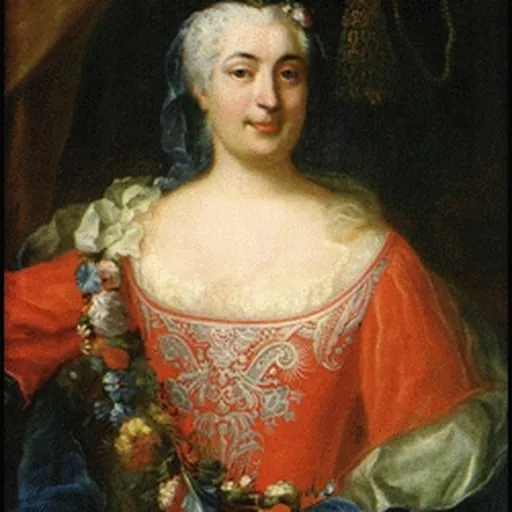
About Hedvig Taube
Lived 1714 – 1744 (aged 29). Hedvig Taube was a Swedish lady-in-waiting and salonnière.
Hedvig Ulrika Taube (31 October 1714 – 11 February 1744), also Countess von Hessenstein, was a Swedish courtier and countess, a countess of the Holy Roman Empire, and royal mistress to king Frederick I of Sweden from 1731 to 1744. She and Sophie Hagman are the only two official royal mistresses in Swedish history.
Early life Hedvig Taube was one of nine children of Count Edvard Didrik Taube (1681–1751) and Christina Maria Falkenberg (1686–1753). Her sister, Catherine Charlotte, was to marry the brother of scientist Countess Eva Ekeblad, who was also the aunt of the renowned Axel von Fersen the Younger. In 1716, the future king Frederick became one of the godparents to her sister Christina Beata. During the 1720s, her father was nearly ruined and placed in heavy debt because of gambling and bad business: in 1730, the family had been forced to change their city residence to a cheaper one.
Hedvig Taube was described as a beauty, and in 1730, the king noticed her, likely on a visit to baron Otto Reinhold Strömfelt, who was married to her paternal aunt. He started to court her with baskets of fruit and flowers sent to the home of her indebted father: reportedly, jewels and other valuable items were hidden beneath the fruit. and he sent his wife alone to the country and kept his daughter with him in the capital. Her betrothed, Erik Sparre, was also removed, as he was included to be a part of the entourage accompanied the king to his visit to Hesse, Her father was appointed , and others who had participated in the affair in the king's favor were rewarded. The queen did not consider it proper to expose the monarch to slander in public, and participated in protecting the king's reputation. During the hunting trip to Dalarna, which the royal court undertook in 1732 to celebrate the visit of the king's brother Prince William of Hesse, the queen demonstrated her disregard to the rumors by displaying affection to her maid of honor Hedvig Taube, when they were seen by the public during walks. After this Hedvig Taube hosted her own receptions in her residence, sometimes alone, and sometimes in the company of the king, and were courted by artists and supplicants. She acted as the patron of artists, the most noted one being Olof von Dahlin, who has been referred to as her court poet. According to contemporaries, Hedvig Taube had "power over the king's mind", and "the use she made of it eventually came to have rather significant consequences in both interior- and foreign policy". Another reason to her change of conduct was reportedly that she, as an orthodox Lutheran, was concerned for the king's soul because of his adultery. The return of Hedvig Taube after her temporary exile was apparently the last straw, and she reacted to it by retiring to bed and refused to show herself in public for some time.
The discontent of queen Ulrika Eleonora was not a small matter for the Riksdag: not only due to the queen's popularity, but also because the queen had abdicated in favor of the king on the condition that she would succeed him if he (being twelve years older) should die before her, a condition which did in fact make the queen the king's heir to the throne, and during the Riksdag of 1741, when the queen stayed with her court at her summer residence Karlberg Palace, the matter of the king's adultery was, for the second time raised in parliament by the Clergy estate, this time by Bishop Erik Benzelius, who referred to the matter as that "which the Queen had made it known" that they should raise, to "set the mourning heart of the Queen to rest". An official statement of protest was made, stating a reminder of the king's oath always to treat the queen with respect when she abdicated in his favor, and that the whole Kingdom was in mourning of the queen's sorrow, and concerned for the welfare of the king's soul. Two delegations from the Clergy estate were appointed: one to the king, and one to Hedvig Taube.
In July 1741, the statement was read to the king in his audience chamber. The king reacted with rage, refused to accept the statement and stated that the Riksdag of the Estates had promised him not to interfere in his private life. He was, on their second attempt, forced to receive the statement. When Bishop Schröder reported the result of the audience with the king to the queen, Ulrika Eleonora insisted that the planned embassy to Hedvig Taube was also to be executed according to plan, and replied to the hesitation of the bishop with the words: "When You priests follow your calling and your conscience, you do well to do so with no concern of other matters."
When the delegation arrived to Hedvig Taube early that morning, she excused herself claiming to be bedridden and ill, but the priests then entered her bedroom, and she was forced to receive them lying in bed. She told them that she could not see why the Riksdag of the Estates should have an interest for her, as she never involved in politics, but was met with the reply that their business was in the welfare of the soul of the king and herself. She covered her face with a sheet and answered crying: "It would have been well, if this had been prevented twelve years ago, when I was too young to protect myself". The delegation expressed sympathy with the fact that she had been led to sin, but that she should not continue with it now that she had been made aware of it, and leave the capital: "Your Ladyship should consider, how greatly she displeases the most honorable Queen of us all, who laments herself because of it, to the point of shortening her life span out of grief, to great damage of our fatherland." Upon this, she answered: "I have never been led to see, that Her Majesty has been ungracious or displeased in this matter" and was given the reply: "We can assure Your ladyship that it is so, and how else could it be?" The delegation then read the statement, "Her ladyship should consider, that she with her conduct for so long has broken her duty as her subject to her royal majesty, her gracious sovereign as well as that of us all", and left the document with her. Hedvig Taube, however, returned to her former position and her residence in the capital as soon as the Riksdag of 1741 was dissolved.
Later life
In accordance with the abdication document of 1720, where the queen abdicated in favor of the king on condition that she succeed him if he should die before her, the queen had in effect been the heir to the throne of Sweden. Upon her death in November 1741, the question of succession to the Swedish throne was raised. Hedvig Taube, who was well aware that her exile was due to the efforts of the British- and Hessian supported Capts party, was expected to support the French-supported Hats party. The French ambassador to Sweden, , courted her and presented her with a set of golden tableware and her sons appointed French colonels to secure her support of the French candidate in the election of an heir to the Swedish throne: Christian IV, Count Palatine of Zweibrücken. It was during this period, that Taube reportedly had hopes to marry the king and have her own sons becoming heir to the throne. When she lost hopes of this, she accepted to support the French candidate. On 29 March 1742 her sons were made Swedish counts, and 2 February 1743 she was made Holy Roman Countess of Hessenstein.
During the Dalecarlian Rebellion (1743), when the rebellious peasants marched to the capital in support of the Danish candidate and protest toward the Hats government, she, as well as Fredrik Gyllenborg, Carl Gustaf Tessin, Anders von Höpken and many other figures of the Hats party left the city fearing for their safety. In 1743, the Russian candidate Adolf Frederick of Holstein-Gottorp was elected heir to the throne. In December, the crown prince was brought to her in secret during the night in company only with the king, a courtier and Erland Broman, and unofficially introduced to her while she lay confined to her bed in pregnancy. During the visit, she begged to crown prince for protection of her and her children. After the visit, the crown prince remarked, that he understood the king's affection, and that he would never have thought Hedvig Taube to be so beautiful and charming.
Hedvig Taube died due to childbirth. Her last pregnancy was very difficult, and during it, she was overheard cursing her father and Erland Broman, throwing the king's gifts around, and told her confessor that it would be the fault of the king if she should come to hell and that he would also be placed there if he did not better himself. According to reports, the king had plans to marry Hedvig Taube as a widower, but the plans were never realized due to her death.
In 1745, Taube was replaced as an official royal mistress by the Catharina Ebba Horn.
Issue Mamsell Ehrlich (1 March 1734 – died shortly after), posthumously known as Fredrika Vilhelmina von Hessenstein. Prince Fredrik Vilhelm von Hessenstein (17 March 1735 – 27 July 1808). Count Karl Edvard von Hessenstein (26 November 1737 – 17 April 1769). Countess Hedvig Amalia von Hessenstein (2 February 1744 – 6 May 1752).
Don’t just read it —
keep it.
Full-length biographies made to live with: read them, listen on the way to work, watch them tonight.
- E-book
- Audio
- Video
Instant download · yours to keep · every purchase keeps this site free
Important facts
People in Hedvig Taube's life
Named in this biography and alive at the same time
Related people
Same field, nearest in time


Contemporaries
People whose lives overlapped Hedvig Taube's





Frequently asked questions
Who was Hedvig Taube?
Swedish noble (1714-1744)
When was Hedvig Taube born?
Hedvig Taube was born on 31 October 1714 in Stockholm.
When did Hedvig Taube die?
Hedvig Taube died on 11 February 1744 in Stockholm.
What was Hedvig Taube's occupation?
Hedvig Taube was a lady-in-waiting and salonnière.
What nationality was Hedvig Taube?
Hedvig Taube was Swedish.
Sources & further reading
Cite this page
APA: Biography.guide. (2026). Hedvig Taube. https://biography.guide/hedvig-taube/
MLA: "Hedvig Taube." Biography.guide, https://biography.guide/hedvig-taube/.
Chicago: "Hedvig Taube." Biography.guide. https://biography.guide/hedvig-taube/.
Data last updated: 2026-09-21 · Spot an error? Report a correction.
Portrait: Wikimedia Commons · author & licence
Page generated 2026-09-27 05:00 UTC