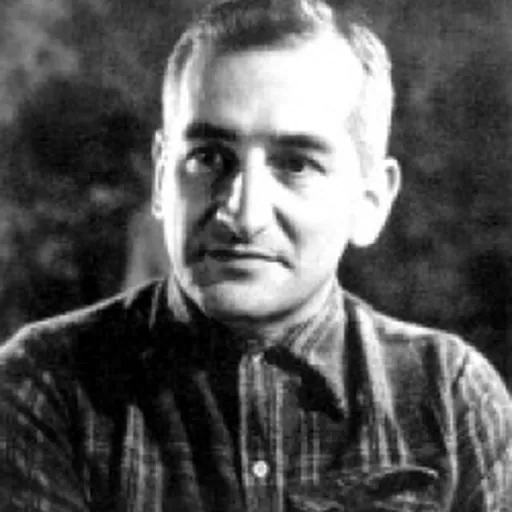
Héctor Germán Oesterheld
Argentine journalist and cartoonist
About Héctor Germán Oesterheld
Lived 1919 – 1978 (aged 58–59). Héctor Germán Oesterheld was an Argentine comics artist, journalist, screenwriter, writer, geologist and science communicator.
Héctor Germán Oesterheld ( ; ; born 23 July 1919; disappeared and presumed dead 1977), also known by the common abbreviation HGO, was an Argentine journalist, comics editor and writer of graphic novels and comics. He is widely celebrated as a master in his field and as one of the pioneering artists in modern Argentine comics.
Through his comics, Oesterheld criticized the numerous military dictatorships that beleaguered the country in different periods ranging from 1955 to 1983, as well as different facets of colonialism and imperialism, choosing a subtle criticism in his early comics during the 1950s and early 1960s, and a stronger and direct approach in his later work, after the execution of Che Guevara in 1967, and onwards from then on: in 1968 he wrote a biographical comic book of Che Guevara, which was subsequently banned and destroyed by the ruling military dictatorship self-styled as "Argentine Revolution" (1966–1973). However, it was later republished (and for the first time in complete form) in 2008.
Shortly before the start of Argentina's last military dictatorship (1976–1983), Oesterheld and his daughters had joined the Montoneros, a leftist (and former peronist) guerrilla group that immediately opposed the military junta. HGO continued to publish works in clandestine form while hidden in secret locations, but he was ultimately kidnapped and disappeared in 1977. His daughters were also arrested and disappeared, as were his sons-in-law. Only HGO's wife, Elsa Sánchez de Oesterheld, escaped the family's fate.
After democracy returned to Argentina, and over the years, Oesterheld's legacy has become vast, influencing several generations of new artists, particularly in the fields of literature and comic books, and he is usually named as one of the "fathers" of modern Argentine comics.
Biography Oesterheld was born on 23 July 1919 in Buenos Aires to Fernando Oesterheld, who was of German and Spanish ancestry, and a Spanish Basque mother, Elvira Ana Puyol. His early studies were in geology, which has been said to contribute to his acuity as a science fiction writer. He began his journalistic career in the early 1940s. His first work appeared in the daily La Prensa newspaper and then was published by Codex.
Soon after, he married Elsa Sánchez. Their first daughter, Estela, was born in 1952, Diana a year later, Beatriz in 1955, and Marina in 1957.
Oesterheld was befriended by a group of postwar Italian comics writers, including Mario Faustinelli, Hugo Pratt, Ivo Pavone, and Dino Battaglia, also known as the Venice Group. Diana, who was 23 at the time, was abducted a month later, on August 7, 1976 in San Miguel de Tucumán. She was taken along with her one-and-a-half-year-old son, Fernando. She was pregnant at the time of her abduction, and she may have given birth in captivity. However, nothing was ever heard of her or this possible second child. Her body has never been recovered. Marina, by then 20, was abducted on November 27, 1976 in San Isidro, Buenos Aires Province. She was eight months pregnant, and it is believed that she, like her sister Diana, may have given birth in captivity. Her body was never located and nothing has ever been learned about the fate of her possible child. Estela, the eldest of the four sisters, was 25 when she was killed in a shootout in Longchamps, Argentina on December 13, 1977, along with her partner, Raúl Mórtola. The military took their bodies, which have never been found.
Out of the whole family, the only survivors were Oesterheld´s wife Elsa and two grandsons: Martín and Fernando.
Martín (born in 1974 to Estela and her partner Raúl Mórtola) was handed to Elsa by the military after his mother had been killed.
Fernando (born 1975 to Diana and her partner Raúl Araldi) was left by the military at an orphanage after the abduction of his mother. He was left there without any identifying information with the goal of erasing his identity. His paternal grandparents found out about this, rescued him and raised him themselves.
Elsa Sánchez participated in the protests of the Mothers of the Plaza de Mayo. She became one of the spokeswomen for the Grandmothers of the Plaza de Mayo, which advocates for the return of children of the "disappeared" to their birth families.
When the Italian journalist Alberto Ongaro enquired about Oesterheld's disappearance in 1979, he received the reply: "We did away with him because he wrote the most beautiful story of Ché Guevara ever done". Argentine journalist Jacobo Timmerman, in his memoir of his own captivity, Prisoner Without a Name, Cell Without a Number (1981), recalls seeing Oesterheld in 1977 across the hall in a prison. In a report to the Argentine National Commission on the Disappearance of Persons, which published its findings in 1984 entitled Nunca Más, Eduardo Arias recalls seeing Oesterheld between November 1977 and January 1978. He said the man was in terrible physical condition and at the secret detention center , which prisoners had sardonically named "".
Legacy Oesterheld worked with artists including Hugo Pratt, Alberto Breccia, Francisco Solano López, Ivo Pavone, Dino Battaglia, as well as Horacio Altuna, José Massaroli, Eugenio Zoppi, Paul Campani, Gustavo Trigo, Julio Schiaffino and others.
In 2026, Oesterheld was selected for inclusion in the Eisner Hall of Fame.
Don’t just read it —
keep it.
Full-length biographies made to live with: read them, listen on the way to work, watch them tonight.
- E-book
- Audio
- Video
Instant download · yours to keep · every purchase keeps this site free
Important facts
People in Héctor Germán Oesterheld's life
Named in this biography and alive at the same time






Related people
Same field, nearest in time



Contemporaries
People whose lives overlapped Héctor Germán Oesterheld's


Frequently asked questions
Who was Héctor Germán Oesterheld?
Argentine journalist and cartoonist (1919–1978)
When was Héctor Germán Oesterheld born?
Héctor Germán Oesterheld was born on 23 July 1919 in Buenos Aires.
When did Héctor Germán Oesterheld die?
Héctor Germán Oesterheld died in 1978.
What was Héctor Germán Oesterheld's occupation?
Héctor Germán Oesterheld was a comics artist, journalist, screenwriter, writer, geologist and science communicator.
What nationality was Héctor Germán Oesterheld?
Héctor Germán Oesterheld was Argentine.
Sources & further reading
· Wikipedia: Héctor Germán Oesterheld
· DBpedia: Héctor Germán Oesterheld
Cite this page
APA: Biography.guide. (2026). Héctor Germán Oesterheld. https://biography.guide/hector-german-oesterheld/
MLA: "Héctor Germán Oesterheld." Biography.guide, https://biography.guide/hector-german-oesterheld/.
Chicago: "Héctor Germán Oesterheld." Biography.guide. https://biography.guide/hector-german-oesterheld/.
Data last updated: 2026-09-22 · Spot an error? Report a correction.
Portrait: Wikimedia Commons · author & licence
Page generated 2026-09-27 05:04 UTC