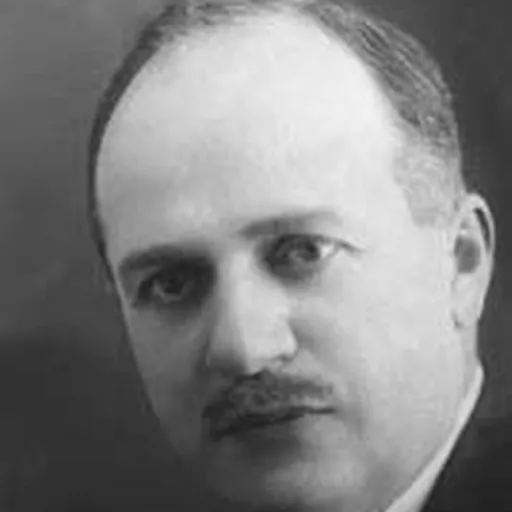
About Hasan Tahsin Uzer
Lived 1877 – 1939 (aged 62). Hasan Tahsin Uzer was a Turkish politician and member of parliament.
Hasan Tahsin Uzer (27 August 1878 – 5 December 1939; surnamed Uzer after 1934) was an Ottoman and later Turkish bureaucrat and politician. Throughout his career as a politician, Tahsin served as a governor to several Ottoman cities including Aydın, Erzurum, Van and the province of Syria. Thereafter, he served as deputy to the cities of Ardahan, Erzurum, and Konya. During the Armenian genocide, he was complicit in the Kemah massacres. After the war, he provided important testimony on the genocide.
Life and career Hasan Tahsin was born in Selanik, Ottoman Empire on 27 August 1878, he was of Albanian descent. He was the son of Ibarahim Ağa and Hatice Hanim, and the childhood friend of Mustafa Kemal Atatürk. During his tenure, he attempted to counter the influence of the Kurds around Abdürrezak Bedir Khan, who were supported by the Russians. After the Russians and the Christian Assyrian tribes retaliated over massacres perpetrated by groups of the Ottoman Special Organization by also inflicting massacres against Kurdish villages, he suggested the deportation of the Assyrians from Hakkari. However, in 1914, Tahsin was removed from his post and transferred to Erzurum where he served as governor until 12 September 1916. He was then transferred to Syria and became the governor of the Syrian province. He resigned from this post on 18 June 1918, but was appointed governor of Syria again a few months later. However, when the Turkish Empire lost the province in late 1918, Tahsin was immediately transferred to Aydın. His governorship of Aydın lasted a few weeks. He was then elected to the Turkish National Assembly as a representative of Izmir. Tahsin was apprehended by British forces in the aftermath of World War I and sent to Malta as one of the Malta exiles. When eventually freed, he continued his political career. After the dissolution of the Turkish Empire and the formation of the Turkish Republic, he joined the Turkish National Assembly once more and represented several cities including Ardahan, Erzurum, and Konya in 1924, 1927, and 1933 respectively.
Hasan Tahsin died in Istanbul on 5 December 1939. He was the father of two sons and two daughters.
While Tahsin was governor of Erzurum, the deportations of Armenians, as part of the initial stages of the Armenian genocide, began. Upon receiving orders to likewise carry out deportations, Tahsin Bey was hesitant. He appealed to the Third Army commandment stationed near Erzurum to stall the deportations, since he believed that the deportees' lands, assets, and lives would be in jeopardy. Historian Raymond Kévorkian thus notes that Tahsin "joined the ranks of the valis, mutesarifs, and kaymakams who displayed a degree of reluctance to apply the deportation orders because they were perfectly conscious of what these implied for the people involved." Kévorkian adds that Tahsin's reaction to the deportations demonstrates that the military authorities were enforcing the deportation orders, and that the politicians had no other choice but to comply with the fait accompli. These military personnel, according to Tahsin himself, were under orders of the central government, and directly involved in the "cleansing" of the Armenians around Erzurum. Meanwhile, in a coded telegram he sent to the central government on 24 May 1915, Tahsin stated that the Armenians were not a threat. He then attempted to spare women, children, and the elderly from deportation, but failed; the army commandment systematically deported all Armenians. Scheubner-Richter testified himself that Tahsin "did what he could, but he had no power."
Tahsin served as governor of Erzurum until 10 August 1916, when he was transferred to Syria.
On 2 August 1919, in the aftermath of the Armenian Genocide, during the Mamuretulaziz trial, Tahsin testified that the Teskilat-ı Mahsusa, under the command of Behaeddin Shakir, was mobilized to kill Armenians. However, despite his efforts, many convoys were "destroyed" in the outskirts of the city.
Hasan Tahsin summarized his testimony during the trial as follows:
Don’t just read it —
keep it.
Full-length biographies made to live with: read them, listen on the way to work, watch them tonight.
- E-book
- Audio
- Video
Instant download · yours to keep · every purchase keeps this site free
Important facts
People in Hasan Tahsin Uzer's life
Named in this biography and alive at the same time

Related people
Same field, nearest in time





Contemporaries
People whose lives overlapped Hasan Tahsin Uzer's




Frequently asked questions
Who was Hasan Tahsin Uzer?
Turkish statesperson (1877–1939)
When was Hasan Tahsin Uzer born?
Hasan Tahsin Uzer was born on 29 August 1877 in Thessaloniki.
When did Hasan Tahsin Uzer die?
Hasan Tahsin Uzer died on 3 December 1939 in Erzurum.
What was Hasan Tahsin Uzer's occupation?
Hasan Tahsin Uzer was a politician and member of parliament.
What nationality was Hasan Tahsin Uzer?
Hasan Tahsin Uzer was Turkish.
Sources & further reading
· Wikipedia: Hasan Tahsin Uzer
Cite this page
APA: Biography.guide. (2026). Hasan Tahsin Uzer. https://biography.guide/hasan-tahsin-uzer/
MLA: "Hasan Tahsin Uzer." Biography.guide, https://biography.guide/hasan-tahsin-uzer/.
Chicago: "Hasan Tahsin Uzer." Biography.guide. https://biography.guide/hasan-tahsin-uzer/.
Data last updated: 2026-09-20 · Spot an error? Report a correction.
Page generated 2026-09-27 05:09 UTC